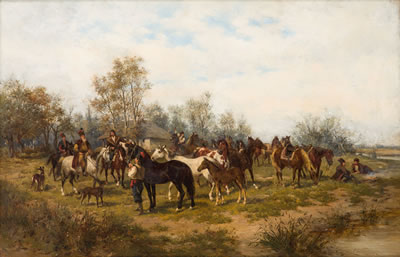
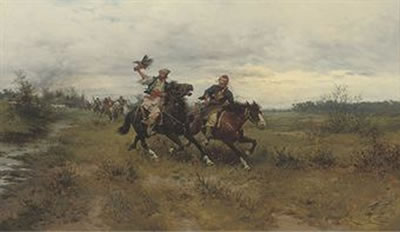
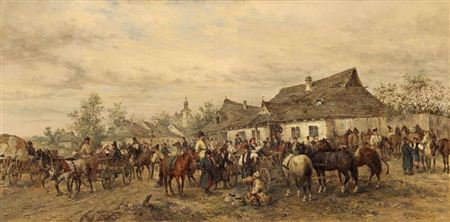
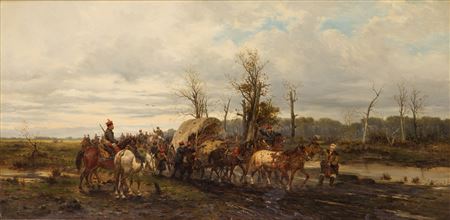
The main theme of Ludwig Gedlek's work is similar to the work of Joseph Brandt, who painted genre scenes from the life of the Cossacks, in particular the Ukrainian Zaporozhian Cossacks. In the... Read full biography
The main theme of Ludwig Gedlek's work is similar to the work of Joseph Brandt, who painted genre scenes from the life of the Cossacks, in particular the Ukrainian Zaporozhian Cossacks. In the nineteenth century numerous Polish painters took on Cossacks as their subject matter and they became a... Read full biography
The main theme of Ludwig Gedlek's work is similar to the work of Joseph Brandt, who painted genre scenes from the life of the Cossacks, in particular the Ukrainian Zaporozhian Cossacks. In the nineteenth century numerous Polish painters took on Cossacks as their subject matter and they became a picturesque part of the iconography of European Romanticism. The history of Ivan Mazepa, the Cossack Hetman of the Hetmanate, for example, inspired Lord Byron's poem Mazeppa (1818), Tchaikovsky's opera... Read full biography
The main theme of Ludwig Gedlek's work is similar to the work of Joseph Brandt, who painted genre scenes from the life of the Cossacks, in particular the Ukrainian Zaporozhian Cossacks. In the nineteenth century numerous Polish painters took on Cossacks as their subject matter and they became a picturesque part of the iconography of European Romanticism. The history of Ivan Mazepa, the Cossack Hetman of the Hetmanate, for example, inspired Lord Byron's poem Mazeppa (1818), Tchaikovsky's opera of the same name (1881-1883) and Alexander Pushkin's poem Poltava (1828-1829). For Polish artists, however, the Cossacks, in particular Zaporozhian Cossacks, assumed a special, symbolic significance. The idea of Polish independence was one that was... Read full biography
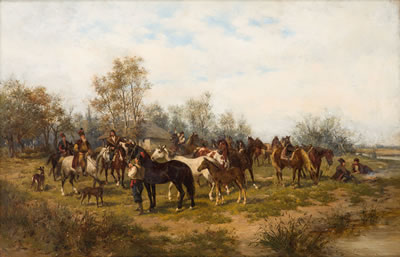
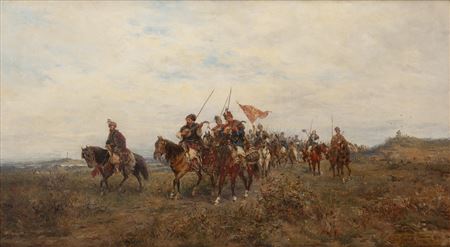
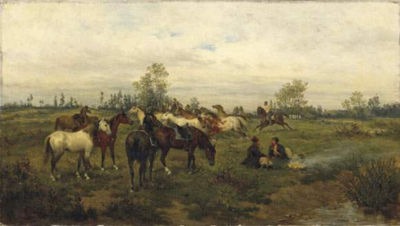
The main theme of Ludwig Gedlek's work is similar to the work of Joseph Brandt, who painted genre scenes from the life of the Cossacks, in particular the Ukrainian Zaporozhian Cossacks. In the nineteenth century numerous Polish painters took on Cossacks as their subject matter and they became a picturesque part of the iconography of European Romanticism. The history of Ivan Mazepa, the Cossack Hetman of the Hetmanate, for example, inspired Lord Byron's poem Mazeppa (1818), Tchaikovsky's opera of the same name (1881-1883) and Alexander Pushkin's poem Poltava (1828-1829). For Polish artists, however, the Cossacks, in particular Zaporozhian Cossacks, assumed a special, symbolic significance. The idea of Polish independence was one that was kept very much alive throughout the nineteenth century and led to several Polish uprisings against the partitioning powers of... Read full biography
Ludwig Gedlek - Art Prices in Auction LotsAuction Lots