Page loaded successfully. Showing biography for Aboudia.
Aboudia BIOGRAPHY
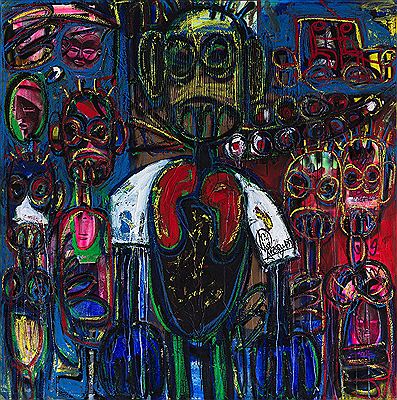
Born 1983 Abidjan, Cote d'Ivore (Ivory Coast) Africa. Known for: Graffiti-inspired, expressive paintings.
. Aboudia was born in 1983 in Abidjan, Côte d'Ivoire. A contemporary Ivorian artist, his work is deeply influenced by the graffiti-lined streets of Abidjan’s working-class neighborhoods, including... Read full biography
. Aboudia was born in 1983 in Abidjan, Côte d'Ivoire. A contemporary Ivorian artist, his work is deeply influenced by the graffiti-lined streets of Abidjan’s working-class neighborhoods, including Abobo, Yopougon, and Treichville. Now based in Brooklyn, his pieces combine spontaneity with layered... Read full biography
. Aboudia was born in 1983 in Abidjan, Côte d'Ivoire. A contemporary Ivorian artist, his work is deeply influenced by the graffiti-lined streets of Abidjan’s working-class neighborhoods, including Abobo, Yopougon, and Treichville. Now based in Brooklyn, his pieces combine spontaneity with layered complexity, reflecting the turmoil and vibrancy of contemporary African life. Aboudia gained international recognition following the Ivorian civil war of 2011, when his chaotic urban landscapes... Read full biography
. Aboudia was born in 1983 in Abidjan, Côte d'Ivoire. A contemporary Ivorian artist, his work is deeply influenced by the graffiti-lined streets of Abidjan’s working-class neighborhoods, including Abobo, Yopougon, and Treichville. Now based in Brooklyn, his pieces combine spontaneity with layered complexity, reflecting the turmoil and vibrancy of contemporary African life. Aboudia gained international recognition following the Ivorian civil war of 2011, when his chaotic urban landscapes captured the trauma of conflict. Recurring motifs of armed soldiers, skulls, and vulnerable civilians convey a world brimming with tension and unease. Yet, he also integrates Ivorian cultural heritage, referencing traditional vohou-vohou forms and nouchi... Read full biography
. Aboudia was born in 1983 in Abidjan, Côte d'Ivoire. A contemporary Ivorian artist, his work is deeply influenced by the graffiti-lined streets of Abidjan’s working-class neighborhoods, including Abobo, Yopougon, and Treichville. Now based in Brooklyn, his pieces combine spontaneity with layered complexity, reflecting the turmoil and vibrancy of contemporary African life. Aboudia gained international recognition following the Ivorian civil war of 2011, when his chaotic urban landscapes captured the trauma of conflict. Recurring motifs of armed soldiers, skulls, and vulnerable civilians convey a world brimming with tension and unease. Yet, he also integrates Ivorian cultural heritage, referencing traditional vohou-vohou forms and nouchi iconography, a language rooted in the streets of Abidjan. His work has been exhibited at leading venues, including . the T... Read full biography
Artist Biography
Biography page for Aboudia ((Born 1983)), known for Graffiti-inspired, expressive paintings. Showing 4 biographical entries and 0 sample artworks.
Aboudia - Artist Info
About Aboudia
Name variants
Aboudia Abdoulaye Diarrassouba
Biography from Bonhams Paris
Abdoulaye Diarrassouba, widely known as Aboudia, has risen to the attention of the international artworld with his dynamic renderings of the street culture of his native Abidjan, Côte d'Ivoire. Born in 1983, Aboudia left home at the age of 15 to study at the Centre Technique des Arts Appliqués in Bingerville before graduating from the Abidjan Institut des Arts in 2005.
Now working between his native Abidjan and Brooklyn, New York, Aboudia recognizes the enduring influence of the visual imagery he encountered when growing up in the urban centre of the Côte d'Ivoire:"Kids in the street would write their dreams using crayons, sand, rocks, tiles – whatever they could find. Some drew houses and cars, others drew classrooms and gardens and families – mom and dad. All the things I had missed in life. And I said to myself that I would borrow the writings – and I mean borrow – it belongs to the kids in the street. I needed to deliver their message to exhibition halls to raise public awareness of these roaming children of the street" (quoted in Todd Bartell, 2017).
Created in 2014, the present work epitomises Aboudia's idiosyncratic interpretation of these images associated with the youth culture of Abidjan. Crowds of childlike figures, outlined in vibrant oil stick, jostle for attention among traffic. The artist conceives of these figures as representative of the next generation of Ivorian children that he believes to be essential to the future success of the country. The children's expressions are ambiguous – somewhere between a smile and a grimace – to evidence the hardships faced by many following the violence that erupted in Côte d'Ivoire associated with the civil war.
Aboudia sees his use of colour and graphic style as an antidote to these challenges: "I want life to be good – so I treat sadness with happiness. I speak of something sad, but it makes you happy when you look at the painting. Boom! There's light. There's color. I use color to transform sadness into happiness" (quoted in Todd Bartell, 2017).Monumental in scale, the present work on canvas sat at the heart of Aboudia's first solo show in Abidjan; Nouchi City: Aboudia at Galerie Cécile Fakhoury (26 September – 15 November 2014).
The artist explains that the size of the work is not solely motivated by the desire to create an imposing visual impression. Rather, he notes, "[l]arge format paintings allow me to think of dreams in the largeness and in the same colours of those youth who roam the streets, painting on the large walls we find all around us" (quoted in Orlando Reade, 2013).Indeed, the gestural application of pigment and large-scale format favoured by the artist recalls both the graffiti murals of Abidjan and the avant-garde formalist experimentations of artists central to the Western canon such as Cy Twombly and Jackson Pollock (both artists whose work Aboudia greatly admired when visiting the permanent collection at the Tate Modern, London). Recognising this presence of diverse cultural and artistic references in his work,
Aboudia names his stylistic approach Nouchi – a term more typically used to describe the slang spoken in the urban centres of Côte d'Ivoire that fuses Ivorian vocabulary with French. The artist's experimentation with hybrid imagery has resulted in a distinctive style that has garnered widespread global appeal.Today, Aboudia's exuberant work has incited a string of record-breaking results at auction. Since 2007, the artist's work has been exhibited widely in international solo and group exhibitions.
His work is also currently held in major collections including that of the Saatchi Gallery (London), the Nevada Museum of Art (USA), and the Jean Pigozzi Collection of African Art. Earlier this year, Aboudia received his first solo exhibition in Paris at Galerie Cécile Fakhoury (19 February – 12 March 2022), demonstrating his presence at the forefront of the European artistic landscape.BibliographyTodd Bartel, 'Aboudia – Light & Dark', The Cambridge School of Weston, 3 September 2017, onlineOrlando Reade, 'How to Paint Ghosts', Africa Is a Country, 4 October 2013, onlineBiography from Bonhams Bond Street
Abdoulaye Diarrassouba, known as Aboudia, stands at the forefront of the landscape of contemporary art with his energetic paintings rendered in oil stick and acrylic. Born in Abidjan, the major urban centre of Côte d'Ivoire, Aboudia trained at the School of Applied Art in Bingerville before graduating from the Abidjan Institut des Arts in 2005.
Aboudia recognises the influence of his experience growing up in Abidjan as central to his artistic practice. His canvases and works on paper fuse imagery drawn from the local street culture of his hometown with traditional West-African sculpture and voodoo iconography. Lines of brightly coloured oil stick articulate figures, traffic and animals atop ghostly passages of semi-opaque acrylic paint that, in places, reveal the layers of newspaper pages, magazine cut-outs, and educational materials typically pasted beneath.
The gestural application of pigment and large-scale format favoured by the artist recall both the graffiti murals of Abidjan and the avant-garde formalist experimentations of artists central to the Western canon such as Cy Twombly, whose work Aboudia had greatly admired when visiting the permanent collection at the Tate Modern, London. Recognising the fusion of diverse cultural and artistic references in his work, Aboudia names his stylistic approach Nouchi – a term more typically used to describe the colloquial language spoken in urban Abidjan which blends several Ivorian languages with French.
Now working between his studios in Abidjan and Brooklyn, Aboudia employs his artmaking as a vehicle to convey the experiences of the Ivorian youth following the violence of the 2011 civil war. 'As an artist, my contribution is to tell our story for the next generation. Writers will write, singers will sing. I paint' (Aboudia quoted in O'Reilly, 2011). He conceives of the figures that populate his work as representative of this next generation of children who he believes to be central to the future success of the country.
Aboudia has achieved global appeal through his kinetic canvases bursting with colour. Since 2007 the artist's work has been widely exhibited in international solo and group exhibitions and is held in major collections including that of the Saatchi Gallery (London), the Nevada Museum of Art (USA), and the Jean Pigozzi Collection of African Art.Biography from Bonhams Bond Street
Aboudia's work is instantly recognizable. His large mixed media collages fuse American avant-garde traditions with the street art of his native city, Abidjan. Whilst acknowledging the influence of Jean-Michel Basquiat's bright color schemes and naively drawn figures, Aboudia prides himself on creating an individual aesthetic. Too many Ivorian artists, he claims, are content to "work in a traditional African style [or] copy famous western styles, giving them an 'African touch'". Aboudia's art is driven by a desire to convey the essence of life in Abidjan, to give a voice to her youths.
Aboudia shot to international fame in 2011, during the siege of Abidjan. Holed up in a basement, the artist continued to paint as rebel forces stormed the town. The works produced during this period function as reportage, capturing the impact of the violence on civilians. His work Dreams depicts the children of Abidjan, wide-eyed and rigid with terror at the atrocities they are witnessing. Aboudia does not focus on the bloodshed itself, but on the subsequent human trauma.
BIBLIOGRAPHY
Anon., 'Aboudia: African Dawn', Wall Street International, 10 April 2014.
N. Hoare, 'The Battle for Abidjan', Dazed Digital, 2012.
O. Reade, 'How to Paint Ghosts: An Interview with Aboudia', Africa Is A Country, 10 April 2013.Biography from Artcurial
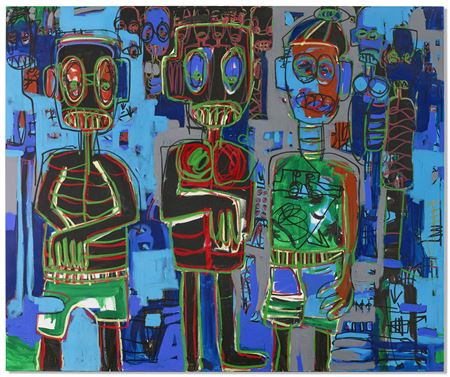
Aboudia was born in 1983 in Abidjan, Côte d'Ivoire. A contemporary Ivorian artist, his work is deeply influenced by the graffiti-lined streets of Abidjan’s working-class neighborhoods, including Abobo, Yopougon, and Treichville. Now based in Brooklyn, his pieces combine spontaneity with layered complexity, reflecting the turmoil and vibrancy of contemporary African life.
Aboudia gained international recognition following the Ivorian civil war of 2011, when his chaotic urban landscapes captured the trauma of conflict. Recurring motifs of armed soldiers, skulls, and vulnerable civilians convey a world brimming with tension and unease. Yet, he also integrates Ivorian cultural heritage, referencing traditional vohou-vohou forms and nouchi iconography, a language rooted in the streets of Abidjan.
His work has been exhibited at leading venues, including
the Tel Aviv Museum of Art
the Nevada Museum
the Royal Academy Summer Exhibition (2017)
the Saatchi Gallery
Aboudia’s artistic approach recalls the expressive power of Cy Twombly and Jean Dubuffet, using bold figuration to expose the chaos and raw intensity of life.