Page loaded successfully. Showing biography for Abraham Mignon.
Abraham Mignon BIOGRAPHY
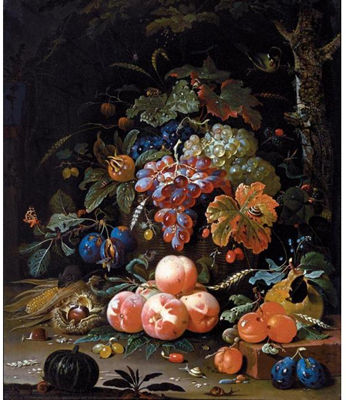
1640 Frankfort, Germany - 1679 Utrecht, Germany. Known for: Super-real fruit, floral still-life, forest, game, fish and grotto painting.
Abraham Mignon was born in Frankfurt, Germanyt where he was baptized in the Calvinist church on 21 June 1640. His family was originally from Hainaut in the Southern Netherlands from where it had... Read full biography
Abraham Mignon was born in Frankfurt, Germanyt where he was baptized in the Calvinist church on 21 June 1640. His family was originally from Hainaut in the Southern Netherlands from where it had immigrated to Germany for religious reasons. In Frankfurt they owned a shop. When Abraham's family moved... Read full biography
Abraham Mignon was born in Frankfurt, Germanyt where he was baptized in the Calvinist church on 21 June 1640. His family was originally from Hainaut in the Southern Netherlands from where it had immigrated to Germany for religious reasons. In Frankfurt they owned a shop. When Abraham's family moved to Wetzlar in 1649, Abraham was placed in the care of Jacob Marrel, a specialist flower painter and art dealer. Marrel gave the young boy also artistic training. He clearly trusted Mignon to handle... Read full biography
Abraham Mignon was born in Frankfurt, Germanyt where he was baptized in the Calvinist church on 21 June 1640. His family was originally from Hainaut in the Southern Netherlands from where it had immigrated to Germany for religious reasons. In Frankfurt they owned a shop. When Abraham's family moved to Wetzlar in 1649, Abraham was placed in the care of Jacob Marrel, a specialist flower painter and art dealer. Marrel gave the young boy also artistic training. He clearly trusted Mignon to handle his business, as he would leave it in Mignon's hands during his frequent visits to the Dutch Republic and in particular, Utrecht. It was also Marrell who asked Mignon to train his live-in stepdaughter Maria Sibylla Merian (1647–1717) in the art of... Read full biography
Abraham Mignon was born in Frankfurt, Germanyt where he was baptized in the Calvinist church on 21 June 1640. His family was originally from Hainaut in the Southern Netherlands from where it had immigrated to Germany for religious reasons. In Frankfurt they owned a shop. When Abraham's family moved to Wetzlar in 1649, Abraham was placed in the care of Jacob Marrel, a specialist flower painter and art dealer. Marrel gave the young boy also artistic training. He clearly trusted Mignon to handle his business, as he would leave it in Mignon's hands during his frequent visits to the Dutch Republic and in particular, Utrecht. It was also Marrell who asked Mignon to train his live-in stepdaughter Maria Sibylla Merian (1647–1717) in the art of still-life painting. Maria Sibylla Merian was the daughter of the engraver Matthew Merian (1647–1717). Maria Sibylla Merian achieved distinction as... Read full biography
Artist Biography
Biography page for Abraham Mignon ((1640 - 1679)), known for Super-real fruit, floral still-life, forest, game, fish and grotto painting. Showing 1 biographical entries and 0 sample artworks.
Abraham Mignon - Artist Info
About Abraham Mignon
Name variants
Abraham Minjon
Biography from the Archives of askART
 Abraham Mignon was born in Frankfurt, Germanyt where he was baptized in the Calvinist church on 21 June 1640. His family was originally from Hainaut in the Southern Netherlands from where it had immigrated to Germany for religious reasons. In Frankfurt they owned a shop.
When Abraham's family moved to Wetzlar in 1649, Abraham was placed in the care of Jacob Marrel, a specialist flower painter and art dealer. Marrel gave the young boy also artistic training. He clearly trusted Mignon to handle his business, as he would leave it in Mignon's hands during his frequent visits to the Dutch Republic and in particular, Utrecht. It was also Marrell who asked Mignon to train his live-in stepdaughter Maria Sibylla Merian (1647–1717) in the art of still-life painting. Maria Sibylla Merian was the daughter of the engraver Matthew Merian (1647–1717). Maria Sibylla Merian achieved distinction as a flower painter.
It is possible that in 1660 Mignon had moved to Wetzlar where the rest of his family had moved. Other sources state that by 1659 Marrell and Mignon had left Frankfurt for Utrecht. It is possible that the death of Mignon's father around this time prompted the relocation to Utrecht. In 1669 Marrel and Mignon were both registered in the Guild of Saint Luke there. Mignon was an assistant in the workshop of Jan Davidszoon de Heem in Utrecht. Jan Davidszoon de Heem was an important innovator of still life painting who had worked for many years in Antwerp before returning to Utrecht in 1667. It is possible that after de Heem moved back to Antwerp in 1672 Mignon took over de Heem's workshop.
Throughout his life Mignon seems to have held on to the strict religious beliefs of his family. This is confirmed by his election in 1672 to the position of deacon of the Waalse Kerk (Walloon Church) of Utrecht, a position he remained in for five years. He married Maria Willaerts on 3 February 1675 in the French reformed Janskerk in Utrecht. His wife was the granddaughter of the marine painter Adam Willaerts, daughter of the painter Cornelis Willaerts and niece of the fish still life painter Jacob Gillig. Some sources state that Mignon moved back to his native Frankfurt in 1676 based on a record that seems to imply that his 6th child was baptized in Frankfurt on 17 December 1676. By 1677 he would then have moved back to Utrecht.
Mignon died in Utrecht at the age of 39. He left two daughters when he died, Catharina and Anna.
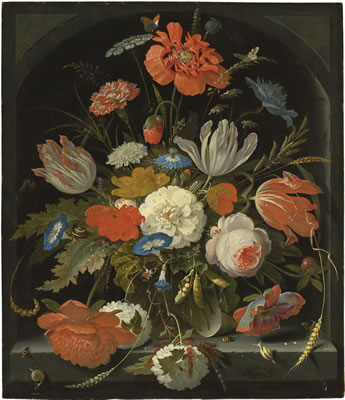
Mignon was a specialist still life painter whose subjects ranged from flowers, fruit, forest still lifes, game pieces, garland paintings, fish still life and insect pieces. His best-known works are his elaborate compositions of flowers and fruits arranged in niches or on stone ledges, or displayed in grottos or amidst ruins. As Mignon never dated his compositions it has been notoriously difficult to establish a chronology for his work. On stylistic grounds it is assumed that his more elaborate still lifes of flowers, characterised by clear colours, sharp focus and the use of a dark background, are Mignong's distillation of de Heem's style. Such works likely date from the years around 1670 when he was working closely with his master in de Heem's workshop.
The principal influences on his work are the works of de Heem and Marrel. De Heem's compositions were the principal reference point for Mignon's still lifes. Mignon also took inspiration from Willem van Aelst and Otto Marseus van Schrieck in his game and insect pieces. Willem van Aelst was clearly an inspiration for the game pieces while the influence of Otto Marseus van Schrieck is particularly visible in Mignon's forest floor still lifes.
Source:
Wikipedia, 2020