Page loaded successfully. Showing biography for Abraham Rattner.
Abraham Rattner BIOGRAPHY

1893 Poughkeepsie, New York - 1978 New York City. Known for: Cubist figure-genre and non objective painting.
Abraham Rattner, known for his rich, Rouault-like color, was born in 1893 in Poughkeepsie, New York. Though he would later meet Claude Monet when studying in Paris, Rattner was temperamentally and... Read full biography
Abraham Rattner, known for his rich, Rouault-like color, was born in 1893 in Poughkeepsie, New York. Though he would later meet Claude Monet when studying in Paris, Rattner was temperamentally and stylistically attuned to Georges Rouault and Pablo Picasso. Initially combining study of architecture... Read full biography
Abraham Rattner, known for his rich, Rouault-like color, was born in 1893 in Poughkeepsie, New York. Though he would later meet Claude Monet when studying in Paris, Rattner was temperamentally and stylistically attuned to Georges Rouault and Pablo Picasso. Initially combining study of architecture at George Washington University, Washington, D.C., with painting classes at the Corcoran School of Art, he quickly decided to concentrate on painting. In light of his later segmented style, and given... Read full biography
Abraham Rattner, known for his rich, Rouault-like color, was born in 1893 in Poughkeepsie, New York. Though he would later meet Claude Monet when studying in Paris, Rattner was temperamentally and stylistically attuned to Georges Rouault and Pablo Picasso. Initially combining study of architecture at George Washington University, Washington, D.C., with painting classes at the Corcoran School of Art, he quickly decided to concentrate on painting. In light of his later segmented style, and given the fragmented, patchy nature of camouflage in his breaking up the contours of forms on canvas, it is interesting that Rattner would have been a specialist in camouflage for the army during World War I. He had begun study at the Pennsylvania Academy... Read full biography
Abraham Rattner, known for his rich, Rouault-like color, was born in 1893 in Poughkeepsie, New York. Though he would later meet Claude Monet when studying in Paris, Rattner was temperamentally and stylistically attuned to Georges Rouault and Pablo Picasso. Initially combining study of architecture at George Washington University, Washington, D.C., with painting classes at the Corcoran School of Art, he quickly decided to concentrate on painting. In light of his later segmented style, and given the fragmented, patchy nature of camouflage in his breaking up the contours of forms on canvas, it is interesting that Rattner would have been a specialist in camouflage for the army during World War I. He had begun study at the Pennsylvania Academy of the Fine Arts* in 1917 before the war interrupted that endeavor. After the war, he attended the Ecole... Read full biography
Artist Biography
Biography page for Abraham Rattner ((1893 - 1978)), known for Cubist figure-genre and non objective painting. Showing 3 biographical entries and 0 sample artworks.
Abraham Rattner - Artist Info
About Abraham Rattner
Biography from the Archives of askART
 Abraham Rattner, known for his rich, Rouault-like color, was born in 1893 in Poughkeepsie, New York. Though he would later meet Claude Monet when studying in Paris, Rattner was temperamentally and stylistically attuned to Georges Rouault and Pablo Picasso.
Initially combining study of architecture at George Washington University, Washington, D.C., with painting classes at the Corcoran School of Art, he quickly decided to concentrate on painting.
In light of his later segmented style, and given the fragmented, patchy nature of camouflage in his breaking up the contours of forms on canvas, it is interesting that Rattner would have been a specialist in camouflage for the army during World War I.
He had begun study at the Pennsylvania Academy of the Fine Arts* in 1917 before the war interrupted that endeavor. After the war, he attended the Ecole des Beaux Arts* in Paris as the result of a traveling fellowship from the Academy. He would live there until World War II began in 1939. Most of his paintings were left in Paris when he fled. Back in the United States, Rattner would illustrate a book by Henry Miller, chronicling their extended cross-country travels by car.
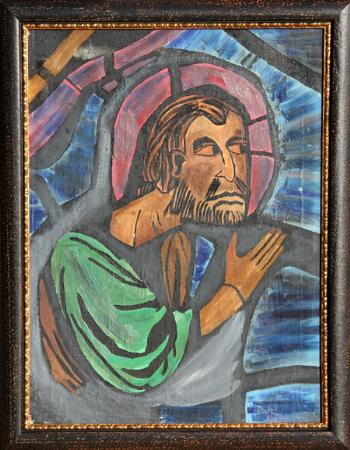
Rattner is best known for religious themes and a very expressive style similar to stained glass with incredibly rich, glazed, impasto paint and color divided into glowing segments by thick black lines. In his last years, the artist moved closer to an Abstract-Expressionist* style.
Rattner died in 1978.
Abraham Rattner taught at the American Academy* in Rome. He was a member of the National Institute of Arts and Letters*. His work is in the Albright-Knox Art Gallery, Buffalo, New York; Art Institute of Chicago; Baltimore Museum of Art; Detroit Institute of Arts; Newark Museum, New Jersey; Pennsylvania Academy of the Fine Arts, Philadelphia; Philadelphia Museum of Art; Phillips Collection, Washington, D.C.; Wadsworth Athenaeum, Hartford, Connecticut; and Whitney Museum of American Art, New York City.
Sources:
Michael David Zellman, 300 Years of American Art
Peter Hastings Falk, Editor, Who Was Who in American Art
* For more in-depth information about these terms and others, see AskART.com Glossary http://www.askart.com/AskART/lists/Art_Definition.aspxBiography from the Archives of askART
 Abraham Rattner was born on July 8, 1893 in Poughkeepsie, New York, the son of a moneyless baker who had fled from Russia in the 1880s. As a boy, he gathered bits of coal along the railroad tracks and worked at whatever odd jobs came along. He studied architecture at George Washington University; at the same time he took painting classes at the Corcoran School of Art. He quickly decided to concentrate on painting.
In 1917 Rattner began studying at the Pennsylvania Academy of Fine Arts in Philadelphia but World War I put an end to those plans. After the war, he attended the Ecole des Beaux Arts in Paris as the result of a travelling fellowship from the Academy. He lived in Paris until 1939; he departed for the United States in such a hurry he left most of his paintings behind.
He started painting after World War I when he settled in the French village of Giverny on the Seine. There he would spend hours watching his ancient neighbor Claude Monet paint his lily pond. He went to Chartres and was overwhelmed by the cathedral windows; in Paris he became the friend of Picasso, Miro and Braque; He passed through an Impressionist phase, dabbled in Cubism; but the rise of Hitler convinced him that any art not primarily concerned with moral and spiritual issues was not for him.
Rattner was best known for religious themes and a very expressive style similar to stained glass. He used incredibly rich, glazed, impasto paint and color divided into glowing segments by thick black lines. In his last years, he moved closer to an Abstract-Impressionist style.
He was married in 1949 to Esther Gentle; another wife was Bettina Bedwell. He died on February 14, 1978.
Written and submitted by Jean Ershler Schatz, artist and researcher from Laguna Woods, California.
Sources:
Time Magazine, September 26, 1960
From the Internet, www.AskART.comBiography from RoGallery
 Born in 1895 in Poughkeepsie, New York, Abraham Rattner came to Washington, D.C. to study architecture at the George Washington University and art at the Corcoran College of Art and Design. In 1917 he went to Philadelphia to study painting at the Pennsylvania Academy of the Fine Arts. That same year, the United States entered World War I, whereupon Rattner volunteered to serve in the Army. After the armistice in 1919, Rattner resumed his studies in Philadelphia, but in 1920 went to Paris, studying at times at l'École des Beaux Arts, l'Académie de la Grande Chaumiere, and l'Académie Ranson. During a 20-year residence in France he saw many kinds of art: cubism, surrealism, and futurism. Rattner also met the avant-garde artists in France: Pablo Picasso, architect Le Corbusier, and American expatriate author Henry Miller. Rattner adopted a cubist style, interpreting nature in bold, vibrant color arrangements.
In 1939, with the tensions of World War II increasing, Rattner returned to the United States, where he was quickly recognized as a leading modernist painter and a superb colorist. In 1940, with his friend Henry Miller's writing and Rattner's illustrations were published as The Air-Conditioned Nightmare (1945), a quirky chronicle of their travels.
Rattner exhibited his painting in New York galleries until 1947 when personal events altered his artistic style. The public exposure of the horrors of the Holocaust after World War II, along with the death of his wife, caused Rattner to turn away from painting for a time. When he resumed his career, he renewed an early interest in architecture and architectural elements, making designs for mosaic and stained glass. By 1960, Rattner's designs, in a modern idiom, brought together stories from his Jewish heritage, including religious themes, with references to the Holocaust or to nuclear war, to convey his concern for the human condition. His late paintings are clearly related to his stained glass designs in their symbolic force and in style, namely his use of vivid colors and bold, swooping outlines that unify the compositions.