Page loaded successfully. Showing biography for Adolf Haer.
Adolf Haer BIOGRAPHY
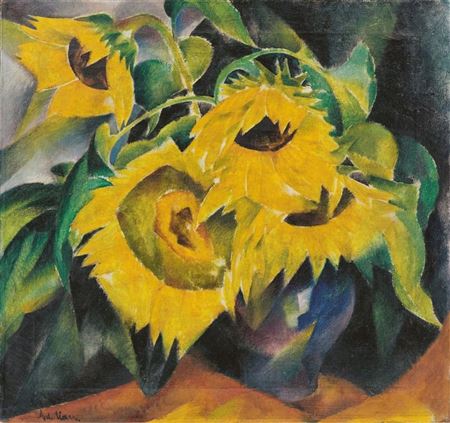
1892 Dusseldorf - 1945 Osnabruck. Known for: Painting.
The painter and graphic artist Adolf Josef Maria de Hear (1892 Dusseldorf - 1945 Osnabrück) has already gained early fame through his membership in the artists' association 'The Young Rhineland',... Read full biography
The painter and graphic artist Adolf Josef Maria de Hear (1892 Dusseldorf - 1945 Osnabrück) has already gained early fame through his membership in the artists' association 'The Young Rhineland', emerged from the later 'The Rheinische secession'. His artistic work has been recognized through... Read full biography
The painter and graphic artist Adolf Josef Maria de Hear (1892 Dusseldorf - 1945 Osnabrück) has already gained early fame through his membership in the artists' association 'The Young Rhineland', emerged from the later 'The Rheinische secession'. His artistic work has been recognized through numerous awards, he received, among others, the 1921 Dürer Award of the City of Nuremberg and 1928 the industrial price of the city Düsseldorf. His oeuvre from the 1920s focused mainly on landscape motifs... Read full biography
The painter and graphic artist Adolf Josef Maria de Hear (1892 Dusseldorf - 1945 Osnabrück) has already gained early fame through his membership in the artists' association 'The Young Rhineland', emerged from the later 'The Rheinische secession'. His artistic work has been recognized through numerous awards, he received, among others, the 1921 Dürer Award of the City of Nuremberg and 1928 the industrial price of the city Düsseldorf. His oeuvre from the 1920s focused mainly on landscape motifs in black and white. These early works are mostly the style of the Rhenish Expressionism, with aspects of Cubism, assigned. In the course of his work de Haer favored still lifes and nudes, characterized by delicate colors. During the outgoing 1930s and... Read full biography
The painter and graphic artist Adolf Josef Maria de Hear (1892 Dusseldorf - 1945 Osnabrück) has already gained early fame through his membership in the artists' association 'The Young Rhineland', emerged from the later 'The Rheinische secession'. His artistic work has been recognized through numerous awards, he received, among others, the 1921 Dürer Award of the City of Nuremberg and 1928 the industrial price of the city Düsseldorf. His oeuvre from the 1920s focused mainly on landscape motifs in black and white. These early works are mostly the style of the Rhenish Expressionism, with aspects of Cubism, assigned. In the course of his work de Haer favored still lifes and nudes, characterized by delicate colors. During the outgoing 1930s and 1940s, much of his work was in de Haers's then residence Kaiserswerth. Also at that time, interest i... Read full biography
Artist Biography
Biography page for Adolf Haer ((1892 - 1945)), known for Painting. Showing 1 biographical entries and 0 sample artworks.
Adolf Haer - Artist Info
About Adolf Haer
Biography from Hargesheimer Kunstauktionen Düsseldorf
The painter and graphic artist Adolf Josef Maria de Hear (1892 Dusseldorf - 1945 Osnabrück) has already gained early fame through his membership in the artists' association 'The Young Rhineland', emerged from the later 'The Rheinische secession'. His artistic work has been recognized through numerous awards, he received, among others, the 1921 Dürer Award of the City of Nuremberg and 1928 the industrial price of the city Düsseldorf.
His oeuvre from the 1920s focused mainly on landscape motifs in black and white. These early works are mostly the style of the Rhenish Expressionism, with aspects of Cubism, assigned. In the course of his work de Haer favored still lifes and nudes, characterized by delicate colors. During the outgoing 1930s and 1940s, much of his work was in de Haers's then residence Kaiserswerth. Also at that time, interest in his work was strong and the artist participated in numerous prestigious exhibitions.
In 1925 de Haer was represented at the special exhibition of the art association and in the great art exhibition Dusseldorf aongside with Lovis Corinth, Ernst Ludwig Kirchner, Oskar Kokoschka and Wassily Kandinsky. Under the auspices of Max Slevogt and Max Liebermann the exhibition of the German Association of Artists in Essen followed in 1931. In 1934 his work was shown at the spring exhibition of the Prussian Academy of Arts in Berlin, and in 1936 at the Kunstverein Hamburg and 1937 at the Kunstverein Hannover. That same year he was once again represented at the Great Art Exhibition Dusseldorf. In 1940 the painting "On the beach" was shown at the Rheinische Art Exhibition Berlin, as well as other works (including "Bathing girls on the Rhine") in the autumn exhibition of the Düsseldorf Kunsthalle. 1941, de Haer's works were shown together with those of known fellow artists such as Otto Modersohn and Milly Steger at the Karl-Ernst-Osthaus Museum Hagen and in the same year alongside Max Clarenbach, Arno Breker and Heinrich Hermann at the Düsseldorf Kunsthalle. Between 1939 and 1942 he published selected works, such as "Grandma and Grandpa Santen" in Duisburg's art collection and several times on the "Great German Art Exhibition Munich" in the House of German Art. Even de Haers works were part of the look of contemporary Rhenish art in various international collections, including 1941 in the Künstlerhaus, 1942 at the Palace of Fine Arts Brussels, Mauritzhuis The Hague, and in 1943 at the Palazzo Strozzi in Florence and in the Taidehalli Helsinki.
Even after de Haers death, interest in his art remained unbroken. In particular, his female nudes and beach scenes were in demand by the public. In a memorial exhibition in 1946 in Hetjens Museum Dusseldorf watercolors bathing girls were exhibited alongside works of great artists of the early 20th century such as Paul Klee and August Macke. Between 1988 to 1989, finally, the traveling exhibition "German Expressionism from 1915 to 1925" works by de Haer were shown in California via Halle to Dusseldorf and Texas.
Under his niece's initiative, much of the Oeuvres de Adolf Haers was compiled in an extensive retrospective exhibition in Kaiserswerth. Even today, his works are part of renowned, national and international collections such as the Municipal Art Hall Dusseldorf, the Kunstmuseum Mülheim, Museum Giersch the Goethe University Frankfurt, the art collections Nuremberg and Passau, and the LA County Museum of Art (USA).