Page loaded successfully. Showing biography for Adolphe-Felix Cals.
Adolphe-Felix Cals BIOGRAPHY
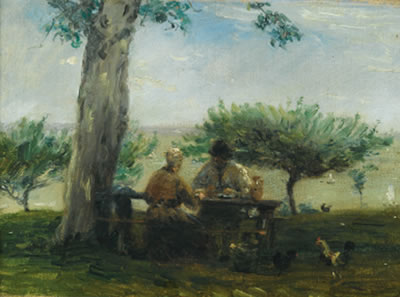
1810 - 1880. Known for: Social realist genre and impressionist landscape painting.
While it is not known exactly when AdolpheFelix Cals began his interest in art, his earliest training came from little known printmakers, who taught Cals engraving, drawing, and how to work from... Read full biography
While it is not known exactly when AdolpheFelix Cals began his interest in art, his earliest training came from little known printmakers, who taught Cals engraving, drawing, and how to work from plaster casts in the studio. After working for such men as Anselin, Ponce, and Bosc (copying the works... Read full biography
While it is not known exactly when AdolpheFelix Cals began his interest in art, his earliest training came from little known printmakers, who taught Cals engraving, drawing, and how to work from plaster casts in the studio. After working for such men as Anselin, Ponce, and Bosc (copying the works of Francois Boucher or Achille Deveria in lithographs), Cals was introduced by another young student to the academic painter Leon Cogniet (17941880) and entered his atelier at the Ecole des Beaux Arts... Read full biography
While it is not known exactly when AdolpheFelix Cals began his interest in art, his earliest training came from little known printmakers, who taught Cals engraving, drawing, and how to work from plaster casts in the studio. After working for such men as Anselin, Ponce, and Bosc (copying the works of Francois Boucher or Achille Deveria in lithographs), Cals was introduced by another young student to the academic painter Leon Cogniet (17941880) and entered his atelier at the Ecole des Beaux Arts during the late 1820's. It is not surprising that Cogniet would expect Cals to study the Masters, for that was the tradition of the atelier, but although Cogniet recognized the talents of his young pupil, he was not pleased with Cals's independent... Read full biography
While it is not known exactly when AdolpheFelix Cals began his interest in art, his earliest training came from little known printmakers, who taught Cals engraving, drawing, and how to work from plaster casts in the studio. After working for such men as Anselin, Ponce, and Bosc (copying the works of Francois Boucher or Achille Deveria in lithographs), Cals was introduced by another young student to the academic painter Leon Cogniet (17941880) and entered his atelier at the Ecole des Beaux Arts during the late 1820's. It is not surprising that Cogniet would expect Cals to study the Masters, for that was the tradition of the atelier, but although Cogniet recognized the talents of his young pupil, he was not pleased with Cals's independent turn of mind. Perhaps the only qualities Cals acquired from Cogniet were interest in painterly detail and use of Romantic... Read full biography
Artist Biography
Biography page for Adolphe-Felix Cals ((1810 - 1880)), known for Social realist genre and impressionist landscape painting. Showing 2 biographical entries and 0 sample artworks.
Adolphe-Felix Cals - Artist Info
About Adolphe-Felix Cals
Biography from ROUGHTON GALLERIES, INC
While it is not known exactly when AdolpheFelix Cals began his interest in art, his earliest training came from little known printmakers, who taught Cals engraving, drawing, and how to work from plaster casts in the studio. After working for such men as Anselin, Ponce, and Bosc (copying the works of Francois Boucher or Achille Deveria in lithographs), Cals was introduced by another young student to the academic painter Leon Cogniet (17941880) and entered his atelier at the Ecole des Beaux Arts during the late 1820's.
It is not surprising that Cogniet would expect Cals to study the Masters, for that was the tradition of the atelier, but although Cogniet recognized the talents of his young pupil, he was not pleased with Cals's independent turn of mind. Perhaps the only qualities Cals acquired from Cogniet were interest in painterly detail and use of Romantic color, although even in this early period Cals maintained his determination to depict themes which stressed the miserable existence of the lower classes.
After Cals left Cogniets atelier and served a brief period in the military, he painted landscapes on the outskirts of Paris (ca. 1833) in preparation for exhibiting his work at the Salon. Three of his works were accepted at the 1835 Salon, including one with strong social implications (Une Pauvre Femme). From that time on until 1870, he exhibited regularly at these yearly shows. Often, however, his works were poorly placed and, thus, overlooked by those who attended. Admittedly, contemporary academic critics found little to interest them because of the social overtones in his genre scenes and landscapes.
Cals made friends with several young painters when he lived in Paris, including Ed. Cousin, who became the subject of one of Cals's early portraits.' During this period, Cals also married Ermance de Provisy, a young art student from an aristocratic family that he had met through Cogniet. When his irascible young wife showed signs of insanity, he left her, taking his small daughter to live with him at numerous locations in Paris. She often accompanied him on his painting excursions to the outskirts of the city (e.g., Argenteuil, Saint Cyr). It was not a happy existence, and the themes that Cals completed during the 1840s mirrored his personal preoccupation with poverty.
Many of these early works show an interest in peasant life that anticipates the later works of Jean Francois Millet but which at the time only served to disturb a Salon public ill-prepared for anything but the classicism of Ingres. In 1846, when Cals exhibited eleven works at the Salon, the assurance of his many Realist friends that he would win a medal for his genre studies convinced him of the success he felt he deserved; his failure to receive of official recognition only added to his disillusionment.
His struggles as an artist were finally alleviated by his friendship with the art dealer Pere Martin. In 1848 Martin, a man of passionate dedication and a firm supporter of the direct and contemporary way of examining the environment and themes of humanity, opened his first shop on rue Mogador. Here and later on Rue Laffitte, Martin was able to sell works by Cals, as well as paintings by Millet, Corot, and others. Among the patrons who came to Martin's shop were private collectors such as the Rouart brothers and Gustave Arosa. With Martin's help, Cals's paintings may have entered private collections of the middle and upper classes, who were attracted to his small scale humble themes and who appreciated the still lifes that Cals began exhibiting in 1848.
Pere Martin was not the only individual to come to Cals's assistance. In 1858, at Martin's gallery, Cals met Count Doria and formed a lifelong friendship with this patron of the arts. Count Doria invited Cals to work at his private villa (until 1869) and there Cals was able to achieve some of his purest studies of light and atmosphere. During the 1850s, Cals also completed a number of studies of family life, many of which were perhaps inspired by a growing appreciation of Chardin, but were based, in part, also upon studies of his own daughter Marie absorbed in her daily activities. This type of painting was popular among other artists (e.g., Edouard Frere and Octave Tassaert), for it was a time when the Realists were studying the ramifications of childhood as part of their widespread appreciation of family life.
Cals enjoyed the friendship of many of the Realists, but his relationship with the Dutch pre-impressionist Jongkind was probably his closest. By the late 1850s, word had already reached Paris that Jongkind was in poor health; in 1861 Cals was sent by Pere Martin and other friends to Holland to settle Jongkind's debts and to bring him back to Paris where he could be cared for. Cals and Jongkind remained good friends, and in 1873 Cals went to live with Jongkind at Honfleur, a region where others as early as the mi-1850s had been studying effects of light. Undoubtedly, Cals's awareness of the landscapes of Charles Daubigny and the seascapes of Eugene Boudin, depicted at differing times of the day and under changing atmospheric conditions, inspired him to follow other pre-Impressionists.
He became increasingly interested in painting landscapes. During the 1860s, when many of his canvases were rejected at the Salon because of their disturbing social themes, Cals gained increasing respect from other traditional Realists (e.g., Bonvin and Ribot), for his participation in the Salon des Refuses classified him as one of the vocal, revolutionary figures in French painting. His entry of a lowerclass genre painting, depicting the work of a shoemaker, typified the honest, hard work by lesser artisans that the Realists were then studying.
By 1874, six years before his death, Cals had become associated with the new movement of the Impressionists, a generation of Realists who emerged as a force on the art scene with their first independent exhibition. Cals's growing interest in newer tendencies in French art and his friendship with young painters (e.g., Claude Monet) thus conditioned him to mortify his style according to innovative theory and painting techniques. These later works that Cals exhibited with the Impressionists reveal a freer brushstroke and a lightened color range.
Cals's home life was never easy, and, like other Realists (e.g., Bonvin and Ribot), he was often afflicted by poverty and personal problems. In 1868, his daughter became insane, and he placed her in Charenton.
Many of Cals's earliest canvases merit further examination, since it was in a variety of genre themes that he first attracted attention. His interest in still life, while apparently not extensive, began in the late 1840s and indicates that he had an opportunity not only to study domestic gemre compositions by Chardin, but also Chardin's Still lifes when they were first being rediscovered. Although he surrendered his expectation of further Salon exhibitions when he chose to exhibit with the Impressionists in 1874, his participation was characteristic of the independent position that he first established in the mid1830s. Altogether, his career embraces the full extent of the Realist movement, from the first generation to the final modification of the tradition.
Museums:
Le Musee du Louvre
Musee de Reims
Musee de HonfleurBiography from Galerie Bassenge, Berlin
Born in Paris, Adolphe-Félix Cals studied painting under Léon Cogniet at the École des Beaux-Arts and exhibited regularly at the Paris Salon from 1835 onwards. His studio was traditionally in the bohemian district of Montmartre. Cals was one of the artists who was rejected by the jury for the salon of 1863 because of "avant-garde trends". In addition to artists such as Claude Monet, Edgar Degas and Camille Pissarro, he finally exhibited his paintings in the “Salon des refusés”. In 1871, Adolphe-Felix Cals bought a house in Honfleur, a picturesque port town in Normandy, which from the 1960s onwards established itself as a small artist colony of impressionist avant-garde artists. Cals was also inspired and developed his impressionistic style there. A large part of his landscape pictures was created here.