Page loaded successfully. Showing biography for Al Feldstein.
Al Feldstein BIOGRAPHY

1925 Brooklyn, New York - 2014 Paradise Valley, Montana. Known for: Comic book art, magazine editing, wildlife and landscape painting.
Following is The New York Times obituary of Al Feldstein. Al Feldstein, the Soul of Mad Magazine, Dies at 88. By BRUCE WEBER. MAY 1, 2014. Al Feldstein, who took over a fledgling humor magazine... Read full biography
Following is The New York Times obituary of Al Feldstein. Al Feldstein, the Soul of Mad Magazine, Dies at 88. By BRUCE WEBER. MAY 1, 2014. Al Feldstein, who took over a fledgling humor magazine called Mad in 1956 and made it a popular, profitable and enduring wellspring of American satire, died on... Read full biography
Following is The New York Times obituary of Al Feldstein. Al Feldstein, the Soul of Mad Magazine, Dies at 88. By BRUCE WEBER. MAY 1, 2014. Al Feldstein, who took over a fledgling humor magazine called Mad in 1956 and made it a popular, profitable and enduring wellspring of American satire, died on Tuesday at his ranch in Paradise Valley, Montana. He was 88. His wife, the former Michelle Key, confirmed the death. In recent years, he was a wildlife and landscape painter in Montana, outside... Read full biography
Following is The New York Times obituary of Al Feldstein. Al Feldstein, the Soul of Mad Magazine, Dies at 88. By BRUCE WEBER. MAY 1, 2014. Al Feldstein, who took over a fledgling humor magazine called Mad in 1956 and made it a popular, profitable and enduring wellspring of American satire, died on Tuesday at his ranch in Paradise Valley, Montana. He was 88. His wife, the former Michelle Key, confirmed the death. In recent years, he was a wildlife and landscape painter in Montana, outside Livingston. Mr. Feldstein had been a writer and illustrator of comic books when he became editor of Mad four years into its life and just a year after it had graduated from comic-book form to a full-fledged magazine. The founding editor, Harvey Kurtzman,... Read full biography
Following is The New York Times obituary of Al Feldstein. Al Feldstein, the Soul of Mad Magazine, Dies at 88. By BRUCE WEBER. MAY 1, 2014. Al Feldstein, who took over a fledgling humor magazine called Mad in 1956 and made it a popular, profitable and enduring wellspring of American satire, died on Tuesday at his ranch in Paradise Valley, Montana. He was 88. His wife, the former Michelle Key, confirmed the death. In recent years, he was a wildlife and landscape painter in Montana, outside Livingston. Mr. Feldstein had been a writer and illustrator of comic books when he became editor of Mad four years into its life and just a year after it had graduated from comic-book form to a full-fledged magazine. The founding editor, Harvey Kurtzman, established its well-informed irreverence, but Mr. Feldstein gave Mad its i... Read full biography
Artist Biography
Biography page for Al Feldstein ((1925 - 2014)), known for Comic book art, magazine editing, wildlife and landscape painting. Showing 2 biographical entries and 0 sample artworks.
Al Feldstein - Artist Info
About Al Feldstein
Biography from the Archives of askART
 Following is The New York Times obituary of Al Feldstein.
Al Feldstein, the Soul of Mad Magazine, Dies at 88
By BRUCE WEBER
MAY 1, 2014
Al Feldstein, who took over a fledgling humor magazine called Mad in 1956 and made it a popular, profitable and enduring wellspring of American satire, died on Tuesday at his ranch in Paradise Valley, Montana. He was 88.
His wife, the former Michelle Key, confirmed the death. In recent years, he was a wildlife and landscape painter in Montana, outside Livingston.
Mr. Feldstein had been a writer and illustrator of comic books when he became editor of Mad four years into its life and just a year after it had graduated from comic-book form to a full-fledged magazine.
The founding editor, Harvey Kurtzman, established its well-informed irreverence, but Mr. Feldstein gave Mad its identity as a smart-alecky, sniggering and indisputably clever spitball-shooter of a publication with a scattershot look, dominated by gifted cartoonists of wildly differing styles.
Sources disagree about Mad's circulation when Mr. Feldstein took over; estimates range from 325,000 to 750,000. But by the early 1960s, he increased it to over a million, and a decade later it had doubled.
The December 1974 issue featured a Nixon-Agnew parody of "The Sting."
He hired many of the writers and artists whose work became Mad trademarks. Among them were Don Martin, whose cartoons featuring bizarre human figures and distinctive sound effects — Katoong! Sklortch! Zazik! — immortalized the eccentric and the screwy; Antonio Prohias, whose "Spy vs. Spy" was a sendup of the international politics of the Cold War; Dave Berg, whose "The Lighter Side of ..." made gentle, arch fun of middlebrow behavior; and Mort Drucker, whose caricatures satirized movies like Woody Allen's "Hannah and Her Sisters" ("Henna and Her Sickos" in Mad's retelling).
Another hire, George Woodbridge, illustrated a Mad signature article written by Tom Koch: a prescient 1965 satire of college sports, criticizing their elitism and advocating the creation of a game that could be played by everyone. It was called 43-Man Squamish, "played on a five-sided field called a Flutney." Position players, each equipped with a hooked stick called a frullip, included deep brooders, inside and outside grouches, overblats, underblats, quarter-frummerts, half-frummerts a full-frummert and a dummy.
"The offensive team, upon receiving the Pritz, has five Snivels in which to advance to the enemy goal," Mr. Koch wrote, part of a nonsensical and hopelessly complicated instruction manual that nonetheless inspired the formation of squamish teams on campuses across the country.
In his second issue, Mr. Feldstein seized on a character who had appeared only marginally in the magazine — a freckled, gaptoothed, big-eared, glazed-looking young man — and put his image on the cover, identifying him as a write-in candidate for president campaigning under the slogan "What — me worry?"
At first he went by Mel Haney, Melvin Cowznofski and other names. But when the December 1956 issue, No. 30, identified him as Alfred E. Neuman, the name stuck. He became the magazine's perennial cover boy, appearing in dozens of guises, including as a joker on a playing card, an ice-skating barrel jumper, a totem on a totem pole, a football player, a yogi, a construction worker, King Kong atop the Empire State Building, Rosemary's baby, Uncle Sam, General Patton and Barbra Streisand.
Neuman became the symbol of Mad, his goofy countenance often intruding, Zelig-like, into scenes from the political landscape and from popular television shows and movies. He signaled the magazine's editorial attitude, which fell somewhere between juvenile nose-thumbing at contemporary culture and sophisticated spoofing.
Mad made fun of itself as well. The staff was referred to on the masthead as "the usual gang of idiots," and the magazine warned readers not to take it seriously even as it winkingly promoted its importance. Its irreverence made it especially popular with teenagers — many comedians have confessed to slavering over issues in their adolescence — and in its tone and fearless targeting of sacred cows it anticipated social satire vehicles like The Harvard Lampoon, National Lampoon, "Saturday Night Live," "The Simpsons," "South Park" and The Onion.
Albert Bernard Feldstein was born on Oct. 24, 1925, in Brooklyn, to Max and Beatrice Feldstein. His father made dental molds. Attracted to drawing as a boy, Al won a poster contest sponsored by the 1939 New York World's Fair.
He attended the High School of Music and Art in Manhattan and, after graduating, took classes at the Art Students League. He also worked part time for a studio that produced comic books. During World War II, he served stateside in the Army Air Forces.
After the war, Mr. Feldstein was a freelance writer and illustrator before going to work for William M. Gaines, the publisher of EC, short for Educational Comics and, later, Entertaining Comics. At EC, Mr. Feldstein created Weird Science, Weird Fantasy, Tales From the Crypt and several other horror and suspense titles.
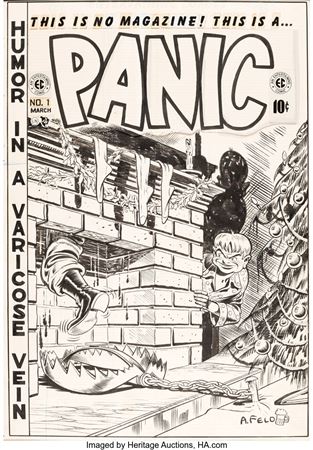
Mr. Gaines also published a comic book, full of irreverent and sometimes juvenile humor, called Mad, the brainchild of Mr. Kurtzman, and a second humor-based comic, Panic, an offshoot of Mad, edited by Mr. Feldstein.
The early 1950s were a grim time for comic books. Moralizing newspaper columnists and eventually Congress attacked them as having a corrupting influence on America's youth. When Mr. Feldstein's horror books were singled out, EC nearly went out of business, and in 1955 Mr. Feldstein temporarily lost his job.
Mad began to flourish under Mr. Kurtzman, but he and Mr. Gaines clashed, and when Mr. Kurtzman left in 1956, Mr. Gaines hired Mr. Feldstein to replace him. He was its editor until 1985.
By then Mad was a victim of its own success. With its brand of satire increasingly available in many other publications and on television, its circulation had been in decline for a decade. Mr. Gaines, who died in 1992, sold the magazine in the early 1960s to the Kinney Parking Company, which went on to buy Warner Brothers and the company now known as DC Comics as well.
Today, Mad, published by the DC Entertainment division of Warner Communications, has a much lower circulation than it did at its peak, but an active and popular website.
After his retirement from Mad, Mr. Feldstein pursued a painting career in Montana and had exhibitions in galleries in the West.
His first marriage, to Clair Szep, ended in divorce. His second, to Natalie Sonia Sigler, ended with her death in 1986.
In addition to his wife, he is survived by two daughters, two stepsons, a stepdaughter and five step-grandchildren.
As editor of Mad, Mr. Feldstein had a palpable influence on popular culture at large. To cite just one example, in 1965 Mad published letters and photographs from college students who said they had been inspired by the squamish article to field teams. (Whether this was true or not is difficult to prove.) One letter writer, from Marquette University, said the school had its own squamish team, and that "at last tally, we have lost two Deep Brooders and one Dummy, who were suspended for sportsmanlike conduct during the course of play."
Daniel E. Slotnik contributed reporting.Biography from the Archives of askART
 Albert B. Feldstein (born October 24, 1925) is an American painter of Western wildlife and an influential author-editor who wrote, drew and edited for EC Comics, followed by a lengthy career as the editor of Mad. He was inducted into the Will Eisner Award Hall of Fame in 2003.
Al Feldstein was born on October 24, 1925 in Brooklyn, New York, and grew up in Flatbush on East 31st Street between Avenue L and Avenue M. He attended P.S. 191, and when he was eight years old, he won a third-place medal in the annual John Wanamaker art competition. After winning an award in the 1939 New York World's Fair poster contest, he decided on a career in the art field and studied at the High School of Music and Art in upper Manhattan.
When he was 15 years old, he was hired by Jerry Iger to work in the Eisner & Iger shop, an art service for the comic book industry. At Eisner & Iger, he earned three dollars a week running errands, inking balloon lines, ruling panel borders and erasing pages. When he began inking backgrounds, his salary jumped to five dollars a week.
With his graduation, he received a scholarship to the Art Students League. He began a rigorous schedule of studying at Brooklyn College during the day, followed by night classes at the Art Students League. At the age of 17, he enlisted in the Air Force in July 1943, as an aviation cadet and began his basic training in Blytheville, Arkansas. His cadet class was held in reserve, and he was assigned to Special Services, creating signs and service club murals, decorating planes and flight jackets, drawing comic strips for field newspapers and painting squadron insignias for orderly rooms.
After his discharge, Feldstein freelanced art for comic books, including Fox Comics.
Arriving in 1948 at Bill Gaines' Entertaining Comics, Feldstein began as an artist, but soon combined art with writing and became the editor on most of the EC titles. Although he originally wrote and illustrated approximately one story per comic, in addition to doing many covers, Feldstein eventually focused on editing and writing, reserving his artwork primarily for covers. From late 1950 through 1953, Feldstein edited and wrote stories for seven EC titles.
While developing a stable of contributing writers that included Otto Binder, Jack Oleck, Carl Wessler and Daniel Keyes, he published the first work of Harlan Ellison. EC employed the comics industry's finest artists and published promotional copy to make readers aware of their staff.
Feldstein encouraged the EC illustrators to maintain their personal art styles, and this emphasis on individuality gave the EC line a unique appearance. Distinctive front cover designs framing those recognizable art styles made Feldstein's titles easy to spot on crowded newsstands.
Those comic books, known as EC's New Trend group, included Weird Science, Weird Fantasy, Tales from the Crypt, The Haunt of Fear, The Vault of Horror, Shock SuspenStories, Crime SuspenStories and Panic. After the New Trend titles folded in 1955, Feldstein edited EC's short-lived New Direction and Picto-Fiction titles.
Feldstein then moved to Mad, succeeding Harvey Kurtzman in 1956, spending the next 29 years at the helm of what became one of the nation's leading and most venerable satirical magazines. Circulation multiplied more than eight times during Feldstein's tenure, peaking at 2,850,000 in 1974, although it declined to three quarters of that figure by the end of his time as editor.
Many new cartoonists and writers surfaced during the early years of Feldstein's editorship. This process leveled off in the 1960s as the magazine came to rely on a steady group of contributors. Feldstein's first issue as editor (#29) was also the first issue to display the twisted work of cartoonist Don Martin. A few months later, he hired Mort Drucker, who quickly established himself as their premier caricaturist. By 1961, with the introduction of Antonio Prohías and Dave Berg, he had fully established the format that kept the magazine a commercial success for decades.
After he retired from Mad in 1984, Feldstein began painting again after his son, Mark Feldstein, gave him his first oil paint set since pre-Mad.
He left Connecticut and relocated in Jackson Hole, Wyoming, where he spent three years painting the Teton Range and its wildlife. Two of his paintings from that period placed in the Top 100 of Arts for the Parks, a competition created in 1986 by the National Park Academy of the Arts.
Feldstein moved in 1992 to Paradise Valley, Montana, near Livingston, finding new approaches to depict the Western way of life in his acrylic paintings. In 1999, he was awarded an Honorary Doctorate of Arts degree by Rocky Mountain College in Billings, Montana, and that year again ranked in the Top 100 of the Arts for the Parks' Competition. In 2000, he was invited to give the Commencement Address to the new century's first graduating class at Rocky Mountain College.
He is represented by numerous Northwest galleries, and he continues to create his Western, wildlife and landscape paintings at his 270 acre ranch south of Livingston and north of Yellowstone National Park.
Source:
"Al Feldstein", Wikipedia, http://en.wikipedia.org/wiki/Al_Feldstein (Accessed 10/2010)