Page loaded successfully. Showing biography for Al Held.
Al Held BIOGRAPHY
1928 Brooklyn, New York - 2005 Todi, Italy. Known for: Geometric abstract painting.
An abstract oil painter often using large, geometric forms with aggressive coloration, Al Held became a major figure in the New York art scene in the later part of the 20th century. His work is... Read full biography
An abstract oil painter often using large, geometric forms with aggressive coloration, Al Held became a major figure in the New York art scene in the later part of the 20th century. His work is stark, usually large-scale, and much of its "in-your-face" forcefulness reflects his desire to bridge the... Read full biography
An abstract oil painter often using large, geometric forms with aggressive coloration, Al Held became a major figure in the New York art scene in the later part of the 20th century. His work is stark, usually large-scale, and much of its "in-your-face" forcefulness reflects his desire to bridge the division between viewers and his paintings. He was born as Alvin Jacob Held in Brooklyn and grew up there and in the Bronx during Depression times when his Polish-Jewish family had a hard time... Read full biography
An abstract oil painter often using large, geometric forms with aggressive coloration, Al Held became a major figure in the New York art scene in the later part of the 20th century. His work is stark, usually large-scale, and much of its "in-your-face" forcefulness reflects his desire to bridge the division between viewers and his paintings. He was born as Alvin Jacob Held in Brooklyn and grew up there and in the Bronx during Depression times when his Polish-Jewish family had a hard time financially. He was asked to leave high school because of chronic in-attendance, so he joined the Navy in 1945 and served for two years. He began associating with people interested in "leftist" politics and art and attended the Art Students League from... Read full biography
An abstract oil painter often using large, geometric forms with aggressive coloration, Al Held became a major figure in the New York art scene in the later part of the 20th century. His work is stark, usually large-scale, and much of its "in-your-face" forcefulness reflects his desire to bridge the division between viewers and his paintings. He was born as Alvin Jacob Held in Brooklyn and grew up there and in the Bronx during Depression times when his Polish-Jewish family had a hard time financially. He was asked to leave high school because of chronic in-attendance, so he joined the Navy in 1945 and served for two years. He began associating with people interested in "leftist" politics and art and attended the Art Students League from 1948 to 1949. Then with money from the G.I. Bill of Rights, he went to Paris and enrolled at the Academie de la Grande Chaumiere. Ossip Zadk... Read full biography
Artist Biography
Biography page for Al Held ((1928 - 2005)), known for Geometric abstract painting. Showing 3 biographical entries and 0 sample artworks.
Al Held - Artist Info
About Al Held
Biography from the Archives of askART
 An abstract oil painter often using large, geometric forms with aggressive coloration, Al Held became a major figure in the New York art scene in the later part of the 20th century. His work is stark, usually large-scale, and much of its "in-your-face" forcefulness reflects his desire to bridge the division between viewers and his paintings.
He was born as Alvin Jacob Held in Brooklyn and grew up there and in the Bronx during Depression times when his Polish-Jewish family had a hard time financially. He was asked to leave high school because of chronic in-attendance, so he joined the Navy in 1945 and served for two years.
He began associating with people interested in "leftist" politics and art and attended the Art Students League from 1948 to 1949. Then with money from the G.I. Bill of Rights, he went to Paris and enrolled at the Academie de la Grande Chaumiere. Ossip Zadkine, Russian-born sculptor, was one of his teachers, and he had his first solo exhibition at Galerie Huit in Paris in 1952.
Until 1959, he painted in the Abstract Expressionist style, admittedly influenced by opposites--Jackson Pollock's emotional, gestural involvement in painting and Piet Mondrian's objectivity. He also went through a phase of Social Realism.
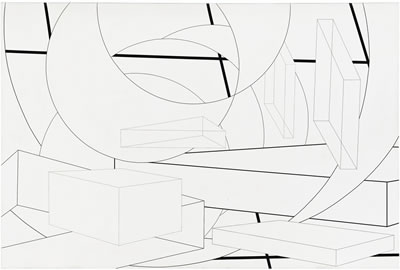
Between 1960 and 1967, Held changed from the heavy textures of Abstract Expressionism to tightly controlled geometric pieces, often giving the appearance of being suspended on the canvas by not touching the edges with color. Many of his works were black and white, exploring aspects of Analytic Cubism. His 90 foot "Albany Mural" in the Empire State Plaza in Albany, New York is a good example of this type of work.
From 1963 to 1980, he was a member of the art faculty of Yale University.
However, he mostly lived in New York City until the mid 1990s, when he went back and forth between homes in Boiceville, New York near Woodstock and Todi, Italy, where he died at age 76 on July 26, 2005 in his swimming pool.
By the 1980s, with the resurgence of realist art, the market for his paintings became less active. But he kept painting, and many of his works were too large to fit into galleries. His painting "Requiem" measured 15 feet high and more than 60 feet in width and was exhibited at P.S. 1 Contemporary Art Center in Queens in 2002.
At the time of his death, Al Held was working on a mural commission for the Jacksonville Public Library in Florida, stained-glass windows for the Federal District Court in Orlando, Florida and a mosaic for the subway stop at Lexington Avenue and 53rd Street in Manhattan.
Held was married and divorced four times. His wives were filmmaker Giselle Wexler, dancer Yvonne Rainer, sculptor Sylvia Stone and Kathleen Monahan.
Sources:
Matthew Baigell, Dictionary of American Art
Ken Johnson, 'Al Held, Painter of Geometric Complexities, Dies at 76', The New York Times, A 17, Friday, July 29, 2005Biography from Hollis Taggart Galleries
Al Held began his art career in 1947, after he finished his service with the Navy. Upon his return to New York, his birthplace, he enrolled in the Art Students League, where he harbored an idea of becoming a muralist.
In 1949, funded by a G.I. Bill stipend, he went to Paris for three years and studied at the Académie de la Grande Chaumière. After deciding to abandon social realism, he adopted an Abstract Expressionist-inspired style characterized by geometric shapes rendered in dark colors and very thick impasto. He sought to marry the objectivity of Piet Mondrian and the subjectivity of Jackson Pollock. (1)
Throughout the 1950s, Held's palette grew progressively lighter. The geometric shapes disappeared, replaced by an intricate network of gestural, multidirectional strokes applied thickly with a palette knife. By the end of the decade, Held had become frustrated with both his style and his medium; he wanted to make the structure underpinning his paintings visible.
Within six months beginning in 1959, Held transformed his work by switching from oil to Liquitex, a quick-drying water-based acrylic medium. The advantage to Liquitex, as Held described, was that "the acrylic couldn't be built up and you couldn't work wet into wet with acrylic, and so the imagery remained clean and clear." (2) Among Held's points of departure for his new work was his admiration for Matisse's "Jazz" cutouts. He was also influenced by the stronger "taxicab" colors of Fernand Léger and Stuart Davis. (3)
The scale of Held's work increased during this period; he slowly filled canvases that were as large as 12 feet high and 28 feet wide. Even small pieces reveal Held's preoccupation with scale. An important formal aspect of his work is his tendency to crop forms, to create the impression that they continue to expand and exist outside the picture plane.
In a 1975 interview, Held described his working process. He would experiment with the placement of the main shapes, sometimes moving them entirely and painting over them. Once he was certain about the placement, he would work to define the edge between one color form and another. At first, he recalled, "the notion of drawing an edge I had no consciousness of. I didn't know what that meant. Or the tension between two edges. I had to literally educate myself."(4) None of his edges is perfectly straight; instead, they are intentionally modulated, convex in some areas and concave in others, to heighten the tension between the forms.
Held's style at this time has been described as concrete abstraction.(5) Other artists working in this vein included Knox Martin and the sculptors Ronald Bladen, George Sugarman, and David Weinrib. Held's work appeared with theirs in the "Concrete Expressionism" show curated by Irving Sandler at New York University in 1965.
Held was a member of the Yale University Faculty of Art from 1962 to 1980. In 1966, he received a Guggenheim Fellowship. The following year, he abandoned color and the flat shapes and began exploring perspective, space, and complex interlocking geometric forms in black and white. He eventually resumed work in color in the late 1970s while continuing his exploration of geometry and perspective.
Held also completed public art projects during his career. One of his last such public projects was a large mural for the New York subway system's East 53rd Street and Lexington stop. Held died at his home in Italy in July 2005. During his career he had one-man shows at the Stedelijik Museum in Amsterdam (1966), the San Francisco Museum of Art (1968), and the Whitney Museum of American Art (1974).
Footnotes
1. Irving Sandler, "Al Held" (New York: Hudson Hills Press, 1984), p. 13.
2. Al Held interviewed by Paul Cummings for the Archives of American Art (1975-76), available at http://www.aaa.si.edu/collections/interviews/al-held-interviews-12773.
3. Sandler, p. 34.
4. Al Held interview.
5. Sandler, see "Chapter 3: The Concrete Abstractions."
© Copyright 2012 Hollis Taggart GalleriesBiography from Modern Art Dealers
In the summer of 1959 the Museum of Modern Art mounted New York’s first big survey of postwar American painting. Titled "The New American Painting", it emphasized the work of the leading Abstract Expressionist artists and enthralled a young Brooklyn-born painter named Al Held.
A veteran of World War II, Al Held had briefly studied at Art Students League and then went to Paris for three years before returning to New York permanently. While Al Held was highly influenced by that show, he developed his own style which departed significantly for everything exhibited at that time.
“Al Held was one of the last and best of the big impact Abstract painters to emerge from the post-War era.” (Ken Johnson-N.Y. Times Art Critic). Al Held is known for his “special conundrums,” with each canvas the product of enormous drawn out labor and planning. Sometimes the artist would repaint pieces several times until he reached the perfect balance of perfection and the bending of perspective for which he was looking. Al Held paintings illustrate geometric magic with his manipulation of the various shapes incorporated into his canvases.
There are edges that you would not see in 3-D; but Al Held paintings bend rectangles and squares into trapezoidal mind play inviting the observer to look and look again as perspectives change. Like moving a lens over shapes, Al Held’s painting compositions reach out to the viewer with whimsical, stimulating oddities. This mechanism separates Al Held’s artwork from the other geo-metricians and hard edge painters from his generation. Al Held’s paintings could never be seen as static and predictable. There is always something new to see.
Al Held began his art career in 1947, after he finished his service with the Navy. Upon his return to New York, he enrolled in the Art Students League, where he harbored an idea of becoming a muralist. In 1949, funded by a G.I. Bill stipend, Al Held went to Paris for three years and studied at the Académie de la Grande Chaumière.
After deciding to abandon social realism, Al Held paintings adopted an Abstract Expressionist-inspired style characterized by geometric shapes rendered in dark colors and very thick impasto. Al Held art sought to marry the objectivity of Piet Mondrian and the subjectivity of Jackson Pollock.
Throughout the 1950s, Al Held’s artist palette grew progressively lighter. The geometric shapes disappeared, replaced by an intricate network of gestural, multidirectional strokes applied thickly with a palette knife. By the end of the decade, Al Held had become frustrated with both his style and his medium. He wanted to make the structure underpinning his paintings visible. Within six months beginning in 1959, Al Held transformed his work by switching from oil to Liquitex, a quick-drying water-based acrylic medium.
The advantage to Liquitex, as Al Held artist described, was that “the acrylic couldn’t be built up and you couldn’t work wet into wet with acrylic, and so the imagery remained clean and clear.” Among Al Held paintings, points of departure for his new work were his admiration for Matisse’s Jazz-themed cutouts. In 1966, Al Held received a Guggenheim Fellowship. The following year, Al Held art abandoned color and the flat shapes began to explore perspective, space, and complex interlocking geometric forms in black and white.
Al Held paintings were now in one-man exhibitions in the critically important André Emmerich Gallery in New York (1968, 1970, 1972, and 1974) and many more collectors and critics began to recognize the importance and the uniqueness of Al Held’s paintings. In 1974, a twenty-five year retrospective of Al Held art was held at the Whitney Museum of American Art. This massive collection substantiated Al Held’s importance as an alternative to the abstract painting that followed Abstract Expressionism.
Other than Frank Stella, Al Held paintings stood alone in style, being neither color field nor minimalist. Al Held artwork would experiment with the placement of the main shapes, sometimes moving them entirely and painting over them. Once he was certain about the placement, he would work to define the edge between one color form and another; creating a tension between two edges. In this regard, Al Held artist style was essentially self-taught. In that interview Al Held said “I had to literally educate myself” because this was a complete departure from his previous style and training. None of Al Held paintings have edges that are perfectly straight; instead, they are intentionally modulated, convex in some areas and concave in others, to heighten the tension between the forms.
Irving Sandler, the curator and biographer of the N.Y. School of painters (Triumph of American Painting) called Al Held painting style concrete abstraction. He went on to curate a show of Al Held artwork along with a number of his fellow contemporaries: Knox Martin; and sculptors Ronald Bladen, George Sugarman, and David Weinrib in an exhibition called Concrete Expressionism curated by Sandler himself at New York University in 1965. This appellation separated the artists from anything that was emerging from the Ab/Ex movement of any region of the country (cf. Irving Sandler, Al Held; New York: Hudson Hills Press, 1984, p. 13; Concrete Expressionism; op. cit. Chapter 3.
Al Held artist and teacher, was a member of the Yale University Faculty of Art from 1962 to 1980. After resigning from Yale in late 1980 Al Held was given a six-month residency At the American Academy in Rome. From that point onward, Al Held paintings resumed in color while continuing his exploration of geometry and perspective. A seminal Al Held painting called M’s Passage, demonstrates a new direction. For the first time the viewer sees large horizontal planes of color, with a giant curved grid of graduating blues sweeping behind the structure; with corkscrew shapes. It amounted to a new and final direction for an already demanding style.
During his career as an artist, Al Held had one-man shows at the Stedelijik Museum in Amsterdam (1966), the San Francisco Museum of Art (1968), and the Whitney Museum of American Art (1974). Al Held artist, died at his home in Italy in July 2005.
AL HELD PAINTINGS IN MUSEUMS:
Art Institute of Chicago, Chicago IL
Museum of Modern Art, New York NY
Brooklyn Museum, Brooklyn NY
Cleveland Museum of Art, Cleveland OH
Fine Arts Museums of San Francisco, San Francisco CA
Tate Gallery, London UK
© Copyright 2018 Modern Art Dealers, Carmel CA