Page loaded successfully. Showing biography for Albert Baertsoen.
Albert Baertsoen BIOGRAPHY
1866 Ghent, Belgium - 1922 Ghent, Belgium. Known for: Luminous, atmospheric landscape, water and city scene painting.
In the heart of Ghent, Albert Baertsoen painted his favorite hour: twilight. One of his paintings is of Maison de Bateliers, the boatmen's hiring hall. In the background are the Church of... Read full biography
In the heart of Ghent, Albert Baertsoen painted his favorite hour: twilight. One of his paintings is of Maison de Bateliers, the boatmen's hiring hall. In the background are the Church of Saint-Michael and an old hotel left over from the First Empire. We look down the canal at a red boat, possibly... Read full biography
In the heart of Ghent, Albert Baertsoen painted his favorite hour: twilight. One of his paintings is of Maison de Bateliers, the boatmen's hiring hall. In the background are the Church of Saint-Michael and an old hotel left over from the First Empire. We look down the canal at a red boat, possibly similar to one where the artist had sat himself down to work. It may be that the affinity of Albert Baertsoen (1866-1922) for winter scenes had something to do with being born on January 9. What is... Read full biography
In the heart of Ghent, Albert Baertsoen painted his favorite hour: twilight. One of his paintings is of Maison de Bateliers, the boatmen's hiring hall. In the background are the Church of Saint-Michael and an old hotel left over from the First Empire. We look down the canal at a red boat, possibly similar to one where the artist had sat himself down to work. It may be that the affinity of Albert Baertsoen (1866-1922) for winter scenes had something to do with being born on January 9. What is certain is that neither his travels to Paris and London nor his artistic successes altered his love for Ghent, the city where he was born and where he died. Belgium was the most industrialized of nations in 19th century Europe, and Ghent was a city... Read full biography
In the heart of Ghent, Albert Baertsoen painted his favorite hour: twilight. One of his paintings is of Maison de Bateliers, the boatmen's hiring hall. In the background are the Church of Saint-Michael and an old hotel left over from the First Empire. We look down the canal at a red boat, possibly similar to one where the artist had sat himself down to work. It may be that the affinity of Albert Baertsoen (1866-1922) for winter scenes had something to do with being born on January 9. What is certain is that neither his travels to Paris and London nor his artistic successes altered his love for Ghent, the city where he was born and where he died. Belgium was the most industrialized of nations in 19th century Europe, and Ghent was a city known for its textile mills. Baertsoen's father was a successful miller, so the family's prosperity made art and music lessons for a talented... Read full biography
Artist Biography
Biography page for Albert Baertsoen ((1866 - 1922)), known for Luminous, atmospheric landscape, water and city scene painting. Showing 1 biographical entries and 0 sample artworks.
Albert Baertsoen - Artist Info
About Albert Baertsoen
Name variants
Albert Bartsoen
Biography from the Archives of askART
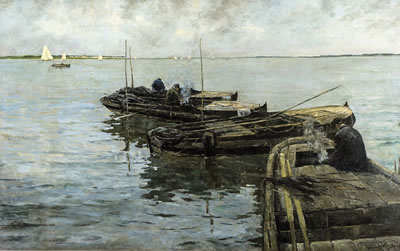 In the heart of Ghent, Albert Baertsoen painted his favorite hour: twilight. One of his paintings is of Maison de Bateliers, the boatmen's hiring hall. In the background are the Church of Saint-Michael and an old hotel left over from the First Empire. We look down the canal at a red boat, possibly similar to one where the artist had sat himself down to work. It may be that the affinity of Albert Baertsoen (1866-1922) for winter scenes had something to do with being born on January 9. What is certain is that neither his travels to Paris and London nor his artistic successes altered his love for Ghent, the city where he was born and where he died.
Belgium was the most industrialized of nations in 19th century Europe, and Ghent was a city known for its textile mills. Baertsoen's father was a successful miller, so the family's prosperity made art and music lessons for a talented child possible. Albert became an accomplished musician before he turned to painting.
As a child Albert walked the streets of Ghent with the artist Gustave Den Duyts. The River Lys, seen in Baertsoen's painting, Thaw In Ghent, was his daily companion. Den Duyts recommended him to Jean Delvin, who became Baertsoen's artistic mentor. Baertsoen had his first exhibition in Paris at twenty-two.
Baertsoen's work is difficult to categorize, yet it is similar in appearance to the American luminism. A meticulous artist who made many sketches before he began each painting, Baertsoen also excelled at etching. This meditative characteristic of his work connects it to luminism.
His contemporaries saw in his work presentiments of the hidden lives of buildings, akin to the art of Fernand Khnopff, who was born at nearby Dendermonde. Although Baertsoen created no obvious personal mythology in his art, he did share Khnopff's inclination to crop his images in unexpected ways. Whether this owes much to photography or is evidence of the walker person's perspective is a curiosity.
What keeps Baertsoen's lyricism from being too pretty is his pessimism. Ghent was the place by which he measured the rest of Flanders. Although he visited Bruges, Baertsoen did interpretation of the medieval city beyond the picturesque to images of its long tradition of devotion such as abandoned beguinages, convents turned into shops, etc. He understood - in the memorable phrase of Hippolyte Fierens-Gevaert - that "the tragedy of Bruges is that it has failed to detach itself from the rosary of old Flemish towns"
Industrialization brought new hardships along with new wealth, something the privileged Baertsoen observed in his work.
Although his artistic output was small, several works take their vantage point from a boat on the canals of Flanders. As one example, in 1898, Baertsoen embarked on a trip down the Ghent-Ternuezen Canal from his hometown to the Dutch port city of Ternuezen. The houseboat was both home and floating studio where Baertsoen painted tranquil scenes along the canal of the small Flemish towns that gradually were replaced by gritty views of working barges in the industrial north. The painting, Little Watercourse In Flanders At Twilight, is a well-known souvenir of the Baertsoen's houseboat days.
The Germans invaded neutral Belgium in the early months of World War I. Flanders became the ground on which some of the war's most horrific fighting took place. Baertsoen moved to London to be with his grown son. The artist was also reunited with his friend Emile Claus as the two worked in the studio of American painter John Singer Sargent. Widespread destruction notwithstanding, Baertsoen returned home to Ghent when the war ended.
Source:
thebluelantern.blogspot.com/2012/01/lyric-pessimism-of-albert-baertsoen.html