Page loaded successfully. Showing biography for Albert Bloch.
Albert Bloch BIOGRAPHY
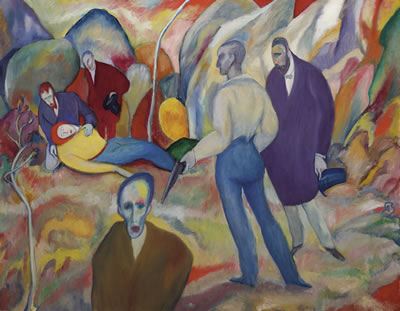
1882 St. Louis, Missouri - 1961 Lawrence, Kansas. Known for: Crowd genre, religious and animal painting, etching, teaching.
Born in St. Louis, Missouri on August 2, 1882, Albert Bloch was born to a Bohemian-Jewish immigrant father and a mother who was a German Jew. But Bloch was not raised in the Jewish faith and he later... Read full biography
Born in St. Louis, Missouri on August 2, 1882, Albert Bloch was born to a Bohemian-Jewish immigrant father and a mother who was a German Jew. But Bloch was not raised in the Jewish faith and he later adopted a form of Christianity. Bloch quit high school at sixteen to study at the St. Louis School... Read full biography
Born in St. Louis, Missouri on August 2, 1882, Albert Bloch was born to a Bohemian-Jewish immigrant father and a mother who was a German Jew. But Bloch was not raised in the Jewish faith and he later adopted a form of Christianity. Bloch quit high school at sixteen to study at the St. Louis School of Fine Arts from 1898 to 1900 with Dawson Dawson-Watkins. Block began his art career as a caricaturist for a satirical newspaper, The Saint Louis Mirror under editor and publisher, William Marion... Read full biography
Born in St. Louis, Missouri on August 2, 1882, Albert Bloch was born to a Bohemian-Jewish immigrant father and a mother who was a German Jew. But Bloch was not raised in the Jewish faith and he later adopted a form of Christianity. Bloch quit high school at sixteen to study at the St. Louis School of Fine Arts from 1898 to 1900 with Dawson Dawson-Watkins. Block began his art career as a caricaturist for a satirical newspaper, The Saint Louis Mirror under editor and publisher, William Marion Reedy. While Bloch's political cartoons were done in the standard manner, "his caricatures and cover illustrations were more advanced stylistically, displaying the bold simplifications and flowing lines of international Art Nouveau." Reedy became a... Read full biography
Born in St. Louis, Missouri on August 2, 1882, Albert Bloch was born to a Bohemian-Jewish immigrant father and a mother who was a German Jew. But Bloch was not raised in the Jewish faith and he later adopted a form of Christianity. Bloch quit high school at sixteen to study at the St. Louis School of Fine Arts from 1898 to 1900 with Dawson Dawson-Watkins. Block began his art career as a caricaturist for a satirical newspaper, The Saint Louis Mirror under editor and publisher, William Marion Reedy. While Bloch's political cartoons were done in the standard manner, "his caricatures and cover illustrations were more advanced stylistically, displaying the bold simplifications and flowing lines of international Art Nouveau." Reedy became a patron of Bloch's and funded a trip to Europe accompanied by his wife and son, to further his artistic training. Throughout the trip he visited Lon... Read full biography
Artist Biography
Biography page for Albert Bloch ((1882 - 1961)), known for Crowd genre, religious and animal painting, etching, teaching. Showing 3 biographical entries and 0 sample artworks.
Albert Bloch - Artist Info
About Albert Bloch
Biography from the Archives of askART
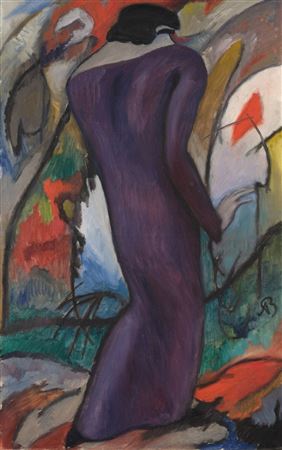 Born in St. Louis, Missouri, Aug. 2, 1882; and died Lawrence, Dec. 9, 1961, Albert Bloch was a painter, etcher, writer and teacher. He studied at the St. Louis School of Fine Arts and abroad for twelve years.
He was a pupil of Dawson Dawson-Watson and privately studied in Munich.
Bloch began his career as a newspaper illustrator. He drew cartoons, caricatures and cover illustrations for the literary weekly The Mirror in St. Louis from 1905 to 1908. In 1908, Bloch went to Munich to study art. While in Germany, Bloch met Wassily Kandinsky and Franz Marc, founders of the Blue Rider (Der Blaue Reiter), who invited him to participate in the group's first exhibition in 1911.
While in Europe, Bloch often exhibited his art alongside painters such as Picasso and Klee, but because he refused to exhibit in commercial galleries once he returned to the United States, he is not nearly so well know as some of his contemporaries.
He returned to the U.S. and taught at the Academy of Fine Arts, Chicago from 1922-23. He became director of the Department of Drawing & Painting at the University of Kansas in 1923 from where he retired in 1947. He is the author of several articles.Biography from the Archives of askART
 Born in St. Louis, Missouri on August 2, 1882, Albert Bloch was born to a Bohemian-Jewish immigrant father and a mother who was a German Jew. But Bloch was not raised in the Jewish faith and he later adopted a form of Christianity.
Bloch quit high school at sixteen to study at the St. Louis School of Fine Arts from 1898 to 1900 with Dawson Dawson-Watkins. Block began his art career as a caricaturist for a satirical newspaper, The Saint Louis Mirror under editor and publisher, William Marion Reedy. While Bloch's political cartoons were done in the standard manner, "his caricatures and cover illustrations were more advanced stylistically, displaying the bold simplifications and flowing lines of international Art Nouveau." Reedy became a patron of Bloch's and funded a trip to Europe accompanied by his wife and son, to further his artistic training. Throughout the trip he visited London and Paris and eventually decided on Munich in the artists' quarter of Schwabing.
Bloch decided to teach himself, rather than be trained formally, by studying the Old Masters in the Alte Pinakothek and modern work by French painters such as Gaugin and Matisse. By 1911 he became increasingly interested in Wassily Kandinsky and Franz Marc's work and by the fall of that year they had met, seen Bloch's work, and were impressed. They invited him to join their new group, the Blue Rider. In December 1911, the Blue Rider had their first exhibition and Bloch showed six pieces, more than any other artist.
While he exhibited with them he remained true to his own flat abstract style. Two subjects are depicted throughout his work, the first Biblical narratives and the second is pantomime figures such as the Harlequin or the Pierrot of the commedia dell'arte. His use of Christian images can be linked to his reading of the Bible, his study of the Old Masters, and the Catholic atmosphere of Munich.
According to Cateforis, "During his American years Bloch undertook a highly personal creative journey, carried on without regard for the changing fashions of the art world and with no expectation of public acknowledgement." Bloch is quoted in saying, "On the whole, I am an impossible creature, quite willing to remain an obscure, rough-hewn square peg, if only I may keep my inward freedom."
Following his return to the United States, in 1915, the Art Institute of Chicago held an exhibit of his work. In 1921 he was given a large retrospective exhibit at the Daniel Gallery in New York and was reviewed by several art magazines. Bloch could have capitalized on being the "American Blue Rider" but rather he was determined to become independent from the art market and decided to exhibit only by invitation. From 1922-23 he taught at the Chicago Academy of Fine Arts. Then in 1923, he took a teaching position at the University of Kansas, Lawrence, and remained there until 1947 when he retired. After his retirement he continued to paint until 1958, two years before his death.
Source: Butterfield's
Cateforis, D. (1997). "Albert Bloch, The American Blue Rider," American Art Review, Vol. IX No. 1Biography from Hollis Taggart Galleries
Albert Bloch (1881-1961): The only American artist associated with Der Blaue Reiter (Blue Rider), a group of early 20th-century European modernists, Albert Bloch is known for expressionist figurative paintings infused with spiritual feeling.
Born in St. Louis, Missouri, of Czechoslovakian and German-Jewish ancestry, Albert Bloch spent his formative years in the Midwest. He first studied art at the St. Louis School of Fine Arts (now part of Washington University). Like many of his contemporaries, Bloch earned a living from commercial art, and between 1905 and 1908 he worked as a caricaturist and illustrator for William Marion Reedy's literary and political weekly The Mirror. Noticing Bloch's artistic talent, Reedy provided him with a monthly stipend to study abroad. At the beginning of 1909, Bloch sailed for Europe.
Between 1909 and 1921, Bloch lived and worked mainly in Germany, making brief visits to other countries on the Continent and to America. His decision to settle in Munich, then a thriving art center, rested largely on his language skills—he had learned German from his parents. Although Reedy pressed Bloch to attend classes at the Royal Bavarian Academy in Munich, Bloch never enrolled, preferring instead to take lessons from painters working in the academic style outside the academy.
Initially Bloch displayed little interest in the revolutionary aesthetics that had been advanced in European art around the turn of the century, but a 1910 trip to Paris opened his eyes to the works of Vincent van Gogh, Pablo Picasso, and Odilon Redon. The following year, he saw a catalogue of the second exhibition of the Neue Künstlervereinigung München (the New Arts' Union of Munich), which included reproductions of works by, among others, Pablo Picasso, Georges Braque, Georges Rouault, and Wassily Kandinsky. Bloch felt an immediate kinship with these artists. He soon met Kandinsky and Franz Marc, both of whom invited him to participate in the first exhibition of Der Blaue Reiter (The Blue Rider), a group of modernist artists who broke away from Neue Künstlervereinigung. With his contribution of six canvases, Bloch was the only American represented in the show, which was held in December 1911 at Munich's Thannhauser Gallery. The Blaue Reiter artists had no formal manifesto, but they shared a desire to express emotional and spiritual truth through painting and, in particular, through symbolic use of color. The group, active from 1911 to 1914, represents one current in the broader expressionist impulse that spread through Germany and beyond in the first half of the twentieth century.
Bloch established a successful career in Germany and remained there, exhibiting his work through World War I. In 1912, he showed at the second Blaue Reiter exhibition, and he was included in the 1912 Sonderbund Exhibition in Cologne, the most famous exhibition of modernism in Europe at that time. The only painting by Bloch accepted for this show was The Duel, a 1912 painting that recalls Edvard Munch's haunting and mysterious figurative works. That same year, Bloch showed at Herwarth Walden's Der Sturm Gallery in Berlin, participat ing in a small exhibition that featured paintings rejected from the Sonderbund exhibit. Walden, one of the foremost proponents of modernism in Europe, fashioned this 1912 exhibition as a protest against the Sonderbund show that, he believed, had not adequately represented members of the Blaue Reiter group.
Bloch's acclaim also reached the American art world. At Kandinsky's recommendation, Arthur Jerome Eddy, the Chicago collector and tireless promoter of modernism, began buying Bloch's paintings and eventually added more than twenty-five of them to his collection. In 1915, Eddy's collection of paintings by Bloch comprised a one-man show at the Art Institute of Chicago; the exhibition traveled to the St. Louis Art Museum.
In 1921, disheartened at what Germany had become after the war, Bloch returned to the United States, where he lived until his death in 1961. Finding himself in dire financial straits, Bloch decided to become a teacher. His first position began in 1922 at the Chicago Academy of Fine Arts, but lasted only one year. From 1923 until his retirement in 1947, Bloch was Professor and Head of the Department of Drawing and Painting at the University of Kansas, Lawrence.
Bloch led a full life of painting, writing, and teaching and found contentment far from the art centers of Europe and America. He frequently chose biblical subject matter or sweeping emotional themes of anguish or exaltation. Wishing to remain "invisible" and unwilling to trade on his European connections, Bloch and his work faded from public view. Over time, Bloch's reticence about discussing his former affiliation with the Blaue Reiter artists obscured his early contributions to an important passage in the history of art.
Throughout his career, Bloch destroyed any paintings that, from his point of view, were unsuccessful. Regrettably, many more early works in German collections were destroyed in the bombings of World War II, while others were banished to Switzerland by the Nazis as "degenerate art." Extant examples of his work from this early period are rare and valuable historical documents.