Page loaded successfully. Showing biography for Albert Engstfeld.
Albert Engstfeld BIOGRAPHY
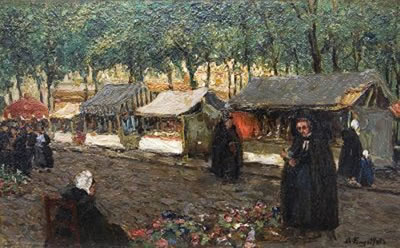
1876 Dusseldorf, Germany - 1956 Langenfeld, Germany. Known for: Naturalistic portraits, genre scenes, and depictions of bourgeois domestic life in early 20th-century Germany.
Albert Engstfeld studied at the Königlich Preußische Kunstakademie Düsseldorf from 1892 to 1896, where his instructors included Peter Janssen and Arthur Kampf. During this period, Engstfeld joined... Read full biography
Albert Engstfeld studied at the Königlich Preußische Kunstakademie Düsseldorf from 1892 to 1896, where his instructors included Peter Janssen and Arthur Kampf. During this period, Engstfeld joined the academic association Laetitia, which fostered connections among emerging artists in the Düsseldorf... Read full biography
Albert Engstfeld studied at the Königlich Preußische Kunstakademie Düsseldorf from 1892 to 1896, where his instructors included Peter Janssen and Arthur Kampf. During this period, Engstfeld joined the academic association Laetitia, which fostered connections among emerging artists in the Düsseldorf School. Beginning in 1903/04, Albert Engstfeld participated in numerous exhibitions in Düsseldorf, Berlin, Dresden, Cologne, and Vienna, establishing a steady presence in the German art scene. He... Read full biography
Albert Engstfeld studied at the Königlich Preußische Kunstakademie Düsseldorf from 1892 to 1896, where his instructors included Peter Janssen and Arthur Kampf. During this period, Engstfeld joined the academic association Laetitia, which fostered connections among emerging artists in the Düsseldorf School. Beginning in 1903/04, Albert Engstfeld participated in numerous exhibitions in Düsseldorf, Berlin, Dresden, Cologne, and Vienna, establishing a steady presence in the German art scene. He frequently traveled to the Netherlands, especially Sluis, and lived in Bruges from 1908 to 1914, where he became affiliated with the Cercle artistique de Bruges. Engstfeld’s work included church interiors, still lifes, and cityscapes, often influenced... Read full biography
Albert Engstfeld studied at the Königlich Preußische Kunstakademie Düsseldorf from 1892 to 1896, where his instructors included Peter Janssen and Arthur Kampf. During this period, Engstfeld joined the academic association Laetitia, which fostered connections among emerging artists in the Düsseldorf School. Beginning in 1903/04, Albert Engstfeld participated in numerous exhibitions in Düsseldorf, Berlin, Dresden, Cologne, and Vienna, establishing a steady presence in the German art scene. He frequently traveled to the Netherlands, especially Sluis, and lived in Bruges from 1908 to 1914, where he became affiliated with the Cercle artistique de Bruges. Engstfeld’s work included church interiors, still lifes, and cityscapes, often influenced by 17th-century Dutch painting but rendered with a realist and late-impressionist sensibility. His compositions are mark.... Read full biography
Artist Biography
Biography page for Albert Engstfeld ((1876 - 1956)), known for Naturalistic portraits, genre scenes, and depictions of bourgeois domestic life in early 20th-century Germany. Showing 1 biographical entries and 0 sample artworks.
Albert Engstfeld - Artist Info
About Albert Engstfeld
Biography from Kunstauktionshaus Schloss Ahlden
Albert Engstfeld studied at the Königlich Preußische Kunstakademie Düsseldorf from 1892 to 1896, where his instructors included Peter Janssen and Arthur Kampf. During this period, Engstfeld joined the academic association Laetitia, which fostered connections among emerging artists in the Düsseldorf School.
Beginning in 1903/04, Albert Engstfeld participated in numerous exhibitions in Düsseldorf, Berlin, Dresden, Cologne, and Vienna, establishing a steady presence in the German art scene. He frequently traveled to the Netherlands, especially Sluis, and lived in Bruges from 1908 to 1914, where he became affiliated with the Cercle artistique de Bruges.
Engstfeld’s work included church interiors, still lifes, and cityscapes, often influenced by 17th-century Dutch painting but rendered with a realist and late-impressionist sensibility. His compositions are marked by tonal restraint and architectural clarity, with a particular sensitivity to light and surface.
In later years, Albert Engstfeld faced financial hardship and declining output, though he received support from patrons such as Alfred Friedrich Flender, president of the Kunstverein für die Rheinlande und Westfalen. A posthumous retrospective was held in 1956 in Hilden as part of the 2. Niederbergische Kunstausstellung.