Page loaded successfully. Showing biography for Albert Gleizes.
Albert Gleizes BIOGRAPHY
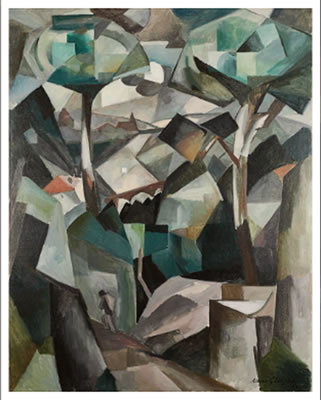
1881 Paris, France - 1953. Known for: Cubist painting, murals.
This French painter and writer born Albert Leon Gleizes was raised in Paris and was the son of a fabric designer who ran a large industrial design workshop. After finishing secondary school, he... Read full biography
This French painter and writer born Albert Leon Gleizes was raised in Paris and was the son of a fabric designer who ran a large industrial design workshop. After finishing secondary school, he worked with his father and then while serving in the army from 1902 to 1905 he began to paint seriously.... Read full biography
This French painter and writer born Albert Leon Gleizes was raised in Paris and was the son of a fabric designer who ran a large industrial design workshop. After finishing secondary school, he worked with his father and then while serving in the army from 1902 to 1905 he began to paint seriously. Initially influenced by the Impressionists, at twenty-one his work La Seine a Asnieres was exhibited at the Societe Nationale des Beaux-Arts in 1902. With several friends in 1906 he founded the Abbaye... Read full biography
This French painter and writer born Albert Leon Gleizes was raised in Paris and was the son of a fabric designer who ran a large industrial design workshop. After finishing secondary school, he worked with his father and then while serving in the army from 1902 to 1905 he began to paint seriously. Initially influenced by the Impressionists, at twenty-one his work La Seine a Asnieres was exhibited at the Societe Nationale des Beaux-Arts in 1902. With several friends in 1906 he founded the Abbaye de Creteil outside Paris. This commune of artists and writers scorned bourgeois society and sought to create nonallegorical, epic art based on modern themes. The commune closed in 1908 due to financial restraints and in 1909 he came under the... Read full biography
This French painter and writer born Albert Leon Gleizes was raised in Paris and was the son of a fabric designer who ran a large industrial design workshop. After finishing secondary school, he worked with his father and then while serving in the army from 1902 to 1905 he began to paint seriously. Initially influenced by the Impressionists, at twenty-one his work La Seine a Asnieres was exhibited at the Societe Nationale des Beaux-Arts in 1902. With several friends in 1906 he founded the Abbaye de Creteil outside Paris. This commune of artists and writers scorned bourgeois society and sought to create nonallegorical, epic art based on modern themes. The commune closed in 1908 due to financial restraints and in 1909 he came under the influence of Fernand Leger, Robert Delauney, Jean Metzinger and later to Henri Faucconnier who led Gleizes to his c... Read full biography
Artist Biography
Biography page for Albert Gleizes ((1881 - 1953)), known for Cubist painting, murals. Showing 2 biographical entries and 0 sample artworks.
Albert Gleizes - Artist Info
About Albert Gleizes
Name variants
Albert Gleizis
Biography from the Archives of askART
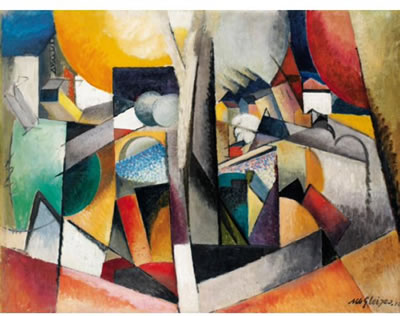 This French painter and writer born Albert Leon Gleizes was raised in Paris and was the son of a fabric designer who ran a large industrial design workshop. After finishing secondary school, he worked with his father and then while serving in the army from 1902 to 1905 he began to paint seriously. Initially influenced by the Impressionists, at twenty-one his work La Seine a Asnieres was exhibited at the Societe Nationale des Beaux-Arts in 1902. With several friends in 1906 he founded the Abbaye de Creteil outside Paris. This commune of artists and writers scorned bourgeois society and sought to create nonallegorical, epic art based on modern themes. The commune closed in 1908 due to financial restraints and in 1909 he came under the influence of Fernand Leger, Robert Delauney, Jean Metzinger and later to Henri Faucconnier who led Gleizes to his cubist style. In 1910 he exhibited at the Salon des Independents, Paris and the Jack of Diamonds in Moscow.
In 1914 Gleizes re-entered the military service. His paintings had become abstract by 1915. Galeries Daimau, Barcelona held his first one man show in 1916. Then beginning 1918 while in America, Gleizes developed an interest in spiritual values and as a result the theme of religious thought entered many of his subsequent writings. He founded Moly-Sabata, another untopian community of artists and craftsmen in Sablons. Later in his career he was commissioned for murals for the Paris Worlds Fair of 1937. In 1947, a major Gleizes retrospective occurred in Lyons at the Chapelle du Lycee Ampere. From 1949 to 1950 Gleizes painted illustrations for Pascal's Pensees and in 1952 he painted a fresco, Eucharist, for the chapel Les Fontaines at Chantilly. Gleizes died in Avignon on June 23, 1953.
Sources include:
Guggenheimcollection.orgBiography from Greg Thompson Fine Art
Initially, Albert Gleizes was influenced by the impressionist movement. It was during this time that, at the age of 21, his work was exhibited at the Societe Nationale des Beaux-Arts in Paris.
In 1909, he began to be influenced by Fernand Leger, Robert Delauney, and Jean Metzinger. It was this influence that eventually lead Gleizes to his well-known cubist style. By 1915, his style had become abstract.
His work is housed in many notable museum collections including: the Museum of Modern Art, New York; the Guggenheim Museum, New York; the Guggenheim, Venice; and the Tate Gallery, London.