Page loaded successfully. Showing biography for Albert Pennoyer.
Albert Pennoyer BIOGRAPHY
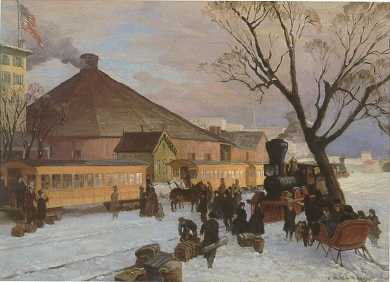
1888 Oakland, California - 1957 Madrid, Spain. Known for: Landscape, portrait and mural painting, illustration.
Albert Sheldon Pennoyer (1888-1957). In a book that he wrote about railroads, Pennoyer (1954) recalls his experiences in World War I as an American Army camouflage artist in the 40th Engineers... Read full biography
Albert Sheldon Pennoyer (1888-1957). In a book that he wrote about railroads, Pennoyer (1954) recalls his experiences in World War I as an American Army camouflage artist in the 40th Engineers Camouflage Corps that was formed in 1917. He describes in particular a fundraising event at the New... Read full biography
Albert Sheldon Pennoyer (1888-1957). In a book that he wrote about railroads, Pennoyer (1954) recalls his experiences in World War I as an American Army camouflage artist in the 40th Engineers Camouflage Corps that was formed in 1917. He describes in particular a fundraising event at the New Willard Hotel in Washington, D.C., on March 6, 1918. The event was a Camouflage Ball, described by newspapers at the time as "a riot of color, costume and cabaret." Among those attending that event were... Read full biography
Albert Sheldon Pennoyer (1888-1957). In a book that he wrote about railroads, Pennoyer (1954) recalls his experiences in World War I as an American Army camouflage artist in the 40th Engineers Camouflage Corps that was formed in 1917. He describes in particular a fundraising event at the New Willard Hotel in Washington, D.C., on March 6, 1918. The event was a Camouflage Ball, described by newspapers at the time as "a riot of color, costume and cabaret." Among those attending that event were President and Mrs. Woodrow Wilson, and other society leaders. According to an article in the Washington Times (1918), "The larger ballroom will be devoted to the ball itself, and to some of the stunts the camoufleurs are to pull [after they arrive in... Read full biography
Albert Sheldon Pennoyer (1888-1957). In a book that he wrote about railroads, Pennoyer (1954) recalls his experiences in World War I as an American Army camouflage artist in the 40th Engineers Camouflage Corps that was formed in 1917. He describes in particular a fundraising event at the New Willard Hotel in Washington, D.C., on March 6, 1918. The event was a Camouflage Ball, described by newspapers at the time as "a riot of color, costume and cabaret." Among those attending that event were President and Mrs. Woodrow Wilson, and other society leaders. According to an article in the Washington Times (1918), "The larger ballroom will be devoted to the ball itself, and to some of the stunts the camoufleurs are to pull [after they arrive in France]." The news article is accompanied by a photograph of five of the camouflage artists (tw... Read full biography
Artist Biography
Biography page for Albert Pennoyer ((1888 - 1957)), known for Landscape, portrait and mural painting, illustration. Showing 2 biographical entries and 0 sample artworks.
Albert Pennoyer - Artist Info
About Albert Pennoyer
Biography from the Archives of askART
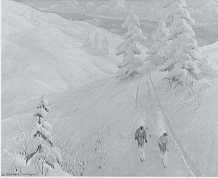 Albert Sheldon Pennoyer (1888-1957)
In a book that he wrote about railroads, Pennoyer (1954) recalls his experiences in World War I as an American Army camouflage artist in the 40th Engineers Camouflage Corps that was formed in 1917.
He describes in particular a fundraising event at the New Willard Hotel in Washington, D.C., on March 6, 1918. The event was a Camouflage Ball, described by newspapers at the time as "a riot of color, costume and cabaret." Among those attending that event were President and Mrs. Woodrow Wilson, and other society leaders. According to an article in the Washington Times (1918), "The larger ballroom will be devoted to the ball itself, and to some of the stunts the camoufleurs are to pull [after they arrive in France]." The news article is accompanied by a photograph of five of the camouflage artists (two whom are John Calhoun Rambeau and illustrator Saul Tepper), dressed in paint-smeared smocks with decorated hats shaped like painters' palettes. According to Pennoyer, he was asked by his commanding officer, Captain Aymar Embury II "to build a model of a railroad field gun which he wished to use as a centerpiece for his dinner table when he entertained a number of his officers and men before the opening of the ball… Sash pulleys for wheels, heavy cardboard mailing tubes for the gun barrel, plenty of quick-drying camouflage paint and moss representing the grass along the roadbed, tied in fairly closely with all we could see in a photograph we had of a railway gun in France."
Later that year, Pennoyer's unit sailed to France, where he and several others (with Sherry Edmundson Fry in the lead) were assigned by Embury to function as the liaison to the French Army's camouflage section. In his book, Pennoyer recalls the challenge of having to camouflage a massive, fourteen-inch naval railway gun, with a firing range of thirty miles.
Sources:
Albert Sheldon Pennoyer, Locomotives in Our Lives: Railroad Experiences of Three Brothers for More Than Sixty Years, 1890-1951. New York: Hastings House, 1954.
"A(lbert) Sheldon Pennoyer" entry in Roy R. Behrens, Camoupedia: A Compendium of Research on Art, Architecture and Camouflage. Dysart, Iowa: Bobolink Books, 2009.
Anon, "They're All Ready for the Camouflage Ball Tonight," in Washington Times. March 6, 1918, p. 10.
Information submitted by Roy R. Behrens.Biography from Crocker Art Museum Store
Painter, pastelist. Born in Oakland, CA on April 5, 1888, the son of a prosperous dry goods merchant who founded a store called Taft and Pennoyer. The Pennoyer family moved to nearby Berkeley while Sheldon was a child. After one year at UC, he sailed to Paris to study architecture at Ecole des Beaux Arts. He soon opted to become a painter instead and studied art at Academies Julian and Grand Chaumière under Ménard and Lucien Simon. At the outbreak of WWI, he left Europe and returned to his home in Berkeley.
About 1919 he moved permanently to NYC but spent much time at his mother's home in Litchfield, CT. Although he had a studio in NYC during his last 38 years, he made many painting trips to California and had a studio shack on his brother's property at Lake Tahoe. He was the author of This Was California (1938) and Locomotives in Our Lives (1954).
Pennoyer died in an auto accident in Madrid, Spain on Aug. 17, 1957.
Working in pastel, gouache and oil, he painted coastals, portraits, landscapes, railroad subjects, and scenes from his travels in Spain, Portugal, Central America, and the U.S.
Member: AFA; SFAA; American WC Society; Century Club; NAC; Allied Artists of America; AAPL; Oakland AA.
Exh: Schussler Galleries (SF), 1914; PPIE, 1915; Calif. Artists, Golden Gate Park Museum, 1915; Oakland Art Gallery, 1916; Doll & Richards Gallery (Boston), 1917 (1st solo); LACMA, 1918, 1919 (solos); Macbeth Gallery (NYC), 1926; San Francisco Art Association, 1919-30; Vickery, Atkins & Torrey (SF), 1930; CPLH, 1958 (memorial).
In: Oakland Museum; CPLH; Henry Ford Museum (Dearborn, Ml); MM; De Young Museum; Society of Calif. Pioneers; Santa Barbara Museum; Smithsonian Inst.; West Point Military Academy; CHS.
Bay of SF, vol. 1, p. 595; Ber; Fid; WWA; Fifteen to Fifty; AAA 1919-33; WWAA 1936-56; NY Times, 8-19-1957 (obit); Art of California, May 1990.