Page loaded successfully. Showing biography for Albert Rutherston.
Albert Rutherston BIOGRAPHY
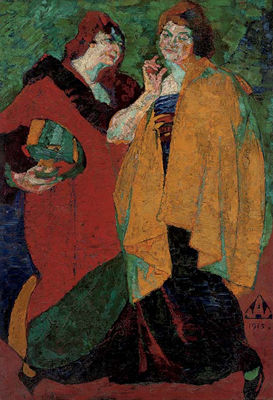
1881 Yorkshire, England - 1953 Switzerland. Known for: Figure painting, decorative watercolors, teaching, costume design.
Albert Rutherston was a member of the talented, artistic Rothenstein family, but he anglicised his surname in 1916 during the First World War as a declaration of patriotism for the country of his... Read full biography
Albert Rutherston was a member of the talented, artistic Rothenstein family, but he anglicised his surname in 1916 during the First World War as a declaration of patriotism for the country of his birth. Born on 5 December 1881, he was the youngest of the six children of Moritz and Bertha... Read full biography
Albert Rutherston was a member of the talented, artistic Rothenstein family, but he anglicised his surname in 1916 during the First World War as a declaration of patriotism for the country of his birth. Born on 5 December 1881, he was the youngest of the six children of Moritz and Bertha Rothenstein, German-Jewish immigrants who had settled in Bradford in Yorkshire in the 1860s. In 1898, aged only sixteen, Rutherston moved to London to study at the Slade School of Fine Art*, following in the... Read full biography
Albert Rutherston was a member of the talented, artistic Rothenstein family, but he anglicised his surname in 1916 during the First World War as a declaration of patriotism for the country of his birth. Born on 5 December 1881, he was the youngest of the six children of Moritz and Bertha Rothenstein, German-Jewish immigrants who had settled in Bradford in Yorkshire in the 1860s. In 1898, aged only sixteen, Rutherston moved to London to study at the Slade School of Fine Art*, following in the footsteps of his elder brother. Rutherston's time at the Slade brought him into contact with a number of the most talented artists of the day, including Ambrose McEvoy, Spencer Gore, Harold Gilman and Wyndham Lewis. His particular friends during this... Read full biography
Albert Rutherston was a member of the talented, artistic Rothenstein family, but he anglicised his surname in 1916 during the First World War as a declaration of patriotism for the country of his birth. Born on 5 December 1881, he was the youngest of the six children of Moritz and Bertha Rothenstein, German-Jewish immigrants who had settled in Bradford in Yorkshire in the 1860s. In 1898, aged only sixteen, Rutherston moved to London to study at the Slade School of Fine Art*, following in the footsteps of his elder brother. Rutherston's time at the Slade brought him into contact with a number of the most talented artists of the day, including Ambrose McEvoy, Spencer Gore, Harold Gilman and Wyndham Lewis. His particular friends during this period, however, were the slightly senior and extremely gifted artists Augustus John and William Orpen. The trio became known as the 'Three Musk... Read full biography
Artist Biography
Biography page for Albert Rutherston ((1881 - 1953)), known for Figure painting, decorative watercolors, teaching, costume design. Showing 2 biographical entries and 0 sample artworks.
Albert Rutherston - Artist Info
About Albert Rutherston
Biography from Tate Modern/Tate Gallery, London
 Albert Rutherston was a member of the talented, artistic Rothenstein family, but he anglicised his surname in 1916 during the First World War as a declaration of patriotism for the country of his birth. Born on 5 December 1881, he was the youngest of the six children of Moritz and Bertha Rothenstein, German-Jewish immigrants who had settled in Bradford in Yorkshire in the 1860s.
In 1898, aged only sixteen, Rutherston moved to London to study at the Slade School of Fine Art*, following in the footsteps of his elder brother. Rutherston's time at the Slade brought him into contact with a number of the most talented artists of the day, including Ambrose McEvoy, Spencer Gore, Harold Gilman and Wyndham Lewis. His particular friends during this period, however, were the slightly senior and extremely gifted artists Augustus John and William Orpen. The trio became known as the 'Three Musketeers' and worked, socialised and holidayed together, indulging in what might be called typically precocious and extrovert 'Sladey' behaviour.
In 1899 they organised a protest campaign against the installation of decorative mosaics in St Paul's Cathedral by the Royal Academician Sir William Richmond (1842-1921). In 1900 he had two paintings admitted to the New English Art Club* and in 1905 he was made a full member.
Max Beerbohm's caricature of the New English Art Club in 1907 portrays Rutherston as a tiny, dark bespectacled figure sitting cross-legged and cross-armed underneath a table. This view represents his position in the British art world of the early twentieth century. He was not only physically short in stature but artistically was dwarfed by his more talented and experimental contemporaries, yet he staunchly maintained his own individuality apart from the main developments in British art. His early paintings were mostly sober interiors with figure compositions, painted with a closely observed realism reminiscent of his brother, William Rothenstein, and characteristic of the style of painting favoured by the majority of the New English Art Club at this time.
Rutherston became acquainted with Walter Sickert during a painting holiday in France in 1900, and like so many others of his generation was drawn to the older artist, later writing that, 'I held him indeed in high hero worship; his work and personality fascinated me so much that I knew no other gateway to France than Dieppe'. In 1904 Rutherston engineered one of the pivotal relationships of the Camden Town Group* by introducing Sickert to his friend and Slade colleague, Spencer Gore, during another painting trip. Rutherston later claimed that it was their news and enthusiasm regarding developments in the London art world which encouraged Sickert to return to England in 1905 from his self-imposed exile in Dieppe.
In the following years Rutherston became one of Sickert's most frequent companions and he was one of the original members of the Fitzroy Street Group, enjoying the social benefits as much as the artistic. 19 Fitzroy Street was a convenient location for the group to be based since at this time Rutherston was already living at number 18 and Gore was opposite at number 21. In a letter to his friend Ethel Sands, Sickert wrote, 'I remember Albert used to hang out of his window in Fitzroy Street when I had the old studio here till he saw a lady ring at my bell. Five minutes afterwards he would ring the bell with the intention of dropping in.' Rutherston's participation in the open studio 'Saturday Afternoon At Homes' only lasted until 1908 and he never became a member of the Camden Town Group. He seems to have outgrown his youthful respect and admiration for Sickert. In 1910 Rutherston wrote to his brother: 'Of Sickert I've seen nothing - he's become somehow a very tragic figure - we dined one night a long while ago & he was very delightful but he seemed a man used & worn out.'
Albert Rutherston was a sociable and extrovert personality who enjoyed meeting people and associating with other painters. He frequently travelled abroad in the company of other artists including Max Beerbohm, Spencer Gore and Walter Russell. He was also open to artistic experimentation under the guidance of his friends. It is therefore surprising perhaps that Rutherston's association with the Fitzroy Street Group was so short lived.
In 1906, while holidaying in Normandy, Rutherston was introduced to watercolour by the artist Edna Clarke Hall (Edna Waugh before her marriage in 1898). In 1910, while in Grasse on the French Riviera with the artist Gerald Chowne, he tried his hand at watercolour painting on silk, a technique most famously used by his friend, Charles Conder.
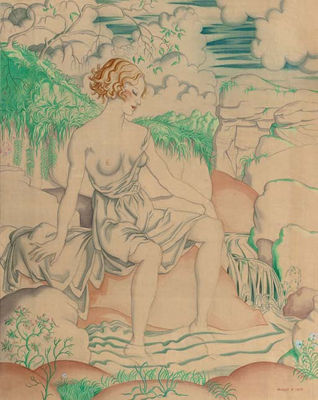
From 1910 Rutherston's work underwent a significant stylistic change reflected by the range of works on display at his first solo exhibition at the Carfax Gallery in October of that year. The majority of these were small-scale decorative watercolours, often painted on silk, featuring stylised young figures and imaginary landscapes in a highly personal linear style with thin colour washes. These works were often book illustrations, designs for stage settings and costumes, or fan-shaped panels for inclusion in pieces of furniture.
In 1911 he designed costumes for Granville-Barker's innovative production of Shakespeare's The Winter's Tale performed at the Savoy Theatre in 1912. One of his last theatrical commissions before the onset of the war was to design the scenery and costumes for a new production of Le Réveil de Flore, a short ballet starring Anna Pavlova, performed in London and the United States in 1914.
The outbreak of the First World War forced a temporary halt to Rutherston's artistic activity. A poor medical record meant that he was initially assigned a desk job working for the Engineers' War Service Register at the Board of Trade in Westminster, but from October 1916 he served with the Northamptonshire Regiment in Egypt and Palestine. After he returned from service abroad he married an actress, Marjory Holman, in October 1919, with whom he had two sons.
During the 1920s and 1930s Rutherston resumed his artistic career but was principally involved in teaching and publishing ventures. His first teaching post was at Camberwell School of Art and during the summer of 1920 he initiated a project to revitalise the Oxford School of Drawing, Painting and Design. This was eventually taken over by the Ruskin School, Oxford, where Rutherston was employed as a visiting lecturer.
In 1929 he became Ruskin Master of Drawing, following the death of Sydney Carline.
His own work flourished when he was recruited as an illustrator by the Curwen Press along with Claud Lovat Fraser and Paul Nash. His designs were used in a number of books including Poor Young People (1925), a collection of poems by Edith, Osbert and Sacheverell Sitwell, Sitwelliana (1928), an anthology of their collected writings, and The Haggadah (1930). Rutherston also edited a series of monographs on Contemporary British Artists (1923-7) and co-wrote a publication with John Drinkwater as a tribute to their friend, Claud Lovat Fraser.
In 1938 Rutherston returned to oil painting after being introduced by Barnett Freedman (1901-1958) to a young art student, Patricia Koring. She became his model for over a decade and the portraits and nude studies which Rutherston produced of her reconfirm his considerable talent for oil painting. Rutherston continued to paint until shortly before his death, while on holiday in Switzerland, 14 July 1953, aged seventy-one.
Written by Nicola Moorby, November 2003
* For references for these terms and others, see AskART Glossary http://www.askart.com/AskART/lists/Art_Definition.aspxBiography from Christie's London, King Street
Albert Rutherston was born in 1881, he was the youngest of six children of the artistic and philanthropic Rothenstein family. His parents Moritz and Bertha Rothenstein settled in Manningham Lane, Bradford from North Germany in the 1860s. During the 20th century, the Rothenstein family were highly influential in the world of Modern British Art.
Albert’s siblings, Charles Rutherston and Emily Hesslein, both assembled important art collections in their own right. Charles’ collection was donated in his lifetime to the City of Manchester, on the understanding that the works would be lent to local teaching institutions. Another brother was the renowned painter Sir William Rothenstein (see lots 155-161). It has been suggested that Albert’s aspiration to become an artist was perhaps influenced not only by William’s work but also his fashionable London lifestyle.
In 1898, at the age of sixteen, Albert followed William to London to study at the Slade School of Fine Art. It was here, where he became acquainted with Augustus John and William Orpen. Together, they were known as the ‘Three Musketeers’. Also, it was about this time that Albert became friends with Walter Sickert during a painting holiday in France. Subsequently, it was Albert introducing Walter Sickert to his friend and Slade colleague, Spencer Gore that led to one of the key relationships of the Camden Town Group.
Although Albert never became a member of the Camden Town Group, he developed his own distinct oeuvre. In the early 1900s he favoured depictions of working women, as represented in the following lots. This early stage in his career saw Albert produce a number of promising and inspiring works most notably the Tate’s Laundry Girls of 1906. This series of working women (see lot 136), has been described by Max Rutherston as not attempting to prettify the ruddy faces of the models (M. Rutherston, Albert Rutherston, London, 1988, p. 5.).
It has been suggested that Albert’s technique within these early years in somewhat similar to the work of his brother William. It was not until 1910, following a nervous breakdown, that Albert’s oeuvre shifted to primarily using watercolour as a medium. After a trip to Grasse in 1910, Albert produced a series of watercolours of the southern French landscape. The majority of these watercolours were on silk and were shown at a seminal one-man show at the Carfax Gallery, London in October of the same year.
The style of these works illustrate a world that could perhaps be considered to be more fantasy than reality. This can be seen in the decorative panel for a mirror (lot 140) and the dreamlike composition of ‘Romance’ (146). The less successful collaboration with Duncan Grant, Frederick Etchells, Bernard Adeney and Macdonald Gill to decorate the dining room of the Borough Polytechnic in South London, led to more promising commercial commissions in costume design.
Albert worked with Harley Granville-Barker on his productions of A Winter’s Tale, Androcles and the Lion and Jennifer’s costume in Shaw’s, The Doctor’s Dilemma (lot 144). Albert changed his surname from Rothenstein to Rutherston in 1916, echoing the patriotism of the House of Windsor. After marrying the actress Marjorie Holman in 1919, he turned to teaching to earn a living.
Initially, Albert taught at Camberwell School of Art and then as director of Oxford School of Painting and Drawing, and was elected Ruskin Master of Drawing until his retirement in 1949. In 1938, Albert was introduced to the student Patricia Koring, who became his muse for many of his later works. Over the course of his lifetime, Albert had nine one-man exhibitions, of which four were with the Leicester Galleries and he was elected A.R.W.S. in 1934 and R.W.S. in 1942. William's son and Albert's nephew, Sir John Rothenstein (1901–1992) went on to become an influencial director of the Tate Gallery, holding the position between 1938 and 1964.