Page loaded successfully. Showing biography for Alberto Morrocco.
Alberto Morrocco BIOGRAPHY
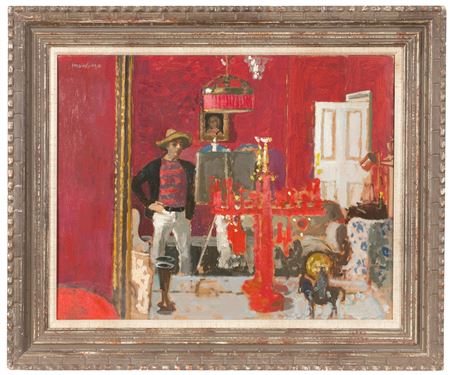
1917 - 1998. Known for: Painting.
ALBERTO MORROCCO (OBE, HonDUniv(Dund,Stirl), FRSA. Alberto Morrocco, painter, was born 14 December 1917 in Aberdeen, the son of immigrant Italians. Precocious talent as a draughtsman secured him... Read full biography
ALBERTO MORROCCO (OBE, HonDUniv(Dund,Stirl), FRSA. Alberto Morrocco, painter, was born 14 December 1917 in Aberdeen, the son of immigrant Italians. Precocious talent as a draughtsman secured him entrance to Gray's School of Art in Aberdeen at the age of 14 from where, following graduation, he... Read full biography
ALBERTO MORROCCO (OBE, HonDUniv(Dund,Stirl), FRSA. Alberto Morrocco, painter, was born 14 December 1917 in Aberdeen, the son of immigrant Italians. Precocious talent as a draughtsman secured him entrance to Gray's School of Art in Aberdeen at the age of 14 from where, following graduation, he briefly toured pre-war France and Italy. The avant-garde of the twenties and thirties, in particular Braque and Picasso, had an immense (though not always happy) influence on him for the rest of his life.... Read full biography
ALBERTO MORROCCO (OBE, HonDUniv(Dund,Stirl), FRSA. Alberto Morrocco, painter, was born 14 December 1917 in Aberdeen, the son of immigrant Italians. Precocious talent as a draughtsman secured him entrance to Gray's School of Art in Aberdeen at the age of 14 from where, following graduation, he briefly toured pre-war France and Italy. The avant-garde of the twenties and thirties, in particular Braque and Picasso, had an immense (though not always happy) influence on him for the rest of his life. The outbreak of war saw him committed to Edinburgh Castle, as penalty for an Italian background. It was no doubt uncomfortable, and to a degree humiliating, but he wrung many a good joke out of his incarceration (his account of periods spent... Read full biography
ALBERTO MORROCCO (OBE, HonDUniv(Dund,Stirl), FRSA. Alberto Morrocco, painter, was born 14 December 1917 in Aberdeen, the son of immigrant Italians. Precocious talent as a draughtsman secured him entrance to Gray's School of Art in Aberdeen at the age of 14 from where, following graduation, he briefly toured pre-war France and Italy. The avant-garde of the twenties and thirties, in particular Braque and Picasso, had an immense (though not always happy) influence on him for the rest of his life. The outbreak of war saw him committed to Edinburgh Castle, as penalty for an Italian background. It was no doubt uncomfortable, and to a degree humiliating, but he wrung many a good joke out of his incarceration (his account of periods spent manufacturing mock field wounds were worthy of Evelyn Waugh). He also struck up an acquaintance with Tiny Rowland, destined fifty years later to be buyin... Read full biography
Artist Biography
Biography page for Alberto Morrocco ((1917 - 1998)), known for Painting. Showing 1 biographical entries and 0 sample artworks.
Alberto Morrocco - Artist Info
About Alberto Morrocco
Biography from Cantor Fine Art
ALBERTO MORROCCO (OBE, HonDUniv(Dund,Stirl), FRSA
Alberto Morrocco, painter, was born 14 December 1917 in Aberdeen, the son of immigrant Italians. Precocious talent as a draughtsman secured him entrance to Gray's School of Art in Aberdeen at the age of 14 from where, following graduation, he briefly toured pre-war France and Italy. The avant-garde of the twenties and thirties, in particular Braque and Picasso, had an immense (though not always happy) influence on him for the rest of his life. The outbreak of war saw him committed to Edinburgh Castle, as penalty for an Italian background. It was no doubt uncomfortable, and to a degree humiliating, but he wrung many a good joke out of his incarceration (his account of periods spent manufacturing mock field wounds were worthy of Evelyn Waugh). He also struck up an acquaintance with Tiny Rowland, destined fifty years later to be buying the work of his fellow inmate in Bond Street galleries.
Following war service as a conscientious objector in the medical corps, and a brief spell teaching evening classes, Morrocco spent the rest of his professional life in Dundee, as Head of the School of painting at Duncan of Jordanstone College of Art. Under his benevolent direction the School adopted a characteristic approach to teaching, with the emphasis on observation and drawing. The sheer intellectual difficulty of the tasks facing the painter left him genuinely puzzled that anyone would consider there was an easier alternative; or indeed, any alternative. To listen to Morrocco dismissing fashions in art with his typical blend of erudition, wit and passion was education enough: his students were very lucky.
He had a spectacular retirement, producing some of his most vigorous work in the period from 1982 to his death. Morrocco was prodigiously productive. Even late in his life and seriously ill he, would commit himself to exhibitions of thirty or forty new works in a year. His best still-life is marked by a unique quality of stillness, even sadness, and many a painting bought initially for its warmth and color has been kept for that strange quality of other-worldliness that few of his contemporaries could understand, let alone capture. Inevitably he would, at times, seem to parody himself, but critics who saw the symbolic repertoire of his still-life (clowns, doves, melons, flowers and knives) as derivative missed the point that no one was more aware of this than the artist himself: much of his best work is a lament for a lost tradition and in this, though reluctant to admit it, Morrocco was certainly more Scottish than Italian.
He was without doubt the greatest portraitist of his generation. He worked quickly and could usually put the subject at ease with a combination of spirited conversation, unfailing courtesy, good humor and (where necessary) gin! Nonetheless, the results could surprise, not because of a failed likeness, which was very rare, but by a degree of psychological insight which could be disconcertingly sharp. The University of Dundee awarded Morrocco an honorary doctorate in 1980. He painted all its Principals and, in 1977, the Queen Mother as Chancellor. Spanning thirty years, these portraits are a perfect illustration of how skillfully he adapted the conventions of the formal portrait to the expectations of a contemporary audience.
At the time of his death, he alone in Scotland could pull off this trick, seemingly without effort. In 1993 a retrospective of Morrocco's work was mounted in Dundee City Art Gallery. A vast number of drawings, collage and paintings filled several rooms. The scale of this astonishing exhibition, and the huge critical interest in it, surprised even the organizers; albeit belatedly, Morrocco enjoyed celebrity in his home town which at least approached his reputation further a field. It was at about this time the illness which eventually killed him was first diagnosed. For a man who would frequently joke that he was a life-long hypochondriac, he faced a rather grim outlook with impressive composure, simply redoubling his determination to work (and play) harder than ever.
Several exhibitions at the Thackeray Gallery in the succeeding years were sold out, often before the doors opened. Morrocco the artist and Morrocco the man were at peace. On the one hand, he was hugely sociable and could light up someone's party by just being there. His own parties were frequently riotous affairs, never to be forgotten by those present. He was, in a word, extremely good company. On the other hand, a degree of personal melancholy was also never far away. In particular, he was nostalgic for an approach to art education which had, he thought, been lost for ever, and angry about the political ideology which had brought this about. He was far too intelligent to think this condition was at all novel, and certainly aware the problem was insoluble, but the tension provided the motivation for much of his work.
He was awarded the San Vita Romano Prize and both the Guthrie and Carnegie Award of the Royal Scottish Academy, where he was elected Fellow in 1962. In addition to the degree from Dundee University, he was awarded an Honorary Doctorate from Stirling University in 1987. He served on the Scottish Arts Council and the Royal Fine Art Commission for Scotland and was appointed OBE in 1993. He was elected an Honorary Fellow of the Society in 1995. Alberto Morrocco died in Dundee on 10 March 1998. He is survived by his wife, the artist Vera Mercer, and by two sons and one daughter.
I am indebted to Leon Morrocco for information and advice in preparing this Notice.
ALAN KENNEDY