Page loaded successfully. Showing biography for Alexander Brook.
Alexander Brook BIOGRAPHY
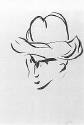
1898 Brooklyn, New York - 1980 Sag Harbor, Long Island, New York. Known for: Still life, landscape, figure and portrait painting.
Born in Brooklyn, New York, Alexander Brook was a realist painter, whose works consisted mostly of still-life subjects, landscapes, and figures, often of women. He was very successful in his day,... Read full biography
Born in Brooklyn, New York, Alexander Brook was a realist painter, whose works consisted mostly of still-life subjects, landscapes, and figures, often of women. He was very successful in his day, winning second prize to Picasso's first prize at the Carnegie Institute International Exhibition of... Read full biography
Born in Brooklyn, New York, Alexander Brook was a realist painter, whose works consisted mostly of still-life subjects, landscapes, and figures, often of women. He was very successful in his day, winning second prize to Picasso's first prize at the Carnegie Institute International Exhibition of Modern Painting in 1930. In New York, he studied at the Art Students League between the years of 1914-1918. It was at the Art Students League that Brook developed significant relationships with Niles... Read full biography
Born in Brooklyn, New York, Alexander Brook was a realist painter, whose works consisted mostly of still-life subjects, landscapes, and figures, often of women. He was very successful in his day, winning second prize to Picasso's first prize at the Carnegie Institute International Exhibition of Modern Painting in 1930. In New York, he studied at the Art Students League between the years of 1914-1918. It was at the Art Students League that Brook developed significant relationships with Niles Spencer, Reginald Marsh, Kenneth Hays Miller, Yasuo Kuniyoshi and, perhaps most significantly, Peggy Bacon, whom he married in 1920. Along with Kenneth Hayes Miller, Brook studied with John C. Johansen, Frank V. DuMond, George Bridgeman and Dimitri... Read full biography
Born in Brooklyn, New York, Alexander Brook was a realist painter, whose works consisted mostly of still-life subjects, landscapes, and figures, often of women. He was very successful in his day, winning second prize to Picasso's first prize at the Carnegie Institute International Exhibition of Modern Painting in 1930. In New York, he studied at the Art Students League between the years of 1914-1918. It was at the Art Students League that Brook developed significant relationships with Niles Spencer, Reginald Marsh, Kenneth Hays Miller, Yasuo Kuniyoshi and, perhaps most significantly, Peggy Bacon, whom he married in 1920. Along with Kenneth Hayes Miller, Brook studied with John C. Johansen, Frank V. DuMond, George Bridgeman and Dimitri Romanofski. Within this group lay the foundations of American Realism. Brook was a member of the Society of Independen... Read full biography
Artist Biography
Biography page for Alexander Brook ((1898 - 1980)), known for Still life, landscape, figure and portrait painting. Showing 4 biographical entries and 0 sample artworks.
Alexander Brook - Artist Info
About Alexander Brook
Biography from the Archives of askART
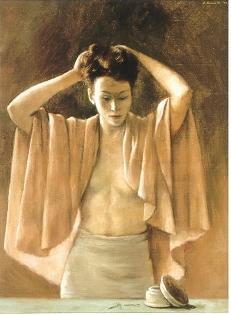 Born in Brooklyn, New York, Alexander Brook was a realist painter, whose works consisted mostly of still-life subjects, landscapes, and figures, often of women. He was very successful in his day, winning second prize to Picasso's first prize at the Carnegie Institute International Exhibition of Modern Painting in 1930.
In New York, he studied at the Art Students League between the years of 1914-1918. It was at the Art Students League that Brook developed significant relationships with Niles Spencer, Reginald Marsh, Kenneth Hays Miller, Yasuo Kuniyoshi and, perhaps most significantly, Peggy Bacon, whom he married in 1920. Along with Kenneth Hayes Miller, Brook studied with John C. Johansen, Frank V. DuMond, George Bridgeman and Dimitri Romanofski. Within this group lay the foundations of American Realism. Brook was a member of the Society of Independent Artists, who rebelled against the strictures of the National Academy of Design.
In 1938 Brook traveled to Savannah, Georgia, there he did some of his most provocative work. After two years in the South, Bacon and Brook were divorced. Brook later married the painter Gina Knee.
During the years 1928 through 1939, Alexander Brook had works in over one-hundred exhibitions, fifteen of which were one man shows. By 1942, Brook had resumed teaching at the Art Students League. Demand for the artist's work kept him in significant collections, galleries, and museums, including the Downtown Gallery (New York), the National Academy of Design, the Rehn Gallery, the Larcada and the Knoedler galleries.
Some feel Brook may have retreated from the art world with the rise of Abstract Expressionism, although a sketchbook that he kept from 1949 to 1951 reveals an active engagement in painting and served multi purposes--a repository for his ideas, an address book, notebook, and travel diary. Of special interest are his notes on watercolor technique. It also includes tips for using new painting tools such as knives, sponges, and razor blades. Most of the sketches in it are of Florida landscapes, which augmented written accounts of his travels. Many later drawings were inspired by the trip Brook made with his third wife to Europe, where he studied the works of Picasso, Goya and Zurbaran.
Brook received awards at the Art Institute of Chicago (1929), the Pennsylvania Academy (1931), the Guggenheim Fellowship (1931), and the San Francisco Art Association (1938).Biography from the Archives of askART
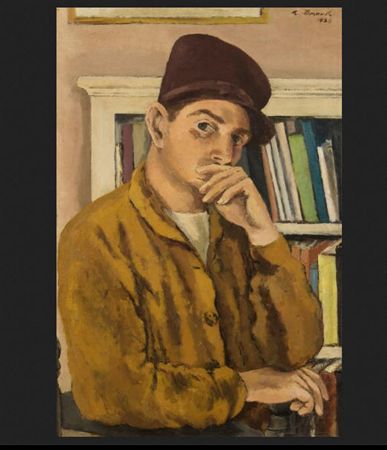 The following was written and submitted by Jean Ershler Schatz, artist and researcher from Laguna Woods, California.
Alexander Brook was born in Brooklyn, New York on July 14, 1898. At the age of sixteen Brook was painting ancient statuary at Pratt Institute, after a bout of polio that fortunately left no traces. At the age of seventeen he enrolled at the Art Students League where in time he became a member of the faculty. Life became a series of successes. He won second prize to Picasso's first prize at the Carnegie Institute International Exhibitioon of Modern Painting in 1930.
Brook had close and congenial friends in painters Niles Spencer, Louis Bouche and Peggy Bacon, whom he married in 1920. Until the tidal wave of abstract art inundated the galleries, no show of contemporary American art seemed complete without an Alexander Brook. But abstract art took over and Brook was out of the public eye. He was a lusty personality who used a lyric brush to paint the tender, not the dramatic, side of life. His colors were subdued and subtly graded.
Brook was a brawny, barrel-shaped man who was up at dawn each morning for a full day of puttering and painting. He and Peggy Bacon were divorced in 1940. He was remarried later to the painter Gina Knee and his wife accompanied him wherever he painted. He died in 1980.
Sources include:
Time Magazine, August 2, 1962
Life Magazine (date unknown)Biography from Charleston Renaissance Gallery
Born in Brooklyn, New York, Alexander Brook studied at the Art Students League with Kenneth Hayes Miller from 1914 to 1918. He was a member of the Woodstock artists' colony with his first wife, Peggy Bacon, from 1920 to 1940. Brook traveled to Savannah in 1938, and spent time between there and New York until 1947.
A prominent artist in Savannah during these years, he was hailed by Life magazine in 1940 as "one of America's best painters."
Brook maintained a studio in an old warehouse on the riverfront, where he worked as an American scene realist, creating evocative landscapes, portraits, and genre paintings rendered in soft brushwork and muted, somber colors, like this vernacular view of rural Georgia.
Brook married the artist, Gina Knee, in 1945 and the couple settled in Sag Harbor, New York.Biography from The Johnson Collection
ALEXANDER BROOK (1838–1888)
Alexander Brook was a major proponent of American Realism during the 1920s, '30s, and '40s. Like other artists practicing under this broad aesthetic umbrella—which encompassed American Scene, American Regionalism, and Social Realism—Brook presented his subjects without flattery, depicting human figures and faces with an unvarnished honesty that made no attempt to enhance appearances. Brook’s unsentimental approach is evident in the execution of Georgia Cracker, and is underscored by its derogatory title. While the phrase “cracker” can be traced back to Shakespearean texts, its use was adopted in the American South, beginning in the mid-nineteenth century, as a slur describing poor rural white persons; over time, it became particularly associated with whites in Florida and Georgia.
Born to Russian émigré parents in Brooklyn, New York, Alexander developed an interest in art while recuperating from polio at the age of twelve. At seventeen, he enrolled at the Art Students League and studied there for the next four years. Brook would later serve on the school's faculty, where his students included Joseph Delaney, among others. Early in his career, Brook wrote critical articles for art journals to supplement his income. He eventually became the assistant director of the Whitney Studio Club, later known as the Whitney Museum of Art, where he worked to promote contemporary, representational art. Brook built a solid reputation during the twenties and thirties with his genre scenes and portraits painted in a realistic manner, winning several important honors. In 1930, he was awarded second place to Picasso's first prize at the Carnegie Institute’s International Exhibition of Modern Painting.
Brook traveled south to Savannah, Georgia, in 1938 and found the city to be a great source of inspiration. He returned in 1940, settling into a studio housed in a former cotton warehouse on the riverfront. Over the next decade, he maintained a sporadic residency and executed some of his best work there. One painting of an African American shantytown on the outskirts of Savannah earned first place at the Carnegie Exposition in 1939. Throughout his career, Brook tended to favor melancholy subjects, saying “I find . . . that I am more concerned, both sympathetically and aesthetically with the simpler and sadder things about me.” That interest is reflected in the dark palette of grays and browns Brook often used to convey emotion in his paintings.
Following his military service in World War II, Brook returned to Savannah with his wife and fellow artist, Gina Knee. Though his palette and subjects were often somber, Brook was known to be a friendly and outgoing individual. He and Knee divided their time between New York and Savannah, and their home became a gathering place for members of the city’s creative community, which included Hattie Saussy. The couple also actively supported local cultural causes, such as the theater and library. During his time there, Brook painted portraits and genre scenes, fulfilled commissions, exhibited his work, wrote articles for art publications, and produced two covers for the Saturday Evening Post. In 1948, Brook left Savannah and purchased a home on Long Island, New York, where he retired from painting in 1966 and died in 1980.
The Johnson Collection, Spartanburg, South Carolina
thejohnsoncollection.org