Page loaded successfully. Showing biography for Alexander Koester.
Alexander Koester BIOGRAPHY
1864 Bergneustadt, Germany - 1932 Munich, Germany. Known for: Portrait, genre, duck and still life painting.
Koester along with Heinrich von Zügel was one of the most important Impressionist animal painters from the Munich School. Originally pressured by his family to become a pharmacist, Koester abandoned... Read full biography
Koester along with Heinrich von Zügel was one of the most important Impressionist animal painters from the Munich School. Originally pressured by his family to become a pharmacist, Koester abandoned his studies and entered the Staatliche Kunsthalle in Karlsruhe. There he trained under some of the... Read full biography
Koester along with Heinrich von Zügel was one of the most important Impressionist animal painters from the Munich School. Originally pressured by his family to become a pharmacist, Koester abandoned his studies and entered the Staatliche Kunsthalle in Karlsruhe. There he trained under some of the more established painters in Germany such as Carl Hoff, Claus Meyer, Heinrich Von Zügel, and Leopold von Kalckreuth. Koester's main residence was in Munich, but he spent most of his time painting in... Read full biography
Koester along with Heinrich von Zügel was one of the most important Impressionist animal painters from the Munich School. Originally pressured by his family to become a pharmacist, Koester abandoned his studies and entered the Staatliche Kunsthalle in Karlsruhe. There he trained under some of the more established painters in Germany such as Carl Hoff, Claus Meyer, Heinrich Von Zügel, and Leopold von Kalckreuth. Koester's main residence was in Munich, but he spent most of his time painting in Klausen in the Tirol. His early pictures were genre scenes of Tyrolian folk life and landscapes, later specializing in painting ducks, which would establish his reputation. Koester attracted attention the moment he first exhibited a painting of ducks... Read full biography
Koester along with Heinrich von Zügel was one of the most important Impressionist animal painters from the Munich School. Originally pressured by his family to become a pharmacist, Koester abandoned his studies and entered the Staatliche Kunsthalle in Karlsruhe. There he trained under some of the more established painters in Germany such as Carl Hoff, Claus Meyer, Heinrich Von Zügel, and Leopold von Kalckreuth. Koester's main residence was in Munich, but he spent most of his time painting in Klausen in the Tirol. His early pictures were genre scenes of Tyrolian folk life and landscapes, later specializing in painting ducks, which would establish his reputation. Koester attracted attention the moment he first exhibited a painting of ducks in Berlin in 1899. For him, it was not just ducks as living creatures that were of interest, but rather the effe... Read full biography
Artist Biography
Biography page for Alexander Koester ((1864 - 1932)), known for Portrait, genre, duck and still life painting. Showing 3 biographical entries and 0 sample artworks.
Alexander Koester - Artist Info
About Alexander Koester
Name variants
Alexander Koster
Biography from Odon Wagner Gallery
Koester along with Heinrich von Zügel was one of the most important Impressionist animal painters from the Munich School. Originally pressured by his family to become a pharmacist, Koester abandoned his studies and entered the Staatliche Kunsthalle in Karlsruhe. There he trained under some of the more established painters in Germany such as Carl Hoff, Claus Meyer, Heinrich Von Zügel, and Leopold von Kalckreuth.
Koester's main residence was in Munich, but he spent most of his time painting in Klausen in the Tirol. His early pictures were genre scenes of Tyrolian folk life and landscapes, later specializing in painting ducks, which would establish his reputation.
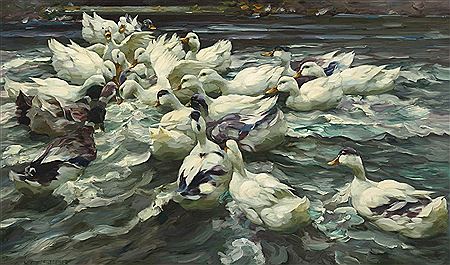
Koester attracted attention the moment he first exhibited a painting of ducks in Berlin in 1899. For him, it was not just ducks as living creatures that were of interest, but rather the effects of sunlight on the birds' feathers. Like the Impressionists, Koester was intrigued by the fleeting play of light on water and leaves. The rhythmical qualities of his duck paintings, in which the birds move in gracious formation, give these pictures an almost musical quality, which is perhaps no coincidence, given that Koester was an accomplished violinist and collector of violins.
Koester's view has an incidental quality to it, albeit carefully contrived, capturing a fleeting moment as the sun catches the birds' feathers and reflects off the moving water. Like an Impressionist picture, it represents a glimpse as a passerby might see it.
However, despite these stylistic parallels with the works of the French Impressionists and avant garde artists at home, who clearly exerted an influence on him, Koester's pictures are intended to reveal a deep felt love and respect for the birds he spent so much time capturing on canvas; whereas his contemporaries in France, for example, might have reduced the birds to no more than dabs of paint, Koester, true to his academic-training, always gave them an endearing character and presence of their own.
Koester remained faithful to his subject matter throughout what were turbulent years in the development of German art. In the 1920s, when Expressionism was making headlines, and already the Blauer Reiter and Brücke movements had been relegated to the annals of art history, Koester continued to paint in his uniquely impressionistic and highly popular style. An anonymous reviewer wrote of his work: "The pleasure derived from these amusing web-footed birds can be explained by admiring the loose plumage, the orange beaks, the reflections in the water, the sunshine the bluish reflexes in the air a wealth of technical challenges" (quoted in Ruth Stein and Hans Koester, 1988, p. 47).Biography from Mehlis
Alexander Max Koester, German painter (1864 Bergneustadt to 1932 Munich), called Duck Koester. First 1882- 85 apprenticeship as a pharmacist in Wintzenheim, near Colmar, studied from 1885 at the Academy of Karlsruhe Karl Hoff, Count Leopold of Kalckreuth and Claus Meyer, then a freelancer in Karlsruhe.
He went on study trips to the Ötz and the Inn Valley to Lake Constance and to the Netherlands, from 1896 he painted in Klausen in South Tyrol freelance.Biography from Auctionata
Trained as a pharmacist, Alexander Koester (1864-1932) began studying art with Karl Hoff and Claus Meyer at the Karlsruhe Academy in 1885. During his studies he makes his living through the painting of portraits. Increasingly though, he dedicated himself to the study of genre painting and created numerous landscape sketches on extended trips which served as a template for the final painting. To be closer to nature, Koester increasingly works in Klausen and Munich. In 1899, he presents the first landscapes with ducks in Berlin. This motif should accompany him during his activity as an artist, which is why he is also known as ‘Duck-Koester’.