Page loaded successfully. Showing biography for Alexandre Calame.
Alexandre Calame BIOGRAPHY
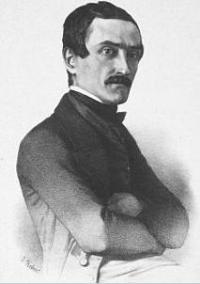
1810 Vevey, Switzerland - 1864 Menton, France. Known for: Mountain landscape paintings.
Among the most celebrated Swiss landscape painters of the 19th century, Alexander Calame made a particular speciality of Alpine mountain scenes. Despite losing his right eye as a child, he was... Read full biography
Among the most celebrated Swiss landscape painters of the 19th century, Alexander Calame made a particular speciality of Alpine mountain scenes. Despite losing his right eye as a child, he was determined to make a career as an artist, and studied with the landscapist François Diday between 1829 and... Read full biography
Among the most celebrated Swiss landscape painters of the 19th century, Alexander Calame made a particular speciality of Alpine mountain scenes. Despite losing his right eye as a child, he was determined to make a career as an artist, and studied with the landscapist François Diday between 1829 and 1832. From 1828 he began producing vues pittoresques suisses in gouache, intended for sale, which allowed him a measure of financial independence. He first came to the attention of French collectors... Read full biography
Among the most celebrated Swiss landscape painters of the 19th century, Alexander Calame made a particular speciality of Alpine mountain scenes. Despite losing his right eye as a child, he was determined to make a career as an artist, and studied with the landscapist François Diday between 1829 and 1832. From 1828 he began producing vues pittoresques suisses in gouache, intended for sale, which allowed him a measure of financial independence. He first came to the attention of French collectors and connoisseurs at the Salon of 1839, where he exhibited a view entitled A Thunderstorm in Handeck, set in the Bernese Oberland. The painting was a great success in Paris, and was purchased by public subscription by the city of Geneva for the Musée... Read full biography
Among the most celebrated Swiss landscape painters of the 19th century, Alexander Calame made a particular speciality of Alpine mountain scenes. Despite losing his right eye as a child, he was determined to make a career as an artist, and studied with the landscapist François Diday between 1829 and 1832. From 1828 he began producing vues pittoresques suisses in gouache, intended for sale, which allowed him a measure of financial independence. He first came to the attention of French collectors and connoisseurs at the Salon of 1839, where he exhibited a view entitled A Thunderstorm in Handeck, set in the Bernese Oberland. The painting was a great success in Paris, and was purchased by public subscription by the city of Geneva for the Musée Rath. At the Salon two years later A View of the Valley of Ansasca was purchased by Louis-Philippe, and Calame’s success w... Read full biography
Artist Biography
Biography page for Alexandre Calame ((1810 - 1864)), known for Mountain landscape paintings. Showing 3 biographical entries and 0 sample artworks.
Alexandre Calame - Artist Info
About Alexandre Calame
Name variants
Alexander Kalam
Biography from the Archives of askART
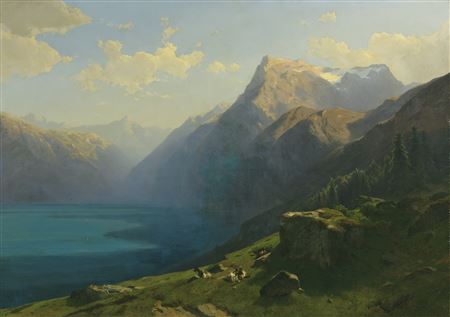 Among the most celebrated Swiss landscape painters of the 19th century, Alexander Calame made a particular speciality of Alpine mountain scenes. Despite losing his right eye as a child, he was determined to make a career as an artist, and studied with the landscapist François Diday between 1829 and 1832. From 1828 he began producing vues pittoresques suisses in gouache, intended for sale, which allowed him a measure of financial independence.
He first came to the attention of French collectors and connoisseurs at the Salon of 1839, where he exhibited a view entitled A Thunderstorm in Handeck, set in the Bernese Oberland. The painting was a great success in Paris, and was purchased by public subscription by the city of Geneva for the Musée Rath. At the Salon two years later A View of the Valley of Ansasca was purchased by Louis-Philippe, and Calame’s success was assured.
Although he worked mainly in Switzerland, Calame also travelled through Germany, the Netherlands, France and Italy. His paintings, worked up from oil sketches and drawings made sur le motif, were in great demand, and were purchased by collectors throughout Europe, and particularly in Russia.
Calame was also an important teacher, and a large number of Swiss artists of the succeeding generation received their training in his studio in Geneva, while in 1854 he published a number of landscape drawings in lithographic form as Leçons de dessin appliqué au paysage. In 1865, the year after the artist’s death, the contents of Calame’s studio, numbering around five hundred works, were dispersed at auction in Paris.
Source:
Website of Stephen Ongpin Fine Art, LondonBiography from the Archives of askART
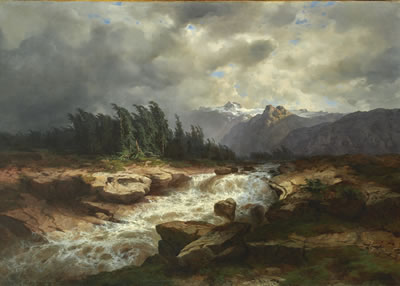 From Switzerland, he became noted for his paintings of Alpine mountains, although he also painted scenes from his travels in Germany and especially Italy. He studied with landscape painter, Francois Diday, and by 1835, had sold a landscape to the museum in Bern. He also exhibited with the Paris Salons beginning in the late 1830s.
Calame lived most of his life in Geneva, but in 1863, he moved to the French Riviera for health reasons.
His composition method was often placing a large clump of trees at one side of the painting and "a sharply receding diagonal leads away from it to a view, often of mountains in the far distance." (83) It was a motif that had much appeal to American collectors of that era, and one of his landscapes, a part of the bequest of James Suydam, was exhibited in New York by the Artists' Fund Society at the National Academy of Design in 1865.
Art historian Valentina Anker theorized that Calame's landscape influenced 19th Century American landscapists such as Thomas Moran, but there is no proof of that assertion.
Source:
David Dearinger, Editor, Painting and Sculpture in the Collection of the National Academy of Design, Volume I, 1826-1925.Biography from Sotheby's Paris
Alexandre Calame was a Swiss painter known for his depictions of Alpine landscapes. He attended courses by François Diday and established his own studio in 1834. Calame undertook several study trips to various European countries, including the Bernese Oberland, Paris, the Netherlands, Germany, Italy, and London. He gained recognition for his work and exhibited at the Paris Salon starting in 1841. In 1855, one of his paintings was purchased by Napoléon III at the Exposition Universelle in Paris.