Page loaded successfully. Showing biography for Alexandre Roubtzoff.
Alexandre Roubtzoff BIOGRAPHY
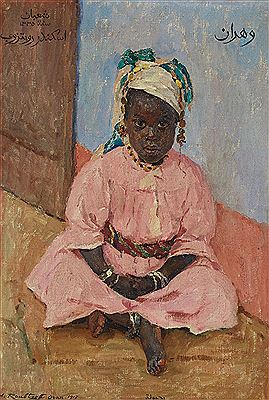
1884 St. Petersburg, Russia - 1949 Tunis, Tunisia. Known for: Oriental scene painting.
Alexandre Roubtzoff, born 24 January 1884 in St. Petersburg and died on 26 November 1949 in Tunis, is a Russian Orientalist painter, naturalized French in 1924, having essentially worked in Tunisia.... Read full biography
Alexandre Roubtzoff, born 24 January 1884 in St. Petersburg and died on 26 November 1949 in Tunis, is a Russian Orientalist painter, naturalized French in 1924, having essentially worked in Tunisia. A student of Ivan Zionglinski and Dmitri Kardovski, Alexandre Roubtzoff is the recipient of six... Read full biography
Alexandre Roubtzoff, born 24 January 1884 in St. Petersburg and died on 26 November 1949 in Tunis, is a Russian Orientalist painter, naturalized French in 1924, having essentially worked in Tunisia. A student of Ivan Zionglinski and Dmitri Kardovski, Alexandre Roubtzoff is the recipient of six major prizes at the Academy of Fine Arts in St. Petersburg. From the Imperial Court of the Romanov, he obtained the Grand Prize of the Academy of St. Petersburg with an interior painting today in the... Read full biography
Alexandre Roubtzoff, born 24 January 1884 in St. Petersburg and died on 26 November 1949 in Tunis, is a Russian Orientalist painter, naturalized French in 1924, having essentially worked in Tunisia. A student of Ivan Zionglinski and Dmitri Kardovski, Alexandre Roubtzoff is the recipient of six major prizes at the Academy of Fine Arts in St. Petersburg. From the Imperial Court of the Romanov, he obtained the Grand Prize of the Academy of St. Petersburg with an interior painting today in the Hermitage Museum. Roubtzoff discovered the Orient in 1913, by Andalusia and Tangier, a young fellow of the National School of Fine Arts in St. Petersburg. In 1914, he arrived in Tunis a few days after Macke and Klee, and he settled there permanently... Read full biography
Alexandre Roubtzoff, born 24 January 1884 in St. Petersburg and died on 26 November 1949 in Tunis, is a Russian Orientalist painter, naturalized French in 1924, having essentially worked in Tunisia. A student of Ivan Zionglinski and Dmitri Kardovski, Alexandre Roubtzoff is the recipient of six major prizes at the Academy of Fine Arts in St. Petersburg. From the Imperial Court of the Romanov, he obtained the Grand Prize of the Academy of St. Petersburg with an interior painting today in the Hermitage Museum. Roubtzoff discovered the Orient in 1913, by Andalusia and Tangier, a young fellow of the National School of Fine Arts in St. Petersburg. In 1914, he arrived in Tunis a few days after Macke and Klee, and he settled there permanently obtaining French nationality in 1924. He did not return to Russia. Frequenting the Institute of Carthage, he realized worldly portrai... Read full biography
Artist Biography
Biography page for Alexandre Roubtzoff ((1884 - 1949)), known for Oriental scene painting. Showing 1 biographical entries and 0 sample artworks.
Alexandre Roubtzoff - Artist Info
About Alexandre Roubtzoff
Name variants
Aleksandr Rubcov
Biography from the Archives of askART
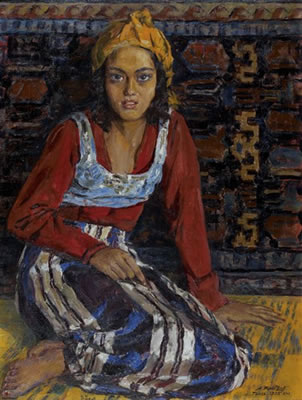 Alexandre Roubtzoff, born 24 January 1884 in St. Petersburg and died on 26 November 1949 in Tunis, is a Russian Orientalist painter, naturalized French in 1924, having essentially worked in Tunisia.
A student of Ivan Zionglinski and Dmitri Kardovski, Alexandre Roubtzoff is the recipient of six major prizes at the Academy of Fine Arts in St. Petersburg. From the Imperial Court of the Romanov, he obtained the Grand Prize of the Academy of St. Petersburg with an interior painting today in the Hermitage Museum.
Roubtzoff discovered the Orient in 1913, by Andalusia and Tangier, a young fellow of the National School of Fine Arts in St. Petersburg. In 1914, he arrived in Tunis a few days after Macke and Klee, and he settled there permanently obtaining French nationality in 1924. He did not return to Russia.
Frequenting the Institute of Carthage, he realized worldly portraits which opened him the doors of the high colonial society. In 1920, with an exhibition showing more than one hundred and twenty canvases, the Tunisian Salon by Alexandre Fichet consecrated him as "the painter of light." His post-impressionist landscapes and gardens, with an elegant and wisely colored touch, are rather close to those of his friend the Baron d'Erlanger * and seduce as much as the great portraits of Bedouins first chosen from the models of the photographer Rudolf Lehnert .*.
Documentary concerns about costumes, ornaments and tattoos - his drawings illustrate the publications of Ernest Gobert * - first inspired classic scenes of everyday life (Preparation of couscous, Femmes au Khôl, 1915). Roubtzoff later became more attached to the looks and sensitivity of his models (Alia, 1937): "It is they, the mountainous Bedouins, rough and ignorant, who are beautiful, noble and refined, while we the representatives of The most advanced civilization, we are ugly, petty, inelegant. "
An "ethnographic" orientalist, Roubtzoff refused the eccentricities of the genre but realized a series of nudes in which the painter applied the recipes of the Western tradition to European and oriental models. In his diary written at the end of his life and the few articles he wrote for the magazine Tunisia ("A quarter of a century in Tunisia", 1938), he defended an East resolutely faithful to his traditions: "An Arab painter Must not forget that it is Arabic and not Von Dongen. Neither did Cezanne either. The Arab must keep his Muslim mentality intact, even if he frequents Montparnasse. " In 1924, during a trip to Turkey, this defender of modernism painted especially the city of Brousse "more seductive than Constantinople too ravaged by fires ... and tourism".
During his lifetime, purchases by the State and several exhibitions in Tunis and in the metropolis gave him an important place in the artistic life of the colony, evidently against the current of Boucherle and the School of Tunis. In 2010, an official tribute was paid to him in Tunisia with the exhibition "Roubtzoff and the Medina" - 48 drawings minutely made in 1944, as well as some paintings, representative of an art whose memory was maintained since the death of the " artist. Roubtzoff, whose canvases still adorn many official residences, is today the Tunisian painter best rated on the art market. His most important works are signed and dated in French and Arabic.
Dead in Tunis on 26 November 1949, he was buried in the Borgel cemetery in Tunis.
Source:
"Alexandre Roubtzoff," Wikipedia-Google Translate, Jan. 2017