Page loaded successfully. Showing biography for Alexis Preller.
Alexis Preller BIOGRAPHY
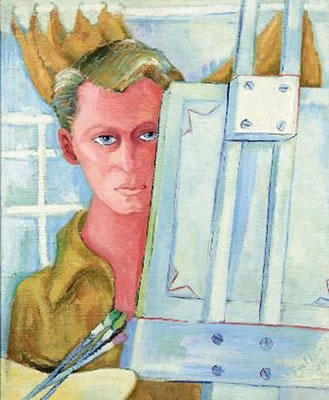
1911 Pretoria, South Africa - 1975. Known for: Abstract painting of elongated female figures, geometric images, sketches.
Alexis Preller 1911(Pretoria, South Africa); died 1975. Art Education:. 1934 Alexis Preller studied art at Westminster School of Art, London, under Mark Getler. 1937 Studied art at Grande Chaumiere,... Read full biography
Alexis Preller 1911(Pretoria, South Africa); died 1975. Art Education:. 1934 Alexis Preller studied art at Westminster School of Art, London, under Mark Getler. 1937 Studied art at Grande Chaumiere, Paris, under Othon Frieze. 1946 Study-trip to London and Paris. 1953 Study-tour of Italy and Egypt.... Read full biography
Alexis Preller 1911(Pretoria, South Africa); died 1975. Art Education:. 1934 Alexis Preller studied art at Westminster School of Art, London, under Mark Getler. 1937 Studied art at Grande Chaumiere, Paris, under Othon Frieze. 1946 Study-trip to London and Paris. 1953 Study-tour of Italy and Egypt. Biography:. 1911 to 1934 Alexis Preller was educated at Pretoria Boys High School, active in theatrical ventures; after completing school Alexis Preller worked for some time as a clerk before... Read full biography
Alexis Preller 1911(Pretoria, South Africa); died 1975. Art Education:. 1934 Alexis Preller studied art at Westminster School of Art, London, under Mark Getler. 1937 Studied art at Grande Chaumiere, Paris, under Othon Frieze. 1946 Study-trip to London and Paris. 1953 Study-tour of Italy and Egypt. Biography:. 1911 to 1934 Alexis Preller was educated at Pretoria Boys High School, active in theatrical ventures; after completing school Alexis Preller worked for some time as a clerk before persuading his family to allow him to seek a future in the arts. 1934 Encouraged by his lifelong friend, Norman Eaton, Alexis Preller set off for London; there JH Pierneef advised him to enroll at Westminster School; with guidance from Gertler he made the... Read full biography
Alexis Preller 1911(Pretoria, South Africa); died 1975. Art Education:. 1934 Alexis Preller studied art at Westminster School of Art, London, under Mark Getler. 1937 Studied art at Grande Chaumiere, Paris, under Othon Frieze. 1946 Study-trip to London and Paris. 1953 Study-tour of Italy and Egypt. Biography:. 1911 to 1934 Alexis Preller was educated at Pretoria Boys High School, active in theatrical ventures; after completing school Alexis Preller worked for some time as a clerk before persuading his family to allow him to seek a future in the arts. 1934 Encouraged by his lifelong friend, Norman Eaton, Alexis Preller set off for London; there JH Pierneef advised him to enroll at Westminster School; with guidance from Gertler he made the choice of painting as his career. 1935 Returned to Pretoria via East Coast of Africa, held his first... Read full biography
Artist Biography
Biography page for Alexis Preller ((1911 - 1975)), known for Abstract painting of elongated female figures, geometric images, sketches. Showing 3 biographical entries and 0 sample artworks.
Alexis Preller - Artist Info
About Alexis Preller
Biography from the Archives of askART
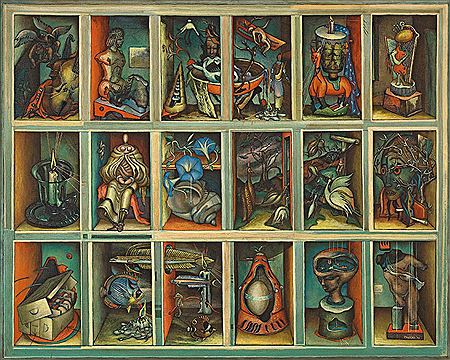 Alexis Preller 1911(Pretoria, South Africa); died 1975
Art Education:
1934 Alexis Preller studied art at Westminster School of Art, London, under Mark Getler.
1937 Studied art at Grande Chaumiere, Paris, under Othon Frieze.
1946 Study-trip to London and Paris.
1953 Study-tour of Italy and Egypt.
Biography:
1911 to 1934 Alexis Preller was educated at Pretoria Boys High School, active in theatrical ventures; after completing school Alexis Preller worked for some time as a clerk before persuading his family to allow him to seek a future in the arts.
1934 Encouraged by his lifelong friend, Norman Eaton, Alexis Preller set off for London; there JH Pierneef advised him to enroll at Westminster School; with guidance from Gertler he made the choice of painting as his career.
1935 Returned to Pretoria via East Coast of Africa, held his first art exhibition; early works were emotional with strong colour and distortion.
1937 On return from further studies in Paris Alexis Preller stayed for a while in Swaziland painting continuously; exhibited in Johannesburg; referred to in Press as 'South African Gauguin'.
1938 Alexis Preller joined the New Group, included on its first art exhibition.
1939 Set out on a safari into the Congo; impressed by tribal ritual and sculptures; stirred by witnessing erupting volcanoes; outbreak of war brought him back to Pretoria.
1940 to 1943 Alexis Preller joined the Field Ambulance Corps, POW in North Africa and Italy until 1943; returned to South Africa and exhibited in Johannesburg; recollections of war experiences influenced his paintings; development of 'urn-heads' and surrealistic imagery; beginning of Blue Period
1944 Builds 'Ygdrasil' , his studio designed by Norman Eaton.
1946 Again in Europe; study in Museums concentrating on Greek sculpture; phase of extensive self-exploration and imaginative translation of themes for Alexis Preller.
1948 Publication of book, Alexis Preller by Christi Truter, with autobiographical introduction.
1948 to 1949 Visits to Zanzibar and Seychelles Islands followed by many paintings; urgency of earlier expression followed by greater serenity; palette mellows toward Brown Period; development of previous themes relating to 'Ndebele Culture'; member of International Art Club, South Africa.
1953 Alexis Preller received Molteno Award; mural commissioned for Johannesburg offices of Receiver of Revenue; trip to Italy, where he studied frescoes in Florence and Arezzo; much impressed and influenced by Piero della Francesca; on return-trip visited Egypt, hieratic expression of that ancient culture had lasting impact on his work. He socialised with Helen Anne Petrie.
1954 Moved to a farm near Hartebeespoort Dam.
1955 Alexis Preller awarded Medal of Honour of South African Akademie.
1955 to 1958 Period of hieratic figure compositions; development of individual formal idioms and mythological symbolism.
1958 Last one-man exhibition Johannesburg; won national Univleis Competition.
1962 Several avenues explored: abstract symbolism, informalism and culmination of Quattrocento-style conceptions.
1965 Beginning of Gold Period; controversy regarding both new abstract and continued figurative expression, but great demand for all his paintings.
1968 Trip to Greece and Italy; began his autobiography.
1969 Alexis Preller experiments with 'intaglio' painting using moulded fibre-glass.
1971 Travels in Greece and Italy.
1972 Prestige Retrospective Exhibition, Pretoria Art Museum, prompted renewed exploration of several earlier themes.
1973 Began building 'Mudif' , a guest house in Middle Eastern Marsh-Arab tradition; filming of documentary production co-directed by Esme Berman and Edgar Bold interrupted by Preller's ill health - completed 1974.
1975 Last Exhibition, Johannesburg; died of heart attack.
Art Exhibitions:
1935 Alexis Preller's first one-man art exhibition, Pretoria.
1936 Empire Art Exhibition, Johannesburg.
1938 New Group Exhibition, Cape Town and subsequent exhibitions.
1948 Overseas exhibition of South African Art, Tate Gallery.
1952 Van Riebeeck Tercent Exhibition, Cape Town.
1954 Venice Biennale.
1956 Venice Biennale.
1966 Republic Fest Exhibition, Pretoria.
1972 Prestige Retrospective Exhibition, Pretoria Art Museum.
1973 Sao Paulo Biennale.
Public Art Collections:
South African National Art Gallery, Cape Town; Johannesburg Art Gallery; Pretoria Art Museum; Durban Art Gallery; William Humphreys Art Gallery, Kimberley; King George VI Art Gallery, Port Elizabeth; Ann Bryant Art Gallery, East London; Hester Rupert Museum; Africana Museum, Johannesburg; Rembrandt Art Foundation; University of Wits Art Gallery; UNISA; Sandton Municipal Collection.
Source:
The Strutt Family Trust, The Mayfair Collection (Suisse) SA, The Mayfair Collection (Pty) Ltd.Biography from Strauss & Co Johannesburg
In the December of 1935, having recently returned from a year at the Westminster School of Art in London, and shortly after closing his first ever exhibition at Glen’s Music Salon in Pretoria, a twenty-four-year-old Alexis Preller, wide-eyed, motivated and curious, came across a group of women labourers on the northern outskirts of town, each of them turned out in dazzling traditional dress. Hammered and weighty brass rings glinted on their necks and ankles, and coloured beads decorated their aprons and armbands.
These were Ndzundza-descended women of the Southern Ndebele people, and their village, to which a young Alexis followed them one day, with its stepped terraces, mud huts, enclosed kraals, and joyful, distinctive, painted walls, would become one of the artist’s greatest sources of inspiration. His first painting to include these Ndebele figures, or Mapogga, as they were also called, was Native Study (Mapogges) [sic]; it showed them with long and gently cylindrical limbs and conical breasts, and it was one of the 117 paintings, and the only one by Alexis, exhibited at the Empire Exhibition at Milner Park in Johannesburg from September 1936.
In that same year, a young photographer called Constance Stuart, another ambitious artist who had grown up in Pretoria, became drawn to the mystique of the Mapogga too. Having outgrown her Kodak Box Brownie, trained in London between 1933 and 1935 at the Regent Street Polytechnic School of Photography, and thereafter at the Bavarian State Institute for Photography in Munich, Stuart turned her new Rolleiflex on the tribal cultures of southern Africa, and rather memorably, in her straightforward and black and white style, on the people of the Ndebele (figs. 1 and 2).
She and Alexis plainly shared a passion, and they were firm friends by 1938 (Stuart purchased the only Mapogga picture on Preller’s fourth solo show, held at the New Group Hall in Queen Street in Pretoria, in October 1938). Consequently, comparing their contemporaneous approaches to their Mapogga subject matter is particularly handy: Stuart’s direct and documentary mode helps emphasize the visionary and daring way in which Preller interpreted the same theme. The Mapogga certainly became one of Preller’s most iconic, spell-binding and protean motifs, and dominated many of his seminal paintings.
Throughout 1950 and 1951, Preller fixated on the Mapogga women. Dignified, perceptive and imposing, they seemed to embody an archaic and distinctly African spirit. Whether singly, with child, or in small groups, Preller revisited this figure endlessly, usually seated and in conical form, with legs outstretched, hands clasped, and blankets, beads and copper necklaces on show. While this Mapogga matriarch emerged as the artist’s most dominant motif at the time, it undertook continuous symbolic and poetic transformations: The artist’s fluid imagination took the Mapogga matriarch figure further still. After completing the vast and complex All Africa mural for the Receiver of Revenue building in Johannesburg, Preller returned to the theme in 1957 with three more epic versions.Biography from Strauss & Co Cape Town
Pretoria-born artist Alexis Preller studied art in London at the Westminster School of Art and expanded his knowledge of art and art history by reading voraciously and travelling widely in Europe and Africa. He studied Egyptian, ancient Greek, Etruscan, early Renaissance and southern and central African art and culture, in particular, and created an art that was of his own place and time rather than a continuation of either traditional European practice or avant-garde Modernism. He visited Ndebele settlements near Pretoria in the late 1940s and early 1950s, and the ‘Mapogga’ women in their distinctive traditional costume and the colourful geometric wall paintings that decorated the homesteads appear in his work from this time. His work became progressively more abstract in later years, informed by his interest in space travel and discovery, and his focus shifted from the local and the African to encompass the universal.