Page loaded successfully. Showing biography for Alfred Courmes.
Alfred Courmes BIOGRAPHY
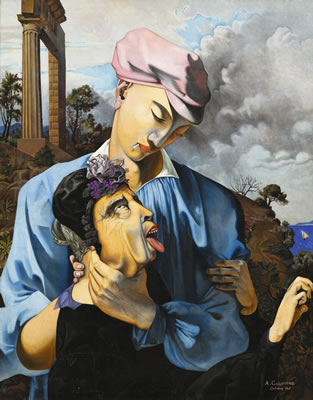
1896 Bormes-les-Mimosas, France - 1993. Known for: Whimsical genre and figure painting-fantasy.
Alfred Courmes was born in Bormes-les-Mimosas, France, in 1896. He was the son of a naval officer. Courmes was educated in Monaco. Following World War I, Courmes studies with Roger de La Fresnaye.... Read full biography
Alfred Courmes was born in Bormes-les-Mimosas, France, in 1896. He was the son of a naval officer. Courmes was educated in Monaco. Following World War I, Courmes studies with Roger de La Fresnaye. (It is believed that he was La Fresnaye's only student.) From 1920 to 1925, Courmes lived in Lavandou... Read full biography
Alfred Courmes was born in Bormes-les-Mimosas, France, in 1896. He was the son of a naval officer. Courmes was educated in Monaco. Following World War I, Courmes studies with Roger de La Fresnaye. (It is believed that he was La Fresnaye's only student.) From 1920 to 1925, Courmes lived in Lavandou in the Provence region of France. In 1922, he exhibited at the Société Lyonaise des Beaux-Arts. Three years later he traveled to Paris to exhibit at the Salon d'Automne, Salon des Tuileries, and the... Read full biography
Alfred Courmes was born in Bormes-les-Mimosas, France, in 1896. He was the son of a naval officer. Courmes was educated in Monaco. Following World War I, Courmes studies with Roger de La Fresnaye. (It is believed that he was La Fresnaye's only student.) From 1920 to 1925, Courmes lived in Lavandou in the Provence region of France. In 1922, he exhibited at the Société Lyonaise des Beaux-Arts. Three years later he traveled to Paris to exhibit at the Salon d'Automne, Salon des Tuileries, and the Salon des Indépendants. In 1926, he painted a now famous portrait of Peggy Guggenheim. In 1927, Courmes moved to Ostende, Belgium. There he befriended James Ensor, Felix Labisse, and the well-known Belgian artist Constant Permeke. These friendships... Read full biography
Alfred Courmes was born in Bormes-les-Mimosas, France, in 1896. He was the son of a naval officer. Courmes was educated in Monaco. Following World War I, Courmes studies with Roger de La Fresnaye. (It is believed that he was La Fresnaye's only student.) From 1920 to 1925, Courmes lived in Lavandou in the Provence region of France. In 1922, he exhibited at the Société Lyonaise des Beaux-Arts. Three years later he traveled to Paris to exhibit at the Salon d'Automne, Salon des Tuileries, and the Salon des Indépendants. In 1926, he painted a now famous portrait of Peggy Guggenheim. In 1927, Courmes moved to Ostende, Belgium. There he befriended James Ensor, Felix Labisse, and the well-known Belgian artist Constant Permeke. These friendships and regular visits to museums in Brussels and Amsterdam where he saw Classical... Read full biography
Artist Biography
Biography page for Alfred Courmes ((1896 - 1993)), known for Whimsical genre and figure painting-fantasy. Showing 1 biographical entries and 0 sample artworks.
Alfred Courmes - Artist Info
About Alfred Courmes
Biography from Papillon Gallery
Alfred Courmes was born in Bormes-les-Mimosas, France, in 1896. He was the son of a naval officer. Courmes was educated in Monaco.
Following World War I, Courmes studies with Roger de La Fresnaye. (It is believed that he was La Fresnaye's only student.) From 1920 to 1925, Courmes lived in Lavandou in the Provence region of France. In 1922, he exhibited at the Société Lyonaise des Beaux-Arts. Three years later he traveled to Paris to exhibit at the Salon d'Automne, Salon des Tuileries, and the Salon des Indépendants. In 1926, he painted a now famous portrait of Peggy Guggenheim.
In 1927, Courmes moved to Ostende, Belgium. There he befriended James Ensor, Felix Labisse, and the well-known Belgian artist Constant Permeke. These friendships and regular visits to museums in Brussels and Amsterdam where he saw Classical as well as Surrealist and Belgian Expressionist works that influenced the development of Courmes' style over the subsequent decades.
In 1927, Courmes exhibited his first one-man show at the Galerie Montparnasse. In 1930 he finally moved to Paris, and in 1935, he exhibited at the prestigious Galerie Bernheim. In 1936 he won the Prix Guillaume.
Courmes was commissioned to create the decorations for the pavilion of Manufacture de Sévres for the 1937 l'Exposition Internationale de Paris. That same year he exhibited at Galerie des Beaux-Arts, Paris.
In 1938, Courmes was commissioned to paint a large-scale mural for the dining room at the French Embassy in Ottawa, Canada. It measured thirty meters long and four meters high. The composition consisted of two hundred and twenty five people.
After the liberation of France, Courmes exhibited with the Surrealists at the Salon d'Automne; he also exhibited at the Salon des Indépendants. In 1946, he exhibited at l'Exposition Surréaliste de Mai with Clovis Trouille and René Magritte.
Courmes continued to exhibit regularly. He showed at the Salon de Mai in 1957, and the Biennale de San Paulo, Brazil in 1965. In 1971, he had an exhibition titled "Les Autres" in Bordeaux. In 1972, he participated in an exhibition at the Grand Palais, in Paris, and in 1977, he had a solo exhibition at Galerie Jean Briance in Paris. Between 1982 and 1989, Courmes had solo exhibitions at the Musée de Grenoble, Galerie Jean Briance, FIAC, Galerie Berggruen, Musée de Roubaix, and the Centre Beaugourg.
In 1973, Jean-Marc Campagne published an illustrated monograph on Courmes' life and work. Courmes continued to exhibit well into the 1980's.
He was awarded the Chevalier de la Légion d'Honneur in 1991. His creativity and imagination never diminished. In recent years the full extent of his contribution to the art of the 20th century is getting recognized. The Montreal Museum included Courmes' work in the 1991 exhibition "The 1920's, The Age of Metropolis." In 1997, his work was included in an exhibition at the Centre Georges Pompidou, in Paris, called "Made in France 1947-1997, 50 Ans de Creation." In 2003, the Musée Arts et Histoire in his hometown of Bormes-les-Mimosas exhibited "Alfred Courmes et Son Pays." This exhibition traveled to Belgium, and was complemented by a large color catalogue. Early in 2004 a heavily illustrated book was published on Courmes' life's work.