Page loaded successfully. Showing biography for Alfred Hutty.
Alfred Hutty BIOGRAPHY

1877 Grand Haven, Michigan - 1954 Woodstock, New York. Known for: Street-landscape and genre painting, etching.
A leading figure in the Charleston Renaissance group of artists, active between 1915 and 1940, who stirred national artist through their widely distributed illustrations of life in the historic city,... Read full biography
A leading figure in the Charleston Renaissance group of artists, active between 1915 and 1940, who stirred national artist through their widely distributed illustrations of life in the historic city, Alfred Hutty worked for Tiffany Studios and lived in Woodstock, New York. He came to Charleston... Read full biography
A leading figure in the Charleston Renaissance group of artists, active between 1915 and 1940, who stirred national artist through their widely distributed illustrations of life in the historic city, Alfred Hutty worked for Tiffany Studios and lived in Woodstock, New York. He came to Charleston looking for a warm climate to spend the winter, and from 1920 to 1924 directed the school of the Carolina Art Association at the Gibbes Art Gallery. A regular summer resident until his death in 1954, he... Read full biography
A leading figure in the Charleston Renaissance group of artists, active between 1915 and 1940, who stirred national artist through their widely distributed illustrations of life in the historic city, Alfred Hutty worked for Tiffany Studios and lived in Woodstock, New York. He came to Charleston looking for a warm climate to spend the winter, and from 1920 to 1924 directed the school of the Carolina Art Association at the Gibbes Art Gallery. A regular summer resident until his death in 1954, he was also one of the founding members of the Charleston Etchers' Club. He worked primarily in drypoint but also did paintings of non-romanticized scenes such as stooped figures in doorways and buildings in need of repair. In fact he did a drypoint... Read full biography
A leading figure in the Charleston Renaissance group of artists, active between 1915 and 1940, who stirred national artist through their widely distributed illustrations of life in the historic city, Alfred Hutty worked for Tiffany Studios and lived in Woodstock, New York. He came to Charleston looking for a warm climate to spend the winter, and from 1920 to 1924 directed the school of the Carolina Art Association at the Gibbes Art Gallery. A regular summer resident until his death in 1954, he was also one of the founding members of the Charleston Etchers' Club. He worked primarily in drypoint but also did paintings of non-romanticized scenes such as stooped figures in doorways and buildings in need of repair. In fact he did a drypoint etching of the tenement on Catfish Row immortalized by DuBose Heyward in his novel Porgy. He also did oil paintings of... Read full biography
Artist Biography
Biography page for Alfred Hutty ((1877 - 1954)), known for Street-landscape and genre painting, etching. Showing 5 biographical entries and 0 sample artworks.
Alfred Hutty - Artist Info
About Alfred Hutty
Biography from the Archives of askART
 Born Grand Haven, MI, 1877; died Woodstock, NY, 1954. Painter. Designer. Printmaker. Spent his boyhood in Kansas City and Leavenworth. Designed stained glass windows in Kansas City and St. Louis and attended the St. Louis School of Fine Arts. In 1907 he moved to Woodstock, NY and studied landscape painting at the New York Art Students League. He, along with George Bellows, is credited with founding the Woodstock Art Colony. Although he continued to live in Woodstock, NY, he began traveling to Charleston, SC in 1919 and was a regular visitor there throughout his life. He was a leader of the Charleston Renaissance producing numerous etchings of Charleston's architecture and social life.
Biography from the Archives of askART
 A leading figure in the Charleston Renaissance group of artists, active between 1915 and 1940, who stirred national artist through their widely distributed illustrations of life in the historic city, Alfred Hutty worked for Tiffany Studios and lived in Woodstock, New York.
He came to Charleston looking for a warm climate to spend the winter, and from 1920 to 1924 directed the school of the Carolina Art Association at the Gibbes Art Gallery. A regular summer resident until his death in 1954, he was also one of the founding members of the Charleston Etchers' Club.
He worked primarily in drypoint but also did paintings of non-romanticized scenes such as stooped figures in doorways and buildings in need of repair. In fact he did a drypoint etching of the tenement on Catfish Row immortalized by DuBose Heyward in his novel Porgy. He also did oil paintings of lush gardens and plantation scenes.
Source:
American Art ReviewBiography from Charleston Renaissance Gallery
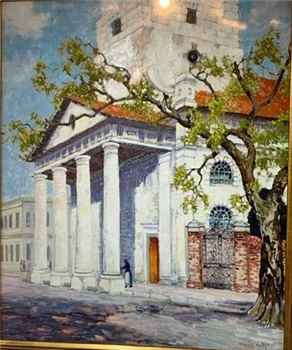 ALFRED HEBER HUTTY (1877-1954)
A central figure in the Charleston Renaissance, Alfred Hutty was born in Grand Haven, Michigan. He grew up in Kansas City and Leavenworth, Kansas, earning an art scholarship at the age of fifteen. He worked as a stained glass designer in Kansas City and St. Louis, where he attended the St. Louis School of Art. Inspired by the landscape art of Birge Harrison, Hutty determined to devote himself to painting and, in 1907, traveled to Woodstock, New York to study under Harrison. He established himself as a regular resident of the Art Students League summer art colony there. During this time, he continued design and production of stained glass for Tiffany Studios in New York City.
Hutty first visited Charleston in 1919, looking for a place to spend the winter, when he famously wired his wife, back in Woodstock: "Come quickly, have found heaven." He returned to the city from 1920 to 1924 to teach at the school of the Gibbes Museum and thereafter divided his time seasonally between homes and studios in Charleston and Woodstock.
In Charleston, he embraced the friendship, collaboration, and activities of local printmakers and other cultural leaders, such as John Bennett and DuBose Heyward, whose 1936 novel, Lost Morning, features an artist modeled after Hutty. He began etching in Charleston in 1921 and was a founding member of the Etchers' Club in 1923. Hutty earned a national reputation as a printmaker in the 1920s and the following decades.
Hutty's work reveals his varied artistic roots in the social realism of the Midwest, as well as the picturesque landscape traditions of Woodstock and Charleston. He produced numerous street views of Charleston's high-style and vernacular architecture.
This essay is copyrighted by the Charleston Renaissance Gallery and may not be reproduced or transmitted without written permission from Hicklin Galleries, LLC.Biography from Carolina Galleries - Southern Art (CLOSED)
Alfred Heber Hutty
1877-1954
Alfred Hutty was born in Grand Haven, Michigan in 1877. He came to Charleston in 1919 when he was already in his early forties and immediately cabled his wife "Come quickly. Have found heaven." Having worked as a stained glass designer in Kansas City and at Tiffany Glass Studios in New York, Hutty had begun a long association with the Woodstock, NY art community and with Lowell Birge Harrison, who was also a mentor of fellow Charleston artist Alice R. H. Smith.
Indeed, even after he moved to Charleston, Hutty maintained a studio in Woodstock until his death in 1954. Primarily an oil and watercolor painter, Hutty apparently did not seriously take up etching until he moved to Charleston but quickly demonstrated his complete mastery of the medium, winning awards all over the country. All the while, he continued to paint in oils and watercolors, and also produced hundreds of pencil drawings and sketches.
Alfred Hutty was one of the founding members of the Charleston Etchers' Club. He was active in the Footlight Player's Workshop in Charleston and painted murals for several public buildings.
During his career as an artist he exhibited at the Pennsylvania Academy of Fine Art (1918), Art Institute of Chicago, Detroit Institute of the Arts (1923, gold), Chicago Society of Etchers (1924, medal), Salmagundi Club (1924, prize), National Academy of Design and the American Watercolor Society.
Public collections that include Alfred Hutty:
Art Institute of Chicago
Los Angeles County Museum of Art
Greenville County Museum of Art
Morris Museum of Art
Gibbes Museum of Art
British Museum
Fogg Museum of Art
New York Public Library
Cleveland Museum of Art
Library of Congress
His memberships include:
British Society of Graphic Artists
Society of American Etchers
Chicago Society of Etchers
California Print Makers
Prairie Print Makers
Southern Print Makers
Allied Artists of America
National Arts Club
American Watercolor Society
Salmagundi Club
Woodstock Art AssociationBiography from The Johnson Collection
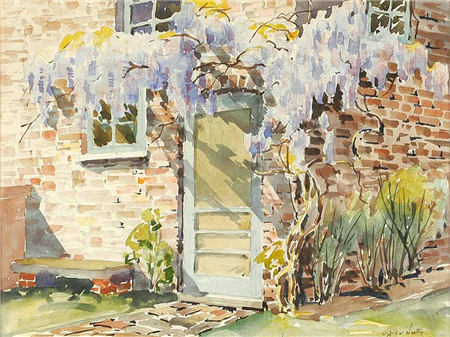 ALFRED HEBER HUTTY (1877-1954)
A Midwesterner by birth, Alfred Heber Hutty is inextricably linked to Charleston, South Carolina. Born in Grand Haven, Michigan, Hutty spent most of his young life in Kansas City; his aptitude in art earned him a scholarship to the newly established Kansas City School of Fine Arts at the age of fifteen. As a young adult, he was employed as a glazier, a trade that led to posts as a stained glass designer, first in Kansas City, then St. Louis, and ultimately with the Tiffany Glass Studio in New York City. In 1908, Hutty began study with the Tonalist landscape painter Birge Harrison in Woodstock, New York, where he became a member of the emerging art colony and established a rural home. “This simple farm, the solace of solitude, the restful friendliness of the community--all these" Hutty noted, "bring out the best in a palette.”
Hutty served in World War I as a marine camouflage artist. At war's end, his search for employment led him to Charleston, a favorite destination for his mentor, Harrison. Upon his first visit to the city in 1919, Hutty famously telegrammed his wife, “Come quickly, have found heaven.” From 1920–1924, Hutty was the director of the Carolina Art Association (now the Gibbes Museum of Art) and steadily became a vital part of the local cultural community. Along with fellow artists Alice Ravenel Huger Smith, Elizabeth O'Neill Verner, and Anna Taylor, Hutty was a leader in Charleston's twentieth-century renaissance, using his art to support the burgeoning tourist trade.
Having befriended local printmakers, he began producing etchings in 1921, was a founding member of the Charleston Etchers Club established two years later, and soon garnered national acclaim as a printmaker. However, Hutty's considerable success in that medium did not quell his enthusiasm for—or excellence in painting in oil and watercolor. Hutty's subject matter was most often the local scene: landscapes, street scenes, and vernacular architecture. As an outsider, Hutty was less inclined than his Southern peers to portray an idealized interpretation of the Lowcountry, and his images offer a more realistic record of the decayed city and its impoverished African American population. Yet Hutty’s images did little to address the pressing social concerns of the day. African American subjects are presented as pleasant participants in a nostalgic narrative; at times, facial features are blatantly exaggerated while other black figures appear to have no distinguishable facial details whatsoever.
Hutty made an extended trip to Europe in 1926, and soon thereafter adopted the pattern of seasonal residencies—spending winters in Charleston and summers in Woodstock—that he would maintain until his death. Over these decades, Hutty's paintings and prints were celebrated in numerous one-man and group exhibitions at prestigious national museums, and he was invited to membership in selective art societies. Lauded as a “poet of line and color,” Hutty's contributions to the cultural vibrancy of his adopted home were recognized in the city's daily newspaper: “Charlestonians cannot do as much for this brilliant artist as he has lovingly done for Charleston."
The Johnson Collection, Spartanburg, South Carolina
thejohnsoncollection.org