Page loaded successfully. Showing biography for Alfred Manessier.
Alfred Manessier BIOGRAPHY
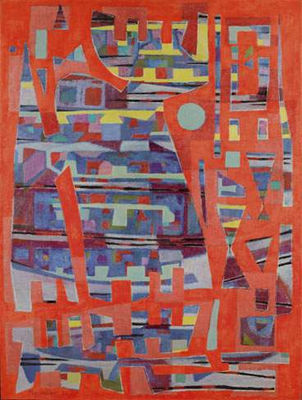
1911 Saint-Ouen, France - 1993. Known for: Abstract geometric figure paintings.
Alfred Manessier was born on December 5, 1911 in Saint-Ouen, Somme department, just north of Paris, France, the only son of a wholesale wine merchant. His paternal grandfather was a designer and... Read full biography
Alfred Manessier was born on December 5, 1911 in Saint-Ouen, Somme department, just north of Paris, France, the only son of a wholesale wine merchant. His paternal grandfather was a designer and cutter of ornamental building stone. He grew up in Abbeville and Amiens and at the fishing port of Le... Read full biography
Alfred Manessier was born on December 5, 1911 in Saint-Ouen, Somme department, just north of Paris, France, the only son of a wholesale wine merchant. His paternal grandfather was a designer and cutter of ornamental building stone. He grew up in Abbeville and Amiens and at the fishing port of Le Crotoy, where he visited his maternal grandmother who was a ropemaker. There he painted pictures of fishing boats and the bay of the river Somme; he responded to the play of light over the river.... Read full biography
Alfred Manessier was born on December 5, 1911 in Saint-Ouen, Somme department, just north of Paris, France, the only son of a wholesale wine merchant. His paternal grandfather was a designer and cutter of ornamental building stone. He grew up in Abbeville and Amiens and at the fishing port of Le Crotoy, where he visited his maternal grandmother who was a ropemaker. There he painted pictures of fishing boats and the bay of the river Somme; he responded to the play of light over the river. Manessier attended the Lycee and the Ecole des Beaux-Arts, in Amiens, where he studied architecture, then on to the Ecole des Beaux-Arts in Paris, but he disliked the atmosphere of the school and spent most of his time in the Louvre, copying paintings by... Read full biography
Alfred Manessier was born on December 5, 1911 in Saint-Ouen, Somme department, just north of Paris, France, the only son of a wholesale wine merchant. His paternal grandfather was a designer and cutter of ornamental building stone. He grew up in Abbeville and Amiens and at the fishing port of Le Crotoy, where he visited his maternal grandmother who was a ropemaker. There he painted pictures of fishing boats and the bay of the river Somme; he responded to the play of light over the river. Manessier attended the Lycee and the Ecole des Beaux-Arts, in Amiens, where he studied architecture, then on to the Ecole des Beaux-Arts in Paris, but he disliked the atmosphere of the school and spent most of his time in the Louvre, copying paintings by Tintoretto and Rembrandt. At the art academies of Montparnasse he found greater freedom of expression, and under the influence of Bissiere, turne... Read full biography
Artist Biography
Biography page for Alfred Manessier ((1911 - 1993)), known for Abstract geometric figure paintings. Showing 2 biographical entries and 0 sample artworks.
Alfred Manessier - Artist Info
About Alfred Manessier
Biography from the Archives of askART
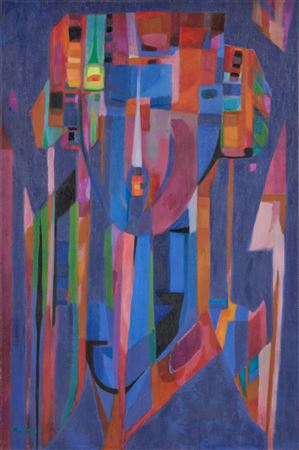 Alfred Manessier was born on December 5, 1911 in Saint-Ouen, Somme department, just north of Paris, France, the only son of a wholesale wine merchant. His paternal grandfather was a designer and cutter of ornamental building stone. He grew up in Abbeville and Amiens and at the fishing port of Le Crotoy, where he visited his maternal grandmother who was a ropemaker. There he painted pictures of fishing boats and the bay of the river Somme; he responded to the play of light over the river.
Manessier attended the Lycee and the Ecole des Beaux-Arts, in Amiens, where he studied architecture, then on to the Ecole des Beaux-Arts in Paris, but he disliked the atmosphere of the school and spent most of his time in the Louvre, copying paintings by Tintoretto and Rembrandt. At the art academies of Montparnasse he found greater freedom of expression, and under the influence of Bissiere, turned from realistic landscapes to painting in the cubist tradition. Manessier left Paris after his father died in 1936. He began turning toward Surrealism about that time.
In October 1938 Manessier married Therese Simonet. They had two children, born in 1940 and 1947. He served in the French Army in 1939 and 1940. During a brief visit to the Somme in 1943, while staying in the Grand Trappist Monastery, he underwent a reconversion to Roman Catholicism. As a result he settled for a while in Bignon, Normandy, where, in accordance with the growing "inwardness" of his vision, he painted compositions with dramatic lighting recalling Georges de la Tour. He designed stained glass windows and tapestries, also a series of lithographs with Easter themes.
Manessier was a tall, thin friendly man who gave an impression of inner vitality and warmth. He spent each summer with his family by the seashore. He regarded his art as a reaction against the materialism of the age.
Written and submitted by Jean Ershler Schatz, artist and researcher from Laguna
Woods, California.
Sources include:
Phaidon Encyclopedia of Art and Artists, 1420-1970
World Artists 1950-80 by Claude Marks.Biography from Dobiaschofsky Auktionen
Alfred Manessier, who is now the main representative of the École de Paris, studied architecture and art in Amiens and Paris from 1926 to 1933. In the early 1930s he exhibited for the first time in the "Salon des Indépendants" and became friends with Jean Le Moal, whom he had met through his teacher Roger Bissière. Until the Second World War, the French worked mainly cubist and under the influence of surrealism, before moving permanently to abstraction in the mid-1940s.
On the occasion of a stay in the monastery, the artist turned to religion around 1943, which from then on was to inspire him both in terms of motifs and in connection with the designs of his numerous, brightly colored glass windows in sacred rooms. For example, he designed the windows of the crypt in the Church of St. Gereon in Cologne, the extensive window cycle of the Church of Our Lady in Bremen, several glass paintings in the Basel All Saints Church and the window of the Holy Grave Chapel in the Cathedral of St. Nicholas in Friborg.
In the post-war period, the artist became increasingly successful, took part in the first three documenta from 1955 and was honored with the Grand International Prize for Painting at the Venice Biennale in 1962. In the 1960s, his painting style relaxed while maintaining the color intensity.
Alfred Manessier's works can now be found in the collections of the Solomon R. Guggenheim Museum and the Museum of Modern Art in New York as well as the Museo Nacional Thyssen-Bornemisza in Madrid.
The offered work was created shortly after Easter 1963 in Ermita de Luchente in southern Spain, a small place between Valencia and Alicante, where Alfred Manessier stayed regularly until 1985 and created numerous brightly colored and light-flooded compositions like this one. We thank Christine Manessier, Abbeville, for her information.