Page loaded successfully. Showing biography for Alfred Wallis.
Alfred Wallis BIOGRAPHY
1855 Devonport, England - 1942 Madron Institution, Penzance, England. Known for: Primitive nautical theme painting.
Alfred Wallis (18 August 1855 - 29 August 1942) was a Cornish fisherman and artist. Wallis's parents, Charles and Jane Wallis were from Penzance in Cornwall and moved to Devonport, Devon to find work... Read full biography
Alfred Wallis (18 August 1855 - 29 August 1942) was a Cornish fisherman and artist. Wallis's parents, Charles and Jane Wallis were from Penzance in Cornwall and moved to Devonport, Devon to find work in 1850 where Alfred and his brother Charles were born. Shortly after this the children's mother... Read full biography
Alfred Wallis (18 August 1855 - 29 August 1942) was a Cornish fisherman and artist. Wallis's parents, Charles and Jane Wallis were from Penzance in Cornwall and moved to Devonport, Devon to find work in 1850 where Alfred and his brother Charles were born. Shortly after this the children's mother died and this prompted the family to move back to Penzance. On leaving school Alfred became an apprentice basket maker before becoming a mariner in the merchant service by the early 1870s. This work... Read full biography
Alfred Wallis (18 August 1855 - 29 August 1942) was a Cornish fisherman and artist. Wallis's parents, Charles and Jane Wallis were from Penzance in Cornwall and moved to Devonport, Devon to find work in 1850 where Alfred and his brother Charles were born. Shortly after this the children's mother died and this prompted the family to move back to Penzance. On leaving school Alfred became an apprentice basket maker before becoming a mariner in the merchant service by the early 1870s. This work involved sailing schooners across the North Atlantic between Penzance and Newfoundland. Alfred married Susan Ward at St. Mary's church in Penzance in 1876, when he was 20 and his wife was 41 and became stepfather to her five children. He continued his... Read full biography
Alfred Wallis (18 August 1855 - 29 August 1942) was a Cornish fisherman and artist. Wallis's parents, Charles and Jane Wallis were from Penzance in Cornwall and moved to Devonport, Devon to find work in 1850 where Alfred and his brother Charles were born. Shortly after this the children's mother died and this prompted the family to move back to Penzance. On leaving school Alfred became an apprentice basket maker before becoming a mariner in the merchant service by the early 1870s. This work involved sailing schooners across the North Atlantic between Penzance and Newfoundland. Alfred married Susan Ward at St. Mary's church in Penzance in 1876, when he was 20 and his wife was 41 and became stepfather to her five children. He continued his life as a deep-sea fisherman on the Newfoundland run in the early days of his marriage allowing him to earn a good wage until the death of... Read full biography
Artist Biography
Biography page for Alfred Wallis ((1855 - 1942)), known for Primitive nautical theme painting. Showing 2 biographical entries and 0 sample artworks.
Alfred Wallis - Artist Info
About Alfred Wallis
Biography from the Archives of askART
 Alfred Wallis (18 August 1855 - 29 August 1942) was a Cornish fisherman and artist. Wallis's parents, Charles and Jane Wallis were from Penzance in Cornwall and moved to Devonport, Devon to find work in 1850 where Alfred and his brother Charles were born. Shortly after this the children's mother died and this prompted the family to move back to Penzance. On leaving school Alfred became an apprentice basket maker before becoming a mariner in the merchant service by the early 1870s. This work involved sailing schooners across the North Atlantic between Penzance and Newfoundland.
Alfred married Susan Ward at St. Mary's church in Penzance in 1876, when he was 20 and his wife was 41 and became stepfather to her five children. He continued his life as a deep-sea fisherman on the Newfoundland run in the early days of his marriage allowing him to earn a good wage until the death of his two infant children when Alfred switched to local fishing and laboring in Penzance.
The family moved to St. Ives, Cornwall, in 1890 where he established himself as a marine stores dealer, buying scrap iron, sails, rope and other items. In 1912, his business, "Wallis, Alfred, Marine Stores Dealer" closed for business and Alfred kept himself busy with odd jobs and worked for a local antiques dealer Mr Armour which provided some insight into the world of objets d'art.
Following his wife's death in 1922, Wallis took up painting, as he later told Jim Ede, "for company".
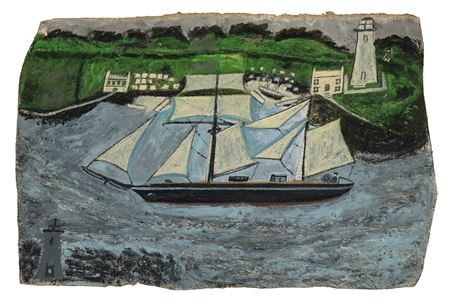
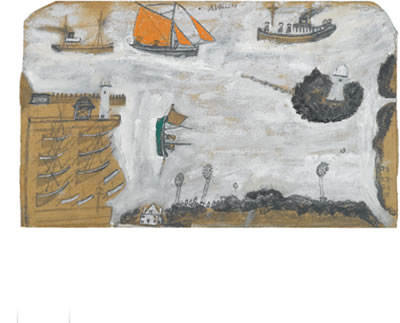
His paintings are an excellent example of naïve art; perspective is ignored and an object's scale is often based on its relative importance in the scene. This gives many of his paintings a map-like quality. Wallis painted his seascapes from memory, in large part because the world of sail he knew was being replaced by steamships. As he himself put it, his subjects were "what use To Bee out of my memery what we may never see again... "Having little money, Wallis improvised with materials, mostly painting on cardboard ripped from packing boxes using a limited palette of paint bought from ships' chandlers.
In many ways, Wallis' timing was excellent. In 1928, a few years after he had started painting, Ben Nicholson and Kit Wood came to St. Ives and established an artist colony. They were delighted to find Wallis and celebrated his direct approach to image-making.(Nicholson commented later 'to Wallis,his paintings were never paintings but actual events') Wallis was propelled into a circle of the some of most progressive artists working in Britain in the 1930s. The influence, however, was all one way; Wallis continued to paint as he always had.) Nicholson later said of Wallis's art 'something that has grown out of the Cornish seas and earth and which will endure')
Through Nicholson and Wood, Wallis was introduced to Jim Ede who promoted his work in London. Despite this attention, Wallis sold few of his paintings and continued to live in poverty until he died in the Madron Workhouse in Penzance. He is buried in Barnoon cemetery, overlooking St. Ives' Porthmeor beach and the Tate St Ives gallery. An elaborate gravestone, depicting a tiny mariner at the foot of a huge lighthouse - a popular motif in Wallis' paintings - was made from tiles by the potter Bernard Leach and now covers Wallis' tomb.
Source
Wikipedia, http://en.wikipedia.org/wiki/Alfred_WallisBiography from Tennants
Alfred Wallis (1855-1942), retired mariner and self-taught artist, is much celebrated for his naïve paintings that reflect his direct experience of the sea and fishing communities in Cornwall. “Houses, Trees and Ships” was given by Dame Barbara Hepworth to fellow St. Ives artist Peter Lanyon and his wife Sheila for their wedding in 1946. Mrs Markova Noel, from whose estate it is now being sold, purchased “Houses, Trees and Ships” from Sheila Lanyon in the 1970s, before loaning it to Sheffield Museums Trust.
Alfred Wallis spent his childhood in Devon and Cornwall and worked as an apprentice basket maker before becoming a mariner in the merchant service in the early 1870s, sailing schooners between Penzance and Newfoundland. Following his marriage to Susan in 1876, when he was 20 and she was 41, he found work deep sea fishing off Newfoundland before switching to local fishing and laboring in Penzance.
In 1890 the family moved to St. Ives, where Wallis became a dealer in marine reclamation and supplies. When his wife died in 1922, Wallis took up painting ‘for company’, never seeking any form of artistic training. Using a limited palette of marine paint and any scraps of cardboard, packing box or wood he could get hold of, he developed his own unique style, depicting what he knew best – port landscapes and shipping. His instinctive, naïve approach saw formal perspective abandoned, and scale was often based on an object’s importance in a scene. Everything he drew came from his memories, largely from his formative years before sail gave way to steam.
Indeed, he is recorded as saying he painted “What use To Bee out of my memory what we may never see again”.