Page loaded successfully. Showing biography for Alphonse Osbert.
Alphonse Osbert BIOGRAPHY
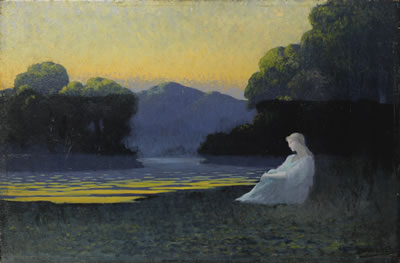
1857 - 1939. Known for: Painting.
Alphonse Osbert was born in 1857. He was a student of Henri Lehmann and Léon Bonnat and a classmate of Seurat and Alexander Seon at the School of Fine Arts. He exhibited at the Salon in 1881 works... Read full biography
Alphonse Osbert was born in 1857. He was a student of Henri Lehmann and Léon Bonnat and a classmate of Seurat and Alexander Seon at the School of Fine Arts. He exhibited at the Salon in 1881 works influenced by Spanish painting, reaffirming his personal aesthetic. It became the turn of the 1890s: a... Read full biography
Alphonse Osbert was born in 1857. He was a student of Henri Lehmann and Léon Bonnat and a classmate of Seurat and Alexander Seon at the School of Fine Arts. He exhibited at the Salon in 1881 works influenced by Spanish painting, reaffirming his personal aesthetic. It became the turn of the 1890s: a recognized figure in the Symbolist movement. The color blue is omnipresent in his work that evokes woodland and lake scenery, mostly nocturnal, where cheminent elegiac figures carrier lyre or... Read full biography
Alphonse Osbert was born in 1857. He was a student of Henri Lehmann and Léon Bonnat and a classmate of Seurat and Alexander Seon at the School of Fine Arts. He exhibited at the Salon in 1881 works influenced by Spanish painting, reaffirming his personal aesthetic. It became the turn of the 1890s: a recognized figure in the Symbolist movement. The color blue is omnipresent in his work that evokes woodland and lake scenery, mostly nocturnal, where cheminent elegiac figures carrier lyre or melancholic druids (No. 419 and 422). Osbert made a very successful synthesis of the heritage of the neo-impressionists and his own vision; this material diffuses and partially dotted giving him his world a dreamlike dimension of great poetry. It exposes to... Read full biography
Alphonse Osbert was born in 1857. He was a student of Henri Lehmann and Léon Bonnat and a classmate of Seurat and Alexander Seon at the School of Fine Arts. He exhibited at the Salon in 1881 works influenced by Spanish painting, reaffirming his personal aesthetic. It became the turn of the 1890s: a recognized figure in the Symbolist movement. The color blue is omnipresent in his work that evokes woodland and lake scenery, mostly nocturnal, where cheminent elegiac figures carrier lyre or melancholic druids (No. 419 and 422). Osbert made a very successful synthesis of the heritage of the neo-impressionists and his own vision; this material diffuses and partially dotted giving him his world a dreamlike dimension of great poetry. It exposes to all the shows of the Rose Cross, at Siegfried Bing and in the best galleries (at Georges Petit in 1895). Author of some great scenery, includi... Read full biography
Artist Biography
Biography page for Alphonse Osbert ((1857 - 1939)), known for Painting. Showing 1 biographical entries and 0 sample artworks.
Alphonse Osbert - Artist Info
About Alphonse Osbert
Biography from Artcurial
Alphonse Osbert was born in 1857. He was a student of Henri Lehmann and Léon Bonnat and a classmate of Seurat and Alexander Seon at the School of Fine Arts. He exhibited at the Salon in 1881 works influenced by Spanish painting, reaffirming his personal aesthetic. It became the turn of the 1890s: a recognized figure in the Symbolist movement. The color blue is omnipresent in his work that evokes woodland and lake scenery, mostly nocturnal, where cheminent elegiac figures carrier lyre or melancholic druids (No. 419 and 422). Osbert made a very successful synthesis of the heritage of the neo-impressionists and his own vision; this material diffuses and partially dotted giving him his world a dreamlike dimension of great poetry. It exposes to all the shows of the Rose Cross, at Siegfried Bing and in the best galleries (at Georges Petit in 1895). Author of some great scenery, including those from the thermal baths of Vichy, Osbert remains true to his world until the 1930s, with equal technical quality and inspiration that the repetitive nature is in itself an interesting aspect: all work Osbert is a kind of "series" obsessive. The quality of his charcoal drawings confirms a sense of composition that can also give up the color without ceasing to be expressive (No. 420, 421 and 422). Osbert wrote: "I want to reach the same simplicity, the great silence".