Page loaded successfully. Showing biography for Angela Gregory.
Angela Gregory BIOGRAPHY
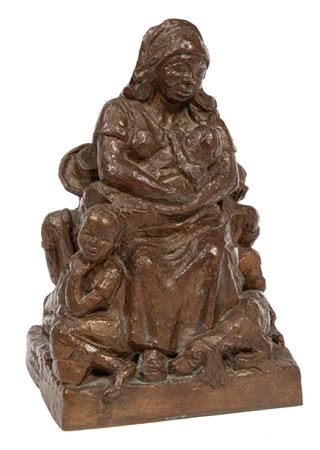
1903 New Orleans, Louisiana - 1990 New Orleans, Louisiana. Known for: Portrait sculpture, architectural decoration.
Angela Gregory probably decided to make art her career because of a strong familial support system. Her father, an academic, was a well-respected professor of engineering at Tulane University, and... Read full biography
Angela Gregory probably decided to make art her career because of a strong familial support system. Her father, an academic, was a well-respected professor of engineering at Tulane University, and her mother graduated from the Newcomb College School of Art before becoming an artist and teacher.... Read full biography
Angela Gregory probably decided to make art her career because of a strong familial support system. Her father, an academic, was a well-respected professor of engineering at Tulane University, and her mother graduated from the Newcomb College School of Art before becoming an artist and teacher. Gregory attended a private school for young women where her mother worked as an art teacher, and not surprising, she was able to benefit from her mother's inspirational lead. Gregory became adept at clay... Read full biography
Angela Gregory probably decided to make art her career because of a strong familial support system. Her father, an academic, was a well-respected professor of engineering at Tulane University, and her mother graduated from the Newcomb College School of Art before becoming an artist and teacher. Gregory attended a private school for young women where her mother worked as an art teacher, and not surprising, she was able to benefit from her mother's inspirational lead. Gregory became adept at clay modeling and relief casting by the young age of fourteen while taking summer classes at Tulane University. She entered Newcomb College School of Art in 1921. In her first three years at Newcomb, Gregory received awards for her watercolors, but her... Read full biography
Angela Gregory probably decided to make art her career because of a strong familial support system. Her father, an academic, was a well-respected professor of engineering at Tulane University, and her mother graduated from the Newcomb College School of Art before becoming an artist and teacher. Gregory attended a private school for young women where her mother worked as an art teacher, and not surprising, she was able to benefit from her mother's inspirational lead. Gregory became adept at clay modeling and relief casting by the young age of fourteen while taking summer classes at Tulane University. She entered Newcomb College School of Art in 1921. In her first three years at Newcomb, Gregory received awards for her watercolors, but her skills with sculpture did not solidify until she began her instruction with the German sculptor, Albert... Read full biography
Artist Biography
Biography page for Angela Gregory ((1903 - 1990)), known for Portrait sculpture, architectural decoration. Showing 2 biographical entries and 0 sample artworks.
Angela Gregory - Artist Info
About Angela Gregory
Biography from The Johnson Collection
ANGELA GREGORY (1903–1990)
“I have decided to become a sculptor. How do you like that? I made up my mind long ago to be an artist and I think I will like that best of all.” With this proclamation, made to her father at the age of fourteen, Angela Gregory determined her life’s path—early on and with confidence. Having grown up in an artistic household on the Tulane University campus in New Orleans—her mother, Selina Bres Gregory, was a painter and potter associated with Newcomb College and a founding member of the Arts and Crafts Club—Gregory was all too familiar with both the joys and challenges of a creative life. Her course set, she spent the summer of 1917 studying clay modeling and relief casting; in 1921, she enrolled as an undergraduate at Newcomb, where her professors included Ellsworth Woodward and Will Henry Stevens.
Upon her graduation from Newcomb in 1925, Gregory earned a scholarship to study illustrative advertising at the Paris branch of the Parsons School of Design. While honored by the award, Gregory’s true objective was realized a year later when she was admitted to the teaching studio of sculptor Antoine Bourdelle, whose expressive style reflected his tenure as an assistant to Auguste Rodin. Keenly aware of the obstacles she would encounter in a “notoriously masculine field,” Gregory asked Bourdelle: “Do you think I have enuf [sic] talent to go on with sculpture or do you think I should develop my interest in painting?” The Frenchman answered with a question of his own: “Did anyone tell Joan of Arc she should rid France of the English? She wanted to do it and she did. It is your decision.” Her unconventional professional path was matched by her equally unconventional resolve to remain single. Gregory, who had watched her mother subordinate her own artistic ambitions to domestic responsibilities, recognized that “too often a woman is torn by conflicting obligations, as a mother, a wife, sister, daughter. Unless she can stay on the track, she becomes a dilettante.”
When her European sojourn ended after three years, Gregory regretfully returned to New Orleans. Although she complained of the city’s relative lack of culture and oppressive heat, she resolutely set to work, building friendships along the way with other artists including Helen Turner and Josephine Crawford. One of her first undertakings was the “Negro Project,” in which she studied African American residents of Port Gibson, Mississippi. The project resulted in some of her most admired works. Comparable to these Port Gibson works, Head of a Woman portrays a serene, mask-form head of a sitter with contemplative, downcast eyes, and softly pursed lips. The surface is smooth in the rounded areas of her forehead, cheeks, and chin, while the hair and neck are depicted with crevices and folds. Imbued with what Gregory termed “quiet dignity,” Head of a Woman conveys the artist’s insistence on emotional authenticity, as well as her sensitivity to African American culture in the region.
Angela Gregory built a national and international reputation, and her body of work includes large-scale architectural decoration, bas-relief portraits, plaques, and medals. Over her long career, she was employed as a state supervisor for the Works Progress Administration’s Federal Art Program, an assistant architectural consultant to the Army Corps of Engineers, and a camouflage designer; she also taught at both Newcomb and St. Mary’s Dominican College. In one of the many eulogies given at her memorial service, the dean of Newcomb College remembered Gregory’s vision and courage, traits that forged a pioneering “life that was full of compassion and ribbed with experience and art.”
The Johnson Collection, Spartanburg, South Carolina
thejohnsoncollection.orgBiography from The Columbus Museum (COMU)
Angela Gregory probably decided to make art her career because of a strong familial support system. Her father, an academic, was a well-respected professor of engineering at Tulane University, and her mother graduated from the Newcomb College School of Art before becoming an artist and teacher. Gregory attended a private school for young women where her mother worked as an art teacher, and not surprising, she was able to benefit from her mother's inspirational lead.
Gregory became adept at clay modeling and relief casting by the young age of fourteen while taking summer classes at Tulane University. She entered Newcomb College School of Art in 1921. In her first three years at Newcomb, Gregory received awards for her watercolors, but her skills with sculpture did not solidify until she began her instruction with the German sculptor, Albert Reicker, at the Arts and Crafts Club. (1)
In 1925, Gregory received a scholarship to the Paris branch of the Parson's School of Fine and Applied Art, which allowed her to study in France and Italy. During her time in France, Gregory entered the studio of the sculptor Émile-Antoine Bourdelle, himself a former student of the great French master Auguste Rodin. She enriched her sculptural instruction with sketching classes as well, completing European studies after three years, before returning to New Orleans in 1928, where she established a studio.
Angela Gregory's work received immediate recognition. Her early training at the widely respected Newcomb College, and then her instruction at Bourdelle's studio in Paris provided her with a strong background on which to formulate her career as an artist. The level of quality in her education supplied her with a reputation that preceded her artistic output, but this era challenged Gregory as she experienced slight culture shock upon settling in New Orleans. Fortunately, she met many influential artists, including Harriet Frishmuth who later recommended her for membership in the National Sculpture Society.
In 1929, General Allison Owen, of the architecture firm of Diboll and Owen, visited Gregory's studio and was so impressed by her work, including La Belle Augustine, that he offered her a commission to produce sculpture to decorate the exterior of the Criminal Courthouse in New Orleans. (2)
She followed this initial project with numerous other commissions for architectural sculpture providing her with a national and international reputation. Throughout her career, Gregory created works for the Louisiana State Capitol, the Tulane Medical School, St. Gabriel's Catholic Church in Louisiana, First National Bank of Commerce, the Union Passenger Station in New Orleans and many other locations.
She continued to sculpt smaller works such as portrait busts and medallions in bronze. Gregory's employment also included the Public Works of Art Program and the Federal Art Project for the state of Louisiana. Gregory taught at both Newcomb College and St. Mary's Dominican College in New Orleans. She served as instructor and artist-in-residence for fourteen years at St. Mary's before retiring in 1976.
Gregory's early, and perhaps most important, work, La Belle Augustine, created a significant impact on furthering her career at an early date. She created this seminal piece after returning from France where her classical training was entrenched in the nineteenth century French aesthetic developed by Auguste Rodin.
For La Belle Augustine Gregory followed the traditional French style, but presented a truly American subject by sculpting the image of a young African-American woman from New Orleans.
Sources:
1. For the most complete biographical information to date, see the exhibition brochure, Angela Gregory: A Sculptor's Life, An exhibit sponsored by the Southeastern Architectural Archive Newcomb College Dean's Residence (New Orleans: Newcomb College, 1981), unpaginated; and Charlotte Streifer Rubinstein, American Women Sculptors: A History of Women Working in Three Dimensions (Boston: G.K. Hall, 1990), 293-296.
2. This information was ascertained through a conversation with James Lamantia of New Orleans who represents the estate of Angela Gregory. staff, Columbus Museum