Page loaded successfully. Showing biography for Anthony Thieme.
Anthony Thieme BIOGRAPHY
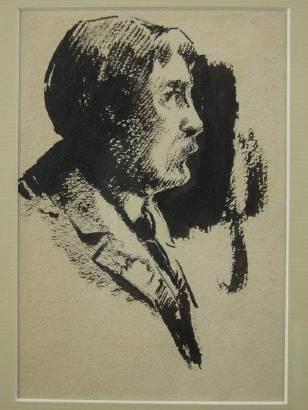
1888 Rotterdam, Holland - 1954 Rockport, Massachusestts. Known for: Coastal landscape and townscape painting.
Anthony Thieme was born on February 20, 1888 in Rotterdam, Holland. He studied at the Royal Academy of Fine Arts in The Hague, Holland, under George Hacker; Garlobini, Guardaciona; and Mancini in... Read full biography
Anthony Thieme was born on February 20, 1888 in Rotterdam, Holland. He studied at the Royal Academy of Fine Arts in The Hague, Holland, under George Hacker; Garlobini, Guardaciona; and Mancini in Italy. He also studied in Germany. In the 1920's he emigrated to the United States, initially residing... Read full biography
Anthony Thieme was born on February 20, 1888 in Rotterdam, Holland. He studied at the Royal Academy of Fine Arts in The Hague, Holland, under George Hacker; Garlobini, Guardaciona; and Mancini in Italy. He also studied in Germany. In the 1920's he emigrated to the United States, initially residing in New York City where he painted Broadway backdrops, and eventually setting up studios in Rockport, Massachusetts and St. Augustine, Florida, seasonally moving from one to the other. Known as a genre... Read full biography
Anthony Thieme was born on February 20, 1888 in Rotterdam, Holland. He studied at the Royal Academy of Fine Arts in The Hague, Holland, under George Hacker; Garlobini, Guardaciona; and Mancini in Italy. He also studied in Germany. In the 1920's he emigrated to the United States, initially residing in New York City where he painted Broadway backdrops, and eventually setting up studios in Rockport, Massachusetts and St. Augustine, Florida, seasonally moving from one to the other. Known as a genre painter he did landscapes including farms, and Paris scenes; his best known works are of boats, fishermen, and harbors, reflecting his Northern and Southern studios in coastal towns. In Rockport, he established the Thieme School of Art where he was... Read full biography
Anthony Thieme was born on February 20, 1888 in Rotterdam, Holland. He studied at the Royal Academy of Fine Arts in The Hague, Holland, under George Hacker; Garlobini, Guardaciona; and Mancini in Italy. He also studied in Germany. In the 1920's he emigrated to the United States, initially residing in New York City where he painted Broadway backdrops, and eventually setting up studios in Rockport, Massachusetts and St. Augustine, Florida, seasonally moving from one to the other. Known as a genre painter he did landscapes including farms, and Paris scenes; his best known works are of boats, fishermen, and harbors, reflecting his Northern and Southern studios in coastal towns. In Rockport, he established the Thieme School of Art where he was Director. Thieme was a strong proponent of the visual arts and held memberships in many associations: American Water Color Societ... Read full biography
Artist Biography
Biography page for Anthony Thieme ((1888 - 1954)), known for Coastal landscape and townscape painting. Showing 8 biographical entries and 0 sample artworks.
Anthony Thieme - Artist Info
About Anthony Thieme
Name variants
Anthony Theime
Biography from the Archives of askART
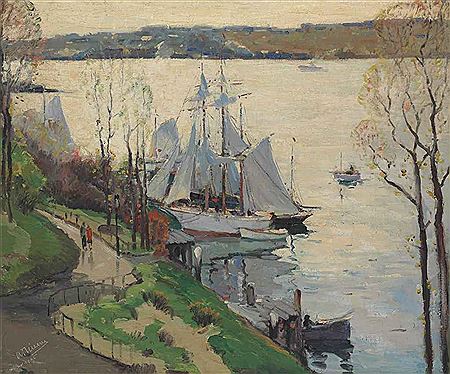 Anthony Thieme was born on February 20, 1888 in Rotterdam, Holland. He studied at the Royal Academy of Fine Arts in The Hague, Holland, under George Hacker; Garlobini, Guardaciona; and Mancini in Italy. He also studied in Germany.
In the 1920's he emigrated to the United States, initially residing in New York City where he painted Broadway backdrops, and eventually setting up studios in Rockport, Massachusetts and St. Augustine, Florida, seasonally moving from one to the other.
Known as a genre painter he did landscapes including farms, and Paris scenes; his best known works are of boats, fishermen, and harbors, reflecting his Northern and Southern studios in coastal towns. In Rockport, he established the Thieme School of Art where he was Director.
Thieme was a strong proponent of the visual arts and held memberships in many associations: American Water Color Society; Art Alliance of America; Salmagundi Club; Connecticut Academy of Fine Arts; Boston Art Club; Providence Water Color Club; Boston Society of Artists; North Shore Art Association; Springfield Art League; Rockport Art Association; New York Water Color Club; American Artists Professional League; Gloucester Society of Artists; Art Alliance of Philadelphia; Philadelphia Painters Club; and the National Arts Club.
As a function of these many memberships, he was an active exhibitor: National Academy of Design 1930-1934; Art Institute of Chicago 1930; Pennsylvania Academy of Fine Arts 1929-1931; Corcoran Gallery of Art 1932; Los Angeles Museum of Art 1930, 1931 (prize); Albright Art Gallery 1932; Detroit Institute of Art 1931; Salmagundi Club 1929 and 1931 (prizes); Springfield, Utah 1928 and 1931 (prizes); Gloucester Art Association 1928 (prize); Springfield Art League 1927 and 1928 (prizes); North Shore Art Association 1930 (prize); Connecticut Academy of Fine Arts 1930 (prize); Jordon Marsh Exhibition (Boston) 1944 (medal); New York Water Color Club 1930 (prize); Boston Tercentenary Exhibition 1930; Ogunquit Art Center 1930; New Haven Painters and Clay Club 1931 (prize); Washington Water Color Club 1931(prize); Los Angeles Museum of Art; Buck Hill Falls Art Association (Pennsylvania) 1938 (prize); he also exhibited in Belgium, France and Holland.
Anthony Thieme's work is held in high regard by collectors and Museums alike, and he is represented in many major collections: Boston Museum of Fine Art; Pittsfield Museum of Art (Massachusetts); Albany Institute of History and Art; Dayton Art Institute; City of New Haven Collection; College of Springfield (Utah); University of Iowa; Museum of Modern Art; Los Angeles Museum of History, Science & Art; Beach College, Storrs, Connecticut; Montclair Art Museum (New Jersey).
In literature, he is internationally recognized appearing in Benezit; Davenport; Fielding; Mallett; Thieme-Becker; the Witt Library Computer Index; and many "Who's Who."
The Rockport Art Association held a retrospective exhibition of his works and the accompanying text details his life and works: Judith A Curtis, "Anthony Thieme 1888-1954," Rockport Art Association, 1999. (80 pages)
Source:
Edwin J. Andres Fine Art
----------------------------------------------------------------------
A marine painter, Anthony Thieme eventually settled in Rockport, Massachusetts where he established the Thieme School of Art and became one of the area's most prolific painters.
As a young man, he had a disagreement with his parents over his decision to pursue a career in the arts. He traveled and worked in Europe for a few years before coming back to the United States.
Source: Skinner Inc.Biography from the Archives of askART
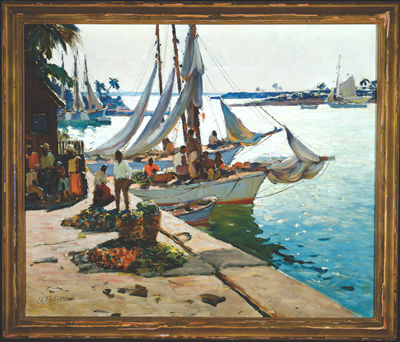 Born in Rotterdam, Holland on Feb. 20, 1888. Thieme spent most of his career in Massachusetts and Florida, but was in Los Angeles in 1931-32. He died in Greenwich, CT on Dec. 7, 1954.
Exh: Hatfield Gallery (LA), 1931; Pasadena Society of Artists, 1932; San Francisco Art Annual, 1932.Biography from The Lusher Gallery LLC
ANTHONY THIEME (1888-1954) was one of America’s most successful artists of the first half of the twentieth century, one of only a handful of American marine and landscape painters of this period whose work occupies the walls of museums and serious private collections. He was a major figure of the Rockport (MA) School of American regional art, and a contemporary of important Rockport artists Aldro Hibbard, Emil Gruppe, W. Lester Stevens, Antonio Cirino, and Marguerite Pierson. Like other Rockport artists, his style was influenced by Impressionism, with special attention paid to the effects of light (especially upon water), but also by the Dutch tradition of seascape painting. Throughout his career, he favored painting en plein air, because it allowed him to better capture the atmosphere’s fleeting effects, and his proficiency in this method earned him the title ‘Master of Light and Shadow.’
Thieme was born in Rotterdam, Holland on February 20, 1888. His parents, Karel and Alida Cornelia Thieme, named him Antonius Johannes, (which he changed upon gaining resident status in America). The young ‘Antoon” (as his parents called him) showed artistic abilities at an early age, and his proficiency at drawing attracted the attention of a local school master, who took him for visits to the art shops of Rotterdam, where the child viewed and learned from the drawings of Rembrandt, Vermeer, Hals, Mauve, and Van Gogh. Thieme’s parents, however, did not believe that an artistic career was a promising vocation for their favorite son, and so they sent him off to a naval school in the north of Holland, hoping that a close proximity to the ocean would instill in him a love of ships, and perhaps lead to a future as a master mariner like his uncle. But the effect of this experience was only to provide Thieme with a further opportunity to study ships and their rigging at close quarters, and perhaps deepen his fascination with the dappling effect of sunlight in water, a theme which inspired him throughout his long and prolific career.
In 1902, at the age of fourteen, Thieme enrolled at the Academy of Fine Arts in Rotterdam, where he remained for two years. This was followed by a brief period of matriculation at the Royal Academy in The Hague. But despite his training, he could not convince his parents to support his artistic leanings, and so, at the age of seventeen, he made the fateful decision to leave home and pursue his passion for art.
Thieme’s first stop wasDusseldorf, Germany. Upon his arrival, he was fortunate to find an excellent mentor in George Hacker, an art instructor who also did stage design for the local theatre. Hacker was a rigorous teacher, and Thieme worked hard at improving his skills at landscape painting; he also used the opportunity to study the craft of stage design, a profession which would support him in the lean years before success as a painter. Being a restless soul, Thieme took leave of Dusseldorf after three years and set out for Zurich, Switzerland. While painting in that city, he met an American art student with whom he decided to walk to Italy, sleeping out of doors and sketching along the way. When the American decided to stop at Lake Como, Thieme kept walking, eventually reaching Turin, Italy, where he obtained employment with Guiseppe Mancini, an architect and painter who had been commissioned to do stage sets for a production of La Giaconda. Thieme proved an able assistant and continued to gain knowledge in the craft of stage-design.
In 1909, Thieme left his position with Mancini and enrolled in the Scuola di Belli Arti (School of Fine Art) in Turin to study with the noted professor Carlo Bini. He spent a year there before moving on to Naples, where he resided for two years, sketching and painting. Unfortunately, amidst all the traveling, a trunk filled with sketches Thieme had executed in Germany and Switzerland was lost forever.
Thieme was very fond of his years spent in Italy, particularly of his time spent in Naples and in the ancient city of Pozzuoli. He used this opportunity to study the impressions of light and shade created by the strong Mediterranean sun. During this period he also learned to sing many operatic arias in fluent Italian, his favorite being Manon Lescaut. Like many painters, music played a vital role in his life.
While in Naples, Thieme met a Belgian sculptor whom he accompanied to London, England. Inspired by the ancient architecture of buildings there, especially St. Paul’s Cathedral, he drew a series of sketches, which he promptly sold to a firm on Fleet Street. Using the money to book passage to America, soon thereafter he arrived in New York City. His training in stage design helped him to land a job painting stage sets for the Russian ballerina Pavlova at the Century Theater. Yet despite what was considered good pay for this time-period (60 dollars per week), Thieme was upset with the lack of respect accorded this profession in America, where the work was rushed through in what he deemed to be a careless manner, compared to Europe, where stage settings were considered high art. Thus, when his commission at the Theatre ended, he packed his bags and, with a fellow-artist as a traveling companion, embarked on a steamer for South America. Upon their arrival in Rio de Janeiro, the pair found a mural painter who employed them on a project doing figure work. The painter was so impressed with Thieme’s sketches that he purchased one for one hundred dollars, an enormous sum of money in 1913 Brazil. When that commission ended, the pair moved on to Argentina, which was in the grip of a depression. One day, while spending their last centavos on a meager breakfast, a man whom they had spoken to on arrival suddenly appeared and asked Thieme to paint twenty-seven figures for a theatrical set, helping him stave off penury for a while longer. Thieme’s traveling companion, however, decided he wanted to paint in Russia, and asked Thieme to join him there once his commission was finished. Thieme set out to do just that, but, while on shipboard, he met a group of passengers who, upon learning of his profession, prevailed upon him to visit Paris - the true mecca of artists, they argued - before proceeding on to Russia.
Paris in 1913 was also in the grip of a widespread depression, and Thieme initially eked out a living by exhibiting his sketches in the window space of several small, cramped stores run by locals whom he had befriended. Fortuitously, though, he ran into the very artist with whom he had been traveling and who had set out for Russia, but had also ended up in France. Thieme’s friend immediately obtained work for him, and the two were kept busy with stage work in Paris, and then London, for some time. But Thieme eventually found the wanderlust gnawing at him again, and decided to return to Italy, where he dedicated himself to painting and sketching. From there he returned to America, with a contract for stage work in New York, but fate stepped in and, instead of New York, he found himself in Boston.
Boston in the early part of the twentieth century was a city of wide, tree-lined streets, intriguing back alleys, gracious brick town houses, and the ambience of the best European cultural centers. Thieme - always a European at heart - quickly fell in love with the city. Finally, he had a found a place where his roving nature was imbued with an air of tranquility. He tore up his New York contract and went to work designing stage scenery for the Copley Theatre, a job which would occupy him for nearly a decade; Additionally, he acquired a studio in the Copley Square area of Boston’s Back Bay, where he did easel paintings, landscapes, marines, and book illustrations, such as Talisman by Sir Walter Scott. Thieme’s association with theatrical producer Henry Jewett, and the highly regarded productions of the Copley Theatre, helped to promote his reputation as a fine-artist. In 1928 he was offered his first exhibition, at the renowned Grace Horne Galleries in Boston. The exhibit opened to critical acclaim, enabling him to give up his work as a stage designer and dedicate his life to painting.
Also in 1928, Thieme received his first award, the first prize in Landscape at the North Shore Arts Association, Gloucester, for a painting entitled Virginia Homestead, which, in a review in the July 14, 1928 edition of the Boston Evening Transcript, was said to “epitomize Southern charm - tall, white pillars, people on a porch, sun-flecked velvety turf.” Thieme’s relationships with Boston’s North Shore artists led both to new friendships and a new direction in his life. Richard Recchia, the well-known sculptor, introduced him not only to picturesque Rockport - a quaint old art colony on the tip of Cape Ann, Massachusetts - but also to Lillian Beckett, a young woman from Portland, Maine who, in 1929, became Thieme’s wife. The couple never had any children, choosing instead to dedicate their lives to one another - and to Thieme’s painting. Lillian, or ‘Becky’ as she preferred to be called, was Thieme’s staunchest ally, not only during their twenty-five year marriage, but also in the years after his death where she did everything she could to promote his artistic reputation. The couple purchased a one-hundred and fifty year old cottage in Rockport, and settled into a routine whereby Thieme painted and tended the land he acquired around the cottage. The fishing boats, white-painted cottages, and church steeples of the picturesque village served as a continual inspiration to Thieme. He also became a highly-regarded art instructor, directing the Thieme Summer School of Art in Rockport from 1929 to 1943, when he was forced to close the school due to ill health. One of the most famous pieces of advice he gave to his admiring students is contained in his collection of papers which are stored in the Archives of American Art in the Smithsonian Institution: “A good landscape painter must paint fast to catch the light of any hour. Unless you know what to put in, what to leave out, the result is a mess. A good carpenter has the best of tools. A good artist should have the same. Use only the best canvas, brushes, and paint. How can you expect to turn out a good canvas if your palette is dirty? Wear holes in the soles of your shoes, but spend money on plenty of paint.”
Thieme’s reputation as a master of ‘sunlight and shadow’ continued to grow. Galleries clamored to carry his work. In 1930 he was elected a member of the prestigious Grand Central Galleries in New York, and exhibited with them regularly. Above all, he loved to paint ‘Motif No. 1’, the old red fishing shack in Rockport Harbor which he painted so many times (four hundred by some accounts) that the image became an internationally recognized symbol of the art colony. In fact, Thieme has been credited with doing more than any other artist to publicize nationwide the many attributes of his adopted hometown.
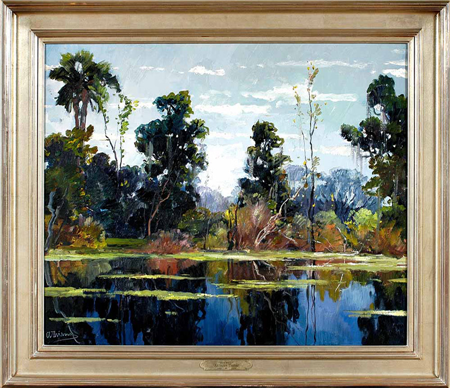
In 1935 Thieme became a naturalized citizen of the United States, and after World War Two, the Thiemes made St. Augustine, Florida their winter home. Tragedy, however, struck in 1946, when his Rockport studio burned down, together with much of his work of the previous thirty years. Rather than immediately rebuild his life in Massachusetts, Thieme struck out on a new journey of exploration. HIs initial landing-place was Charleston, South Carolina, where he spent two months in prolific activity, inspired by the revelation of light and color far more intense than that to which he had become accustomed. The work that he produced in Charleston was“a far cry from his picturesque New England harbor scenes” as one reviewer acknowledged after taking in Thieme’s 1947 Exhibition at the Grand Central Galleries. The serenity and tonal discipline of his seascapes was set aside for elaborations of wrought iron, profusions of blossoms, and the dense, tropical foliage which he witnessed in Charleston. After concluding his stay in South Carolina he continued on his journey: to Nassau (the Bahamas, where he had previously visited and painted) in 1948, to Guatemala in 1949, to the Riviera in 1951, and to Spain in the year of his death, 1954. He also spent time painting in Grasse, France, and his work from this period was exhibited in 1950 at a critically acclaimed show at the Bernheim-Jeune Galleries in Paris. Though he continued to earn praise and win prizes for the excellent and timeless quality of his work, he was not a happy man. He found Europe much changed after the ravages of war. His soul had always remained that of a European, and it saddened him to see what had become of the countries he had once known. His wife recounted (Thieme papers; Smithsonian Institution) that her husband often said that “‘he was born fifty years too late. He disliked the rush and roar of the modern age... this conflict was always within him, the longing to paint peace and quiet, beauty and harmony, yet confronted daily with the ugliness of modernity.”
After spending much of 1954 painting on Majorca, and the east coast of Spain, Thieme returned home to Rockport, weary and emotionally drained. He brought back with him an abundance of work, to be exhibited at an upcoming major show at the Grand Central Galleries. On December 6th of that year, the Thiemes, en route to spend the winter in St. Augustine, took a break in their journey in Greenwich, Connecticut. That morning, in the bathroom of their hotel room, Anthony Thieme, unable to resolve his deep inner turmoil, or perhaps distressed over an unpublicized major illness, shot himself. He was sixty-six years old.
EXHIBITIONS:
1930-1934 National Academy of Design; 1930 Art Institute of Chicago; 1929-1931 Pennsylvania Academy of Fine Arts; 1932 Corcoran Gallery of Art; 1930-1931 Los Angeles Museum of Art (prize); 1932 Albright Art Gallery; 1931 Detroit Institute of Art; 1929-1931 Salamagundi Club (prizes); 1928-1931 Springfield, Utah (prizes); 1928 Gloucester Art Association (prize); 1927-1928 Springfield Art League (prizes); 1930 North Shore Art Association (prize); 1930 Connecticut Academy of Fine Arts (prize); 1930 New York Water Color Club (prize); 1930 Boston Tercentenary Exhibition; 1930 Ogunquit Art Center; 1931 Hatfield Gallery, LA; 1931 New Haven Painters and Clay Club (prize); 1931 Washington Water Color Club (prize); 1932 Albright Art Gallery (prize); 1932 Pasadena Society of Artists; 1932 San Francisco Art Annual; 1938 Los Angeles Museum of Art; 1938 Buck Hill Falls Art Association (Pennsylvania) (prize); 1944 Jordan Marsh Exhibition (Boston) (medal); 1949 Pan-American Art Show (Miami) (prize)
MEMBERSHIPS:
American Artists Professional League; American Water Color Society; Art Alliance of America; Boston Art Club; Boston Society of Artists; California Academy of Fine Arts; Connecticut Academy of Fine Arts; Gloucester Society of Artists; National Arts Club; New York Water Color Club; North Shore Art Association; Philadelphia Art Alliance; Providence Water Color Club; Rockport Art Association; Salmagundi Club; Springfield Art League
COLLECTIONS:
Albany Institute of History and Art, NY; Beach College, Storrs, Connecticut;; City of New Haven Collection; Dayton Art Institute; Los Angeles County Museum of Art; Metropolitan Museum of Art; Montclair Art Museum; Museum of Fine Arts, Boston; New Britain Museum of Art, CT; Pittsfield Museum of Art, MA; College of Springfield, Utah; University of Iowa
Written January 2015 by Brian Flon, author of "Hell's Kitchen Requiem" (2014), available as an e-book at Amazon, ITunes, and Barnes & Noble.
Permission to reproduce on askART provided by Lusher Gallery LLC on August 22, 2019.
Copyright note: ©The Lusher Gallery LLC 2015. This biography may NOT be reproduced in whole or in part without the prior written consent of The Lusher Gallery LLC.Biography from Charleston Renaissance Gallery
 Anthony Thieme was born in Rotterdam, Holland. He studied at the Academy of Fine Arts in Rotterdam (1902-04), at the Royal Academy at The Hague (1905), as an apprentice artist in Dusseldorf, Germany, under George Hoecker, Germany's foremost stage designer (1906-08), and at the School of Fine Arts, Turin (1909-1910). After completing his studies he traveled in Europe, England, and South America, and he worked as a stage designer in these places both before and after coming to the United States in 1917. In 1919 he settled in Boston where for nine years he worked as a designer and painter of stage settings for the Copley Theatre, while also doing book illustrations for Boston publishers.
By 1927, he had established a studio at Cape Ann in Rockport, Massachusetts, where he taught summer painting classes and became well-known for his seascapes and shore scenes. While he worked in an Impressionist manner, he was also profoundly influenced by the Dutch seascape tradition, and was particularly interested in the effects of light on water. His work was exhibited in New York, Washington, Paris, and London, and was acquired by many museums.
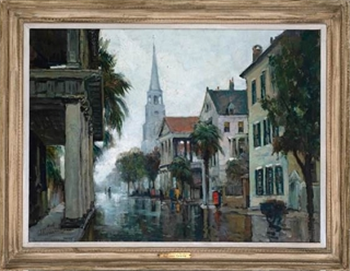
In 1946, Thieme's Cape Ann studio burned down, together with much of his work of the previous thirty years. Rather than rebuild his life in Massachusetts, Thieme struck out for territory which he had not previously explored. His first stop was Charleston, South Carolina, where he spent two months in prolific activity, inspired by the revelation of light and color far more intense than that to which he had become accustomed.
The paintings that he produced in Charleston were a far cry from his "picturesque New England harbor scenes," as the reviewer of Thieme's exhibition in 1947 at the Grand Central Art Galleries acknowledged. The serenity and tonal discipline of his seascapes was abandoned for the elaborations of wrought iron and profusion of blossoms that Charleston imposed on his senses. The heady aroma of the Southern landscape induced him to continue his travels - to St. Augustine and Nassau in 1948, to Guatemala in 1949, to the Riviera in 1951, and to Spain in the year of his death, in 1954.
Source:
ART AND ARTISTS OF THE SOUTH: The Robert P. Coggins Collection, Bruce W. Chambers, Ph.D., University of South Carolina Press, 1984, pp. 80-81.Biography from Pierce Galleries
Anthony Thieme (American, 1888-1954):
Anthony Thieme was a painter, designer and teacher who was born in Rotterdam, Holland in 1888. He was trained at the Royal Academy in Holland and in Italy and Germany. He studied with George Hacker, Guiseppe Mancini, Garlobini and Guardaciona. He came to America in 1920 and was instrumental in making Rockport, MA a center for art and artists. After 1950, he wintered in St. Augustine, Florida and summered in Rockport.
Position: Teacher, Thieme School of Art, Rockport, MA.
He was a member of the American Water Color Society; Salmagundi Club; California Academy of Fine Arts; Boston Art Club; Providence Water Color Club; Boston SAC; North Shore Art Association; Springfield Art League; Rockport Art Association; American Artists Professional League; Gloucester Society of Artists; New York Water Color Club; Philadelphia Art Alliance; the National Arts Club and more.
Awards include medals at L.A. County Museum of Art (1931); Salmagundi Club, NYC (1929, 1931); Springfield Utah (1928, 1931); Gloucester AA (1928); Springfield Art League (1927, 1928); North Shore AA (1930); CAFA (1930); Jordan Marsh Exhibition (1944); NYWCC (1933); New Haven Paint & Clay Club (1931); Washington Water Color Club (1931); Buck Hill Falls AA, PA (1938); Dow Award, St. Augustine, FL (1949); and more.
Work is represented in the permanent collections at the Museum of Fine Arts, Boston; Pittsfield Museum of Art, MA; Albany Inst. Of History & Art, NY; Dayton Art Institute; City of New Haven Collection; Springville, Utah; University of Iowa; Metropolitan Museum of Art; Montclair Art Museum; L.A. County Museum of Art, CA; New Britain Museum of Art, CT; Buck Hill Falls, PA; and more.
Submitted by P.J. PierceBiography from Hess Fine Art & Auctions
One of the best-known plein-air American impressionist artists, Anthony Thieme claimed, "the open air is my studio". He was born on February 20, 1888 in Rotterdam, Holland and studied in Germany under George Hacker in Dusseldorf. Later, in Turin, Italy, Giuseppe Mancini and Carlo Bini showed him more in the wonderful world of art.
Already having an insatiable taste for art, when he immigrated to America in 1917, he began painting Broadway backdrops in New York and eventually settled in Rockport, Massachusetts where he established his studio. It was here in Rockport where he found his impressionist- inspired views of the local harbor, streets, quarries, and coastline.
During this time he also operated the Thieme School of Art from 1929 to 1943. It is here that he was inspired to paint this painting entitled " Sunlight Day" which has been inscribed on the back of this painting along with Cove hill, this being the specific area in Rockport.
His technique differs from most artists of his time period but it is thought to be a product of his traveling lifestyle, and being a part of the world. He typically wintered in South Carolina, Guatemala, Mexico, and the Bahamas, as well as in St. Augustine, Florida, where he took a studio in 1947.
Because of his frequent intercourse with multiple environments, he was enveloped in different cultures and scenes that can be shown through his colors, strokes, and subject matters. It was so refined that art critics to connoisseurs alike praised his work. He has won numerous prizes, has and is featured in a number of museums, and has found a permanent place in literature.Biography from The Johnson Collection
 ANTHONY JOHANNES THIEME (1888-1984)
Anthony Thieme was born in the Dutch port city of Rotterdam in 1888. He studied at the Academy of Fine Arts in Rotterdam, at the Royal Academy at the Hague, as an apprentice to George Hoecker, a well known stage designer in Düsseldorf, Germany, and to Antonio Mancini, an Italian Impressionist. After completing his studies, Thieme journeyed throughout Europe and South America, working in stage design to support his travels. Thieme first came to the United States in 1917 and initially worked as a set designer and book illustrator first in New York and later in Boston.
By the late 1920s, Thieme had married and moved from Boston to Cape Ann in Rockport, Massachusetts, an emerging art colony. Like the other Rockport artists, his style was influenced by Impressionism, with special attention paid to the effects of light, but also by the Dutch tradition of seascape painting. Throughout his career, Thieme favored painting en plein air, or outside, because it allowed him to better capture the atmosphere's fleeting effects. He has been referred to as the "Master of Light and Shadow."
Thieme's paintings were often met with critical acclaim and were displayed at galleries in New York, London, and Paris. He also established the Thieme School of Art at Cape Ann in 1929 and taught classes out of his studio until 1943. Tragedy struck in 1946 when his studio burned to the ground, destroying much of the work he had produced over thirty years. Devastated by this loss, Thieme left Massachusetts in search of new adventures and inspirations. He traveled south to Charleston, South Carolina and was greatly inspired by the dense, tropical foliage and the warm, coastal light. He spent two months in Charleston, painting prolifically, before continuing on to Florida, the Caribbean, and Central America. Until his mysterious death in 1954, Thieme spent his summers in Rockport and the winter months based in St. Augustine, Florida.
Throughout his career, Thieme exhibited his work widely and was active in numerous art associations and clubs. He participated in exhibitions across the country including ones at the Pennsylvania Academy of the Fine Arts, and the Corcoran Gallery in Washington, D.C. He was a member of the National Arts Club, the American Watercolor Society, the Salmagundi Club, the Boston Art Club, the Art Alliance of America, and the Rockport Art Association.
The Johnson Collection, Spartanburg, South Carolina
www.thejohnsoncollection.orgBiography from Modern Art Dealers
Sharing a common country of birth (Holland) and a love of color and boldness in their paintings, Vincent Van Gogh and Anthony Thieme both endured emotional turmoil and both ended their lives the same way.
Striking out on his own at the age of seventeen, Johannes Thieme (he later changed his first name to Anthony), became a fearless and adventurous traveler, linguist, and avocational opera singer, who initially found employment as a scenic backdrop painter in New York City and then in Boston. Along his artistic way he studied oil painting, watercolor, printmaking, and drawing in Dusseldorf, Naples, the Hague, and Paris.
Anthony Thieme and his wife, the former Lillian Beckett, met at the wedding of Richard Recchia, and the noted sculptor suggested the tip of Cape Ann, the quarry town of Rockport, as an ideal spot for the en plein air painter to set up his easel. Thieme did so for many summers, and he never strayed very far from his favorite subject, the angular, red-painted, lobster buoy-covered "Motif #1."
It is estimated that Thieme painted about 400 canvases of the now famous fishing shack (rebuilt after a terrific winter storm), usually with hunchbacked fishermen standing at the wharf's edge. The fishing boats, white-painted cottages, and church steeples of the picturesque village were a continual inspiration to Thieme, and gave an Old World, laid-back satisfaction to the prolific artist who often could be quite curt and outspoken. However, his admiring students were dismayed, when due to health issues, he was forced to close the Thieme Summer School of Art, which had beeen under his direction from 1929 to 1943.
Anthony Thieme received favorable criticism and artistic awards during his career, including two in 1930: the Delano Prize from the New York Watercolor Club, and the Athenaeum Prize at the Connecticut Academy of Fine Arts; the Lucien Powell Citizen Jury Prize from the Los Angeles Museum (1931); the Gold Medal for the Best Painting in New England by the Contemporary Artists Association (1944); and an award for the best marine painting at the Pan-American Art Show in Miami (1949). Anthony and "Becky" wintered in St. Augustine, and after he became a naturalized citizen of the United States in 1935, they visited Mexico and Guatemala where the hot, primary colors of the two Spanish- language countries influenced his palette.
Museums:
The Metropolitan Museum of Art, the Boston Museum of Fine Arts, the Art Institute in Chicago, and museums in London and Brussels have Thieme's works in their collections, and he is a much sought after artist to this day.