Page loaded successfully. Showing biography for Antoni Piotrowski.
Antoni Piotrowski BIOGRAPHY
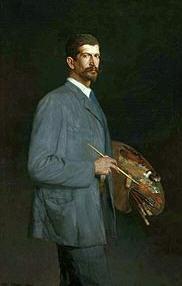
1853 Nietulisko Duze, Russia/Poland - 1924 Warsaw, Poland. Known for: War correspondant and illustrator, horses, portraits, genre.
Antoni Piotrowski (Bulgarian): . Antoni Pyotrovski; 1853–1924) was a Polish Romanticist and realist painter who worked as war correspondent and illustrator for various Western European weeklies and... Read full biography
Antoni Piotrowski (Bulgarian): . Antoni Pyotrovski; 1853–1924) was a Polish Romanticist and realist painter who worked as war correspondent and illustrator for various Western European weeklies and periodicals in late-19th century during the Liberation of Bulgaria. Piotrowski was born in 1853 into... Read full biography
Antoni Piotrowski (Bulgarian): . Antoni Pyotrovski; 1853–1924) was a Polish Romanticist and realist painter who worked as war correspondent and illustrator for various Western European weeklies and periodicals in late-19th century during the Liberation of Bulgaria. Piotrowski was born in 1853 into a family of sheet iron worker in Nietulisko Duze near Kunów, then in the Russian sector of the partitioned Poland. From 1869 on, Piotrowski studied painting with professor Wojciech Gerson in Warsaw.... Read full biography
Antoni Piotrowski (Bulgarian): . Antoni Pyotrovski; 1853–1924) was a Polish Romanticist and realist painter who worked as war correspondent and illustrator for various Western European weeklies and periodicals in late-19th century during the Liberation of Bulgaria. Piotrowski was born in 1853 into a family of sheet iron worker in Nietulisko Duze near Kunów, then in the Russian sector of the partitioned Poland. From 1869 on, Piotrowski studied painting with professor Wojciech Gerson in Warsaw. Between 1875 and 1877 he studied in Munich with Wilhelm Lindenschmit the Younger, and from 1877 to 1879, with Poland's nominal painter Jan Matejko at the Academy of Fine Arts in Kraków.[1] . In 1879, Piotrowski travelled to the newly liberated... Read full biography
Antoni Piotrowski (Bulgarian): . Antoni Pyotrovski; 1853–1924) was a Polish Romanticist and realist painter who worked as war correspondent and illustrator for various Western European weeklies and periodicals in late-19th century during the Liberation of Bulgaria. Piotrowski was born in 1853 into a family of sheet iron worker in Nietulisko Duze near Kunów, then in the Russian sector of the partitioned Poland. From 1869 on, Piotrowski studied painting with professor Wojciech Gerson in Warsaw. Between 1875 and 1877 he studied in Munich with Wilhelm Lindenschmit the Younger, and from 1877 to 1879, with Poland's nominal painter Jan Matejko at the Academy of Fine Arts in Kraków.[1] . In 1879, Piotrowski travelled to the newly liberated Principality of Bulgaria as a correspondent of the British weekly newspapers The Graphic and The Illustrated London News as... Read full biography
Artist Biography
Biography page for Antoni Piotrowski ((1853 - 1924)), known for War correspondant and illustrator, horses, portraits, genre. Showing 3 biographical entries and 0 sample artworks.
Antoni Piotrowski - Artist Info
About Antoni Piotrowski
Name variants
Antoni Pyotrowski
Biography from the Archives of askART
 Antoni Piotrowski (Bulgarian):
Antoni Pyotrovski; 1853–1924) was a Polish Romanticist and realist painter who worked as war correspondent and illustrator for various Western European weeklies and periodicals in late-19th century during the Liberation of Bulgaria.
Piotrowski was born in 1853 into a family of sheet iron worker in Nietulisko Duze near Kunów, then in the Russian sector of the partitioned Poland. From 1869 on, Piotrowski studied painting with professor Wojciech Gerson in Warsaw. Between 1875 and 1877 he studied in Munich with Wilhelm Lindenschmit the Younger, and from 1877 to 1879, with Poland's nominal painter Jan Matejko at the Academy of Fine Arts in Kraków.[1]
In 1879, Piotrowski travelled to the newly liberated Principality of Bulgaria as a correspondent of the British weekly newspapers The Graphic and The Illustrated London News as well as the French news magazines Illustration and Le Monde Illustré.
He moved back to Paris only to return to Bulgaria in 1885 to join the Serbo-Bulgarian War as a Bulgarian volunteer. For his merits during the fighting he was honoured with an Order of Bravery.
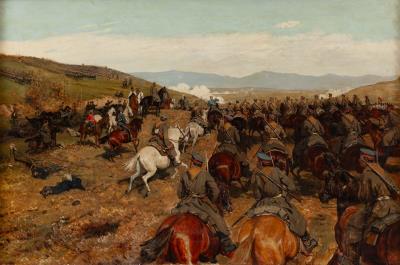
During his time as an artist in the Bulgarian Army Piotrowski painted the Battle of Slivnitsa, the storming of Tsaribrod and the Bulgarian entry in Pirot. He also published illustrations from the war in various Western European illustrated periodicals.
Among his works were portraits of Bulgarian princes (knyaze) Alexander of Battenberg and Ferdinand of Saxe-Coburg-Gotha; Piotrowski was awarded an Order of Civil Merit by the latter. All his nine historical battle-scenes painted in Bulgaria were purchased by the Bulgarian state, and are exhibited in the National Museum of Military History in Sofia.
Piotrowski returned to Bulgaria in 1889: he visited Batak and painted his epic canvas The Batak Massacre. This painting of his won an award at the Plovdiv Fair in 1892. In 1900 Piotrowski returned to Poland and settled in Warsaw. In 1905, he was a war correspondent in Manchuria.
He died in 1924 in Warsaw.
Source:
Wikipedia, 2022Biography from Desa Unicum
Antoni Piotrowski came from the Warsaw artistic milieu. He began his studies in painting in 1869 in Wojciech Gerson's Drawing Class. He received his academic education at the Munich Academy in 1875-77 and at the Krakow School of Fine Arts, for the next two years with Jan Matejko.
However, it did not stop there. This is how the next stage of Piotrowski's education was characterized by Wladyslaw Prokesch -
"Unable to be concerned only with the ideals of Matejko, who wanted to make every talented pupil of the Krakow school of fine arts into a painter of historical scenes, Piotrowski wanted to get acquainted with other directions of Western painting and left for Paris. In the capital of France, where he spent four years, he did not waste any time. He exhibited there successively in the Salon his paintings - 'Chata w fogie', Then the artist started working as a correspondent-illustrator of English and French magazines, documenting the Bulgarian-Serbian war. While in Bulgaria, he created a series for the National Gallery of Sofia, and also became famous as a portrait painter of the local aristocracy. The artist traveled a lot. His next expedition was a trip to the Middle East in 1897 and 1903. This time the main topic of his works was the Greek-Turkish war that was taking place there.
Piotrowski also willingly took up genre themes from the life of the countryside and historical themes, such as scenes from the January Uprising. One of his most famous painting commissions was participation in the creation of the monumental panorama of Berezina.T he painting On the way to the hunt shown in the auction catalog is an example of a work illustrating the life of the Polish countryside.
Piotrowski had the opportunity, together with his friends - Józef Chelmonski and Stanislaw Witkiewicz, to go to open-air studies in the provinces. His interest was aroused there by the silhouettes of horses, figures of peasants and the power of nature. The daring composition is also an excellent example of the artist's style, which he developed during his studies on the Izara.
Although the work was created in 1883, i.e. in the Paris period, it fully reveals the atmosphere of the Munich Stimmung. The speeding sleigh was harnessed by a pair of black horses. The choice of such a theme gave the artist the opportunity to show the dynamics of these animals and show off the ability to use strong perspective shortcuts.You can easily compare Piotrowski here with probably the most outstanding Polish painter of speeding horses - Józef Chelmonski.
Both painters knew each other very well from their Warsaw times. For some time in Paris, Piotrowski visited Chelmonski's atelier there. Like him, he painted numerous scenes of sleds, sleds, and markets. Compositions of this type enjoyed great popularity in the French capital at that time. It was a great earning opportunity for many artists, so they eagerly flocked to the Seine. Orders for monumental scenes flowed both from European collectors and from a wealthy American clientele who was looking for such performances. The painting presented in the catalog, once in the collections overseas,Biography from Desa Unicum
Antoni Piotrowski (1853 - 1924)
Antoni Piotrowski is a painter educated in the studios of Wojciech Gerson and Jan Matejko and in the circle of the Munich Academy of Fine Arts. He is known mainly for his genre performances, in which he strongly emphasized folk motifs.
Piotrowski was also an excellent illustrator of history. He has repeatedly taken up threads taken from the more or less distant past, in which there are often figures of riders on horses, rendered with incredible skill in the art. The turning point in Piotrowski's work was undoubtedly the trip to the Balkans.
In 1885, as a correspondent of several British and French magazines, he left for Bulgaria. He found himself in the whirlwind of war events there. He dealt mainly with providing illustrations, among others. for such titles as The Illustrated London News or Le Monde Illustré.
The mysterious image of a woman in shimmering robes, created in 1916, is undoubtedly a reminiscence of a trip to those parts of Europe. A model with a headscarf and a transparent veil on her face is an interesting example of the artist's interest in the local population.