Page loaded successfully. Showing biography for Assadour.
Assadour BIOGRAPHY
Born 1943 Beirut, Lebanon. Known for: Engraving and gouache painting, geometric shapes, and figures in landscape.
“Assadour is born in Beirut in 1943, in a Lebanese-Armenian family. He went abroad at the age of 18 to study engraving and painting, first in Italy and later in Paris. Assadour is recognized as a... Read full biography
“Assadour is born in Beirut in 1943, in a Lebanese-Armenian family. He went abroad at the age of 18 to study engraving and painting, first in Italy and later in Paris. Assadour is recognized as a great master in the field of engraving, and he developed a renowned oeuvre of gouaches on paper and... Read full biography
“Assadour is born in Beirut in 1943, in a Lebanese-Armenian family. He went abroad at the age of 18 to study engraving and painting, first in Italy and later in Paris. Assadour is recognized as a great master in the field of engraving, and he developed a renowned oeuvre of gouaches on paper and oils on canvas. His paintings are rare and often sought after as he did not execute many. A recurrent theme in Assadour’s paintings, is figures inserted in a land or cityscape which is only... Read full biography
“Assadour is born in Beirut in 1943, in a Lebanese-Armenian family. He went abroad at the age of 18 to study engraving and painting, first in Italy and later in Paris. Assadour is recognized as a great master in the field of engraving, and he developed a renowned oeuvre of gouaches on paper and oils on canvas. His paintings are rare and often sought after as he did not execute many. A recurrent theme in Assadour’s paintings, is figures inserted in a land or cityscape which is only suggested by the geometric lines and shapes of the composition. This constructivist approach refers to Assadour’s attempt to put some order to the world’s chaos, like the one he experienced back in Beirut and just like the disorder he still... Read full biography
“Assadour is born in Beirut in 1943, in a Lebanese-Armenian family. He went abroad at the age of 18 to study engraving and painting, first in Italy and later in Paris. Assadour is recognized as a great master in the field of engraving, and he developed a renowned oeuvre of gouaches on paper and oils on canvas. His paintings are rare and often sought after as he did not execute many. A recurrent theme in Assadour’s paintings, is figures inserted in a land or cityscape which is only suggested by the geometric lines and shapes of the composition. This constructivist approach refers to Assadour’s attempt to put some order to the world’s chaos, like the one he experienced back in Beirut and just like the disorder he still sees today, and the first of all disorders, the Armenian genocide. In the artist’s latest works, monumental figures seem more and more to rep... Read full biography
Artist Biography
Biography page for Assadour ((Born 1943)), known for Engraving and gouache painting, geometric shapes, and figures in landscape. Showing 1 biographical entries and 0 sample artworks.
Assadour - Artist Info
About Assadour
Name variants
Bezdikian Assadour, Assadour Bezdikian
Biography from the Archives of askART
 “Assadour is born in Beirut in 1943, in a Lebanese-Armenian family. He went abroad at the age of 18 to study engraving and painting, first in Italy and later in Paris. Assadour is recognized as a great master in the field of engraving, and he developed a renowned oeuvre of gouaches on paper and oils on canvas. His paintings are rare and often sought after as he did not execute many.
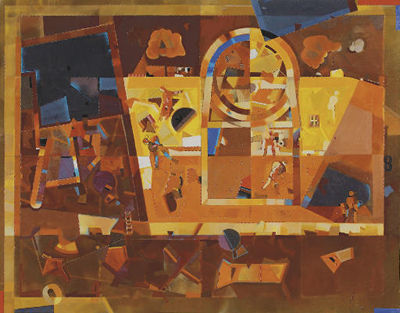
A recurrent theme in Assadour’s paintings, is figures inserted in a land or cityscape which is only suggested by the geometric lines and shapes of the composition. This constructivist approach refers to Assadour’s attempt to put some order to the world’s chaos, like the one he experienced back in Beirut and just like the disorder he still sees today, and the first of all disorders, the Armenian genocide. In the artist’s latest works, monumental figures seem more and more to replace architectural structure and to be the core of the composition’s space.” (Claude Lemand)
Translated from French by Valérie Didier Hess.
_____
Joseph Tarrab, ASSADOUR. Painting / Motherland (1995)?
In his works, Assadour first seeks to find technical and artistic solutions to the graphic and plastic questions he asks himself. These solutions are the ones which generate his limited vocabulary of shapes and configurations applied: pentagram (a star with five branches), a dislocated or rather articulated cross, circles, crescents, rainbows, cut-outs and regular or irregular polygonal patterns, cross-hatching etc.?
When Assadour draws a straight line, he finds it monotonous so he makes it blossom into a starry pentagon before completing it. As he reaches its end, he needs a joint to make the transition so he creates a gesticulating and mobile cross-shaped figure which can produce either expansion depending on whether it unfolds itself, or contraction when it folds back.
Assadour lays out an empty space which is too empty according to him, so he decides to add a circle or a star, and so on. With the help of these simple elements and these geometrical atoms, his aim is to succeed in drawing up a time/space, ambiguous and with several meanings through discrepancies and discontinuities of planes and colorful areas, a procedure which goes back to the Safavid miniaturists.?
In the oil paintings, these discontinuities create ranges and planes which lean over, topple, capsize and get wrecked, sliding out from the canvas’ edges, as if being weighed down by their figural and chromatic density. The world seems to be scattered in a thousand pieces, with each piece carefully laid out and painted. There is a human puppet trapped in it, who is one element amongst others and who struggles, runs, gesticulates or takes the position of a crucified person, and this world then disintegrates, dragging bodies and goods in the depths of nothingness. A destabilizing anarchy which has been brilliantly and cleverly organized by its author condemns the defeat of an unstable and almost anti-cosmic world to disappear. This leak is no other than the flow of time, where each moment, each image and each thought slip out from the realm of consciousness. ?
It was unavoidable for the work to not be devoid of a meaning: despite their technical aspect, the pentagonal star and the cross are a couple of examples amongst others which are very ancient archetypes, much too embedded in History and symbolism to remain neutral. Among the rich plurality of their meaning, they symbolize an accomplished man, body, spirit and soul, who has regained his radiance.?
Assadour’s technical reflection therefore transforms itself into an almost spiritual meditation, unexpectedly similar to that of the Arab artist-geometricians whose complex arabesques were a representation for the Perfect Man (“Al Insan Al Kamel”). Hence some new textured colors appear on his palette, such as gold-, copper-, silver-, and carborundum-dust. The way in which he paints these flat colorful areas recalls the miniaturists’ techniques as well as the furrowed patterns in Japanese Zen gardens, the latter being the most emblematic place for meditation. These elements reflect Assadour’s `Middle Eastern illuminator’ characteristic, just as he admitted himself. He has no choice as he is trapped by his own formal and chromatic vocabulary of which the significance always ends up transcending the original purpose designated by Assadour.
These `assadourian’ views are coherent as he is always fully aware of how he proceeds. ?Furthermore, the notion of coherence is reaffirmed through his watercolors’ formal structure, which in a similar yet different way than in his oil paintings, creates a play between opposites: high, empty, light, ethereal, bearable against low, heavy, full, dense and suffocating. All the elements, which pile up at the bottom, attracted by the forces of gravity, being `caput mortuum’, waste, rubble, debris, levitate freely in the air at the top. ?
It is as if there were two worlds, a material and a spiritual one, of which the limits are defined by shade and light, transparency and opacity of the colors (burnt Umber and Sienna, ochre, purple, brown, beige, gold, copper, brick color, blue, with red, orange and yellow), infrequency and abundance of signs, silence and loquacity and by opening and closing. This mediation on the being, with its lightness and heaviness, spreads out over a framework made of isosceles triangles following the lines which have been traced by the folding and unfolding of the paper used as the artwork’s support.?
The underworld is not entirely lost for Assadour as the white areas and windows allow infiltration and communication between both worlds despite their segregation. In one of his paintings, there is even a tiny ladder, as if depicted to escape from the prison of shapes and colors. Despite everything, it seems that hope still exists, even within the darkest night. It is normal: does art not drive out yet call upon the `assadourian’ demons and does it not rescue the artist by letting him recreate the Creation after having de-created it? Is this `de-creation’ not one of the main exercises practiced by the high spiritual traditions? In any case, it is not the hope to escape from the painting for Assadour: just as the poet does not live on a planet Earth but rather in a language, the painter does not live in the world but rather in a painting. It is the only motherland from where no one can be evicted. Painting is Assadour’s inalienable Armenia-Harmony, perhaps his paradise once lost and now recovered ? Yet he says that he only knows Hell – let us call it his purgatory.
Translated from French by Valérie Hess
Source:
"Assadour," Galerie Claude Lemand, Web, 1/4/2018