Page loaded successfully. Showing biography for Audrey L Flack.
Audrey L Flack BIOGRAPHY
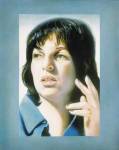
1931 New York City - 2024. Known for: Super real figure-genre and still life painting.
A photo-realist painter of popular images, Audrey Flack was committed to the idea that the greatest art is that which can be understood by the masses of people. She had major influence in the... Read full biography
A photo-realist painter of popular images, Audrey Flack was committed to the idea that the greatest art is that which can be understood by the masses of people. She had major influence in the revitalizing of still-life subjects in the 1970s and 1980s, and unlike most photo-realist painters was... Read full biography
A photo-realist painter of popular images, Audrey Flack was committed to the idea that the greatest art is that which can be understood by the masses of people. She had major influence in the revitalizing of still-life subjects in the 1970s and 1980s, and unlike most photo-realist painters was emotionally committed to her subject matter. She regarded emotional commitment as part of being feminine, something of which she is proud. Flack was one of the first painters to acknowledge that she... Read full biography
A photo-realist painter of popular images, Audrey Flack was committed to the idea that the greatest art is that which can be understood by the masses of people. She had major influence in the revitalizing of still-life subjects in the 1970s and 1980s, and unlike most photo-realist painters was emotionally committed to her subject matter. She regarded emotional commitment as part of being feminine, something of which she is proud. Flack was one of the first painters to acknowledge that she referred to photographs when painting and would project photos from slides onto her canvases, painting over the images. She began working in a representational style when Abstract Expressionism was dominating the art world. She is especially committed to... Read full biography
A photo-realist painter of popular images, Audrey Flack was committed to the idea that the greatest art is that which can be understood by the masses of people. She had major influence in the revitalizing of still-life subjects in the 1970s and 1980s, and unlike most photo-realist painters was emotionally committed to her subject matter. She regarded emotional commitment as part of being feminine, something of which she is proud. Flack was one of the first painters to acknowledge that she referred to photographs when painting and would project photos from slides onto her canvases, painting over the images. She began working in a representational style when Abstract Expressionism was dominating the art world. She is especially committed to subjects of strong-minded women, eschewing oppression, and openly associated with feminine objects such as finger-nail polish and china cups.... Read full biography
Artist Biography
Biography page for Audrey L Flack ((1931 - 2024)), known for Super real figure-genre and still life painting. Showing 3 biographical entries and 0 sample artworks.
Audrey L Flack - Artist Info
About Audrey L Flack
Biography from the Archives of askART
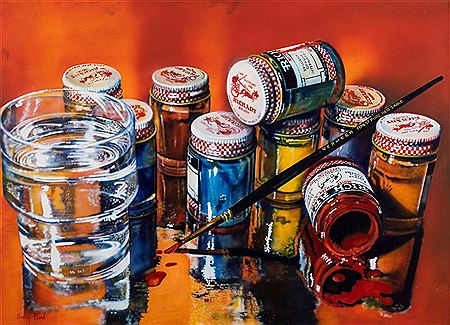 A photo-realist painter of popular images, Audrey Flack was committed to the idea that the greatest art is that which can be understood by the masses of people. She had major influence in the revitalizing of still-life subjects in the 1970s and 1980s, and unlike most photo-realist painters was emotionally committed to her subject matter. She regarded emotional commitment as part of being feminine, something of which she is proud.
Flack was one of the first painters to acknowledge that she referred to photographs when painting and would project photos from slides onto her canvases, painting over the images. She began working in a representational style when Abstract Expressionism was dominating the art world. She is especially committed to subjects of strong-minded women, eschewing oppression, and openly associated with feminine objects such as finger-nail polish and china cups.
Flack was raised in Washington Heights, New York and graduated from Cooper Union in 1951. Josef Albers, then the new chair of the Yale University School of Art and Architecture, actively recruited her as part of his attempt to upgrade the quality of the students in that department. But determined to be a realist, she fought with Albers continuously, rebelling against his aggressive and exclusively taught theories of hard-edged geometric expression. She earned a B.F.A. degree from Yale, and some said it was only by armed truce with Albers that she graduated.
Seeking strong, realistic anatomy training, she enrolled in the Arts Student League where she studied with Robert Beverly Hale and developed a unique figural style, often painting with Philip Pearlstein. She openly made fun of what she regarded as the male chauvinist, groupie behavior of the New York School of abstract-expressionist painters. She exhibited in the 1950s and often the only representational artist in the group, was perceived as hopelessly middle class in her appeal.
In the early 1960s, Flack began to copy black and white photographs, and her painting "Kennedy Motorcade," was the first color photo from which she copied. Because this photo so closely resembled the photo, she was much criticized by other photo-realist paintings. However, she countered that photos were just another aspect of reality.
By 1970, she was projecting color slides onto her canvases and began to do what became her trademark work, large-scale sensuous, vivid figure and portraits paintings and complex still lifes with gambling and religious iconography. Her work, often done with airbrush, is rarely smaller than six feet in height and width, because of the size, confrontational subject matter, and bright colors was often shocking to viewers.
Selected Books:
1972
Coke, Van Deren. The Painter and the Photograph, University of
New Mexico Press, Albuquerque
1972
Kultermann, Udo. New Realism, New York Graphic Society, New York
1973
Kortlander, William. Paintings With Acrylics, Van Nostrand Reinhold Co. New York
1973
Sager, Peter. Neue Formen des Realismus, Verlag M. DuMont Schauberg, Cologne
1973
Who's Who in American Art, R. R. Bowker & Co., Inc., New York
1974
Kamarck, Edward. Arts in Society: Women and the Arts, University of Wisconsin Extention, Madison, WI
1975
Art--A Women's Sensibility: The Collected Works and Writings of Women Artists, California Institute of the Arts, Valencia
1975
Battcock, Gregory. Super Realism, A Critical Anthology, E.P. Dutton & Co., New York
1975
Chase, Linda. Hyperrealisme, Rizzoli, Inc., New York
1975
Kultermann, Udo. Neue Formen des Bildes, Verlag Ernst Wasmuth, Tubingen, West Germany
1975
Nemser, Cindy. Art Talk, Charles Scribner's Sons, New York
1975
Pomeroy, Ralph. The Ice Cream Connection, Paddington Press Ltd., London
1975
Rose, Barbara. Readings in American Art, 1900-1975, Praeger Publications, Inc., New York
1975
Alloway, Lawrence. Topics in American Art Since 1945, Norton
1976
Peterson, Karen; Wilson, J.J. Woman Artists, Harper & Roe, NY
1976
Who's Who in American Art, R. R. Bowker & Co., Inc., New York
1977
Melville, Keith. Marriage and Family Today, Random House, NY
1977
Rose, Barbara; Brown, Jules D. American Painting, Skira/Rizzoli, NY
1977
Selleck, Jack. Faces, Davis Publications, Worcester, MA
1978
Lipman, Jean; Marshall, Richard. Art About Art, E. P. Dutton & Co., New York
1978
Saff, Donald; Sacilotto, Deli. Printmaking, Holt Rinehart & Winston, New York
1978
Walters, Margaret. The Nude Male: A New Perspective, Paddington Press Ltd., New York
1978
Flack, Audrey. "Louisa Ignacia Roldan," Women's Studies, Vol.6, Gordon and Breach Science Publishers Ltd., Great Britain; also published in Helicon Nine, 1979
1979
Chaet, Bernard. Artist's Notebook: Techniques and Materials, Holt, Rinehart and Winston, New York
1979
Lucie-Smith, Edward. Super Realism, Phaidon Press Ltd., Oxford
1979
Saff, Donald; Sacilotto, Deli. Screenprinting History and Process, Holt, Rinehart and Winston, New York
1979
Seeman, Helene Zucker; Siegfried, Alanna. SoHo, Neal-Schuman, NY
1980
Lucie-Smith, Edward. Art in the Seventies, Phaidon Press Ltd., Oxford
1980
Lindey, Christine. Superrealist Painting and Sculpture, William Morrow Company, Inc., New York
1980
Meisel, Louis K. Photorealism, Harry N. Abrams, Inc., New York
1980
Curtis and Hunt. A History and Technique: The Air Brush Book, Orbis Pubio, London
1981
Krantz, Les. The New York Review of Art, The Krantz Co., New York Audrey Flack (Page 34)
1981
Flack, Audrey. Audrey Flack On Painting, Harry N. Abrams, Inc., New York
1982
Rubinstein, Streifer, Charlott. American Women Artists from Early Indian Times to the Present, G. K. Hall & Co, Boston, p. 385, color plate 46
1982
Paschal, Robert. Air Brushing for Fine and Commercial Artists, Van Nostrand Rheinhold, New York
1982
Johnson, Ellen. American Artists On Art, 1940-1980, Harper & Row, New York
1982
Messer, Tom. 25 Artists-Photos by Hans Namuth, University Publishing of America, Frederick, MD
1982
Australian National Gallery - An Introduction, The Australian National Gallery, Canberra, p.115, illustration p.116
1983
Milman, Miriam. Trompe L'Oeil Painting, Rizzoli International, Publications, Inc., New York, p.69, Illustration
1984
Van Wagner, Judy Collischan. Women Shaping Art, Praeger
1984
Robbins, Corinne. The Pluralist Era, 1968-1981, Harper & Row, NY
1985
Russo, Alexander. Profiles on Women Artists, University Publications of America, Inc., Frederick, MD, p.57-70
1985
McCarter, William and Rita Gilbert. Living With Art, Alfred A. Knopf, Inc., p.53, plate #60
1985
Brommer, Gerald F. and George K. Horn. Art In Your Environment, Davis Publications, Inc., Worchester, MA, p.59, illustration
1985
Brommer, Gerald F. and George K. Horn. Art In Your World, Davis Publications, Inc., Worchester, MA, p.104, Illustration
1985
Krantz, Les. American Artists - An Illustrated Survey of
Leading Contemporary Americans, Facts on File Publications, New York, NY, p.110, Illustration p.113
1985
Hunter, Sam and John Jacobus. Modern Art, Second Edition, Harry N. Abrams, Inc., New York, NY, p.374, illustration p.708
1985
Krantz, Les. American Art Galleries, Facts on File Publications, New York NY, p.211
1985
Pelfrey, Robert; Mary Hall. Art and Mass Media, Harper & Row, New York, NY, Illustration p.131
1985
Paschal, Robert W.; Robert R. Anderson. The Art of the Dot, (Advanced Airbrush Techniques), Van Nostrand Reinhold Company, Inc., New York, NY, p.8, Illustration p.9
1985-86 Lucie-Smith, Edward. American Art Now, William Morrow and Company, Inc., New York, NY, Illustration p.84
1986
Martin, Alvin. American Realism - Twentieth Century Drawing and Watercolors, (The Glenn C. Janss Collection), San Francisco
Museum of Modern Art in association with Harry N. Abrams, New York NY, Illustration p.147, pp.127,153,212
1986
Siegel, Peter. The Complete Airbrush Book, Leon Amiel Publisher, New York, NY, pp.112-117
1986
Janson, H.W. History of Art, Harry N. Abrams, Inc., New York, NY (first revised edition)
1986
Arnason, H.H. History of Modern Art, (third edition), Harry N. Abrams, Inc., NYC, pp.607-"Wheel of Fortune," 609,614
1986
Flack, Audrey. Art and Soul, E.P. Dutton, New York, NY
1987
Heller, Nancy G. Women Artists - An Illustrated History, Abbeville Press, New York, NY, pp.201,202-Illus. Marilyn Audrey Flack (Page 35)
1987
National Museum of Women in the Arts, Harry N. Abrams, Inc.
1988
Krantz, Les. The New York Art Review, American References, Inc., Chicago, IL, pp.130,544
1988
Landa, Robin. Inspired By Faith-A How-to Guide to Religious Oil Paintings, Fleming H. Revell Company, Old Tappan, NJ, Plate 15 "Baba" & Plate 18 "WWII"
1989
Preble, Duane and Sarah. Artforms, Harper & Roe Publishers, New York, NY, Illustration p.136, pp.137,450
1989
Ward, John L. American Realist Painting 1945-1980, UMI Research Press, Ann Arbor, MI, pp.268,272, 274, 319-321,324,326-329, Illustrations pp.273,320
1989
Rosen, Randy, and Catherine C. Brawer. Making Their Mark: Women
Artists Move into the Mainstream, 1970-85, Abbeville Press Publishers, New York, NY, pp.45, 71-72,77,79,235,245,286, Illustrations p.71 "Queen," p.72 "Wheel of Fortune (Vanitas)"
1989
Fichner-Rathus, Lois. Understanding Art, Second Edition, Prentice Hall, Englewood Cliffs, NJ, p.452-453 "World War II (Vanitas)" Illustrated
1989
Gadon, Elinor W. The Once and Future Goddess, Harper & Row Publishers, San Francisco, CA, p.271 "Isis" Illustrated
1990
Cirlot, Lourdes. Las Ultimas Tendencias Pictoricas, Ediciones Vicens-Vives, S.A., Barcelona, Spain, pp.32, 139-"Bounty", 1978, illustrated
1990
Goddard, Donald. American Painting, Hugh Lauter Levin Associates, Inc., New York, NY, pp.295, 296-"Queen", 1976, illustrated
1990
Advanced Placement Course Description, Art Studio Art, History of Art, The College Board, New York, NY, May 1990, May 1991, "Chanel" illustrated p. 38
1990
Nash, Gary B. The American People: Creating A Nation And A Society, Second Edition, Harper and Row, New York, ill. p. 957
1991
Greenberg, Jan, and Sandra Jordan. The Painter's Eye - Learning to Look at Contemporary Art, New York: Delacorte Press, pp. 16, 17,
68-70, 74, 86-87
1991
Quaglierini, Carlo; Amorosi, Luca. Chimica e Tecnologia del Materiali per l'Arte, Bologna: Zanichelli Editore, cover ill.
1991
Wheeler, Daniel. Art since Mid-Century: 1945 to the Present. New York: The Vendome Press, 1991, p. 277, ill.
1991
Stockley, Michael. Art Detective. Port Melbourne, Australia: Rigby Heinemann, pp. 98-99, ill.
1991
Contemporary American Women Artists, San Rafael, CA: Cedco Publishing Company, pp. 34-37 ill., 107-108.
1992
Bro, Lu. Figure & Form - Volume 1: Skills and Expressions, Dubuque, IA: Wm. C. Brown Communications, Inc., p. 178 ill., color plate 18
1992
Betti, Claudia, Sale, Teel. Drawing: A Contemporary Approach, 3rd ed., Harcourt Brace Jovanovich, Publishers, p. 167
1992
Chapman, Laura H. Art: Images and Ideas, Worcester, MA: Davis Publications, Inc.
1992
Dantzic, Cynthia Maris. Design Dimensions: An Introduction to the Visual Surface, Englewood Cliffs, NJ: Prentice Hall, Inc., p. 147 ill.
1992
Fichner-Rathus, Lois. Understanding Art, 3rd Ed. Englewood Cliffs, NJ: Prentice Hall, Inc., p. 449-450 ill. Audrey Flack (Page 36)
1992
Gouma-Peterson, Thalia. Breaking the Rules: Audrey Flack, A Retrospective 1950-1990, New York: Harry N. Abrams, Inc.
1992
Lutz, Thomas et al., editors. Uber-Lebens-Mittel: Kunst aus Konzentrationslagern und in Gedenkstatten fur Opfer Des Nationalsozalismus, Marberg, Germany: Jonas Verlag, p. 60 ill.
1992
Williams, Donald; Wilson, Barbara Vance. From Caves to Canvas: An Introduction to Western Art, Sydney, Australia: McGraw-Hill, p. 275-276 ill.
1992
Kurtz, Bruce D. Contemporary Art 1965 - 1990, Englewood Cliffs, NJ: Prentice Hall, p. 155-156 ill.
1993
Amishai-Maisals, Ziva. Depiction and Interpretation: The Influence of the Holocaust on the Visual Arts, Oxford, England: Pergamon Press, color plate 4 ill.
1993
Rose, Phyllis. The Norton Book of Women's Lives, New York: W.W. Norton & Co., "Queen" cover illustration
1993 Silver, Larry. Art in History, Englewood Cliffs, NJ: Prentice Hall, "Civitas" p. 460, 467 ill.
1993
Meisel, Louis K. Photorealism since 1980, New York: Harry N. Abrams, p. 205-218
1993
Roalf, Peggy. Looking at Paintings: Self-portraits, New York: Hyperion Books for Children, p. 44-45 ill.
1993
Roalf, Peggy. Looking at Paintings: Flowers, New York: Hyperion Books for Children, p. 44 ill.
1993
Audette, Anna Held. The Blank Canvas, Boston: Shambala Publications, p. 20-21 ill.
1994
Sayre, Henry M. A World of Art, Englewood Cliffs, NJ: Prentice Hall, p. 34 ill.
1994
Broude, Norma and Mary D. Garrard, eds. The Power of Feminist Art, New York: Harry N. Abrams, p. 115, 193 ill.
1994
Witzling, Mara R., ed. Voicing Today's Visions - Writings by Contemporary Women Artists, New York: Universe Publishing, cover illustration, pp.5,7,8,10, 110 ill.,111-131, 159, 176.
1994
Lucie-Smith, Edward. American Realism, London: Thames and Hudson, pp. 200, 201 ill.
1995
Lewis, Richard and Susan. The Power of Art, Fort Worth, TX: Harcourt Brace
1995
Capek, Michael. Artistic Trickery, Minneapolis: Lerner Publications, p. 6 ill, p. 27
1995
Buser, Thomas. Experiencing Art Around Us, St. Paul: West Publishing, pp. 178, 179 ill, 181.
1995
Fichner-Rathus, Lois. Understanding Art, 4th Ed. Englewood Cliffs, NJ: Prentice Hall, Inc., p. 455-456 ill.
1995
Kristensen, Jane and Jørgen Riber Christensen. Billedtid 2, Copenhagen: Dansklærerforeningen, p. 7 ill.
1995
Lucie-Smith, Edward. Art Today, London: Phaidon Press, p. 233 ill., p. 465 ill.
1995
Broude, Norma and Mary D. Garrard, eds. The Power of Feminist Art: The Movement of the 1970's, History and Impact, New York: Harry N. Abrams, Inc., pp. 108, 112, 123, 141, 279; Marilyn (Vanitas),193, 194; Weeping Madonna, 115.
1996
Biller, Maxim. Land van Vaders en Verraders, Amsterdam: J.M Meulenhoff, cover illustration
1996
Feinstein, Hermine. Reading Images: Meaning and Metaphor, Reston, VA: The National Art Education Association, p. 8 ill. Audrey Flack (Page 37)
1996
Lamm, Robert C. The Humanities in Western Culture, Volume 2, Tenth Edition, U.K.: Brown & Benchmark Publishers, pp. 340, 392, 397, illustrated
1996
Wilson, S.J. Women, Families & Work, Fourth Edition, Toronto: McGraw-Hill Ryerson, "Queen" cover illustration
1997
Slatkin, Wendy. Women Artists in History: From Antiquity to the Present, 3rd Ed., New Jersey: Prentice-Hall, PP. 204-205, ill.
1997
Remer, Abby. Pioneering Spirits: The Lives and Times of Remarkable Women Artists in Western History, Worcester, MA: Davis Publications, Inc., pp. 132, 134, illustrated
1997
Graham, Lanier. Goddesses, Italy: Abbeville Press, p. 247: pp. 77, 212, illustrated
1997
Gaze, Delia, ed. Dictionary of Women Artists, Chicago: Fitzroy Dearborn, p. 527 illustrated
1997
Baigell, Matthew. Jewish-American Artists and the Holocaust, New Brunswick, NJ: Rutgers University Press, fig. 32
1998
Finkelstein, Joanne. After A Fashion, Australia: Melbourne University Press, cover illustration
1998
Borzello, Frances. Seeing Ourselves: Women's Self-Portraits, London: Thames and Hudson, p. 194, p. 197 "Wheel of Fortune" illustrated
1998
Stockley, Michele. Art Investigator, Port Melbourne, Australia: p. 232-233, "Jolie Madame" illustrated
1999
Friday, Nancy. Mijn Moeder en ik, Amsterdam: Rainbow Pocketboeken, front cover, "Mother Cake" illustrated
1999
Brennan, Bonnie and Hanno Hardt, ed. Picturing the Past: Media, History & Photography, Urbana and Chicago, IL: University of Illinois Press, p. 117 "World War II (Vanitas) illustrated
1999
Krumins, Imants and Michael Thomas. Art Starts: Art and Design for Upper Secondary. Singapore: Oxford University Press, p. 32 "Jolie Madame" illustrated
2000
Mittler, Gene. Art in Focus, New York: Glencoe/McGraw-Hill, p.558 "Marilyn (Vanitas)" illustrated
2000
Flowers, Arthur and Anthony Curtis. The Art of Gambling Through the Ages, Las Vegas: Huntington Press, pages 96-97 "Gambler's Cabinet" illustrated
2000
Kuspit, Donald. The Rebirth of Painting in the Late Twentieth Century, Cambridge, England: The Cambridge University Press, pages 197-199 "Gambler's Cabinet" illustrated
2000
Manos-Jones, Maraleen. The Spirit of Butterfiles: Myth, Magic and Art, New York: Harry N. Abrams, p. 68 "World War II (Vanitas)" illustrated
2002
Stewart, Mary. Launching the Imagination: A Comprehensive Guide to Basic Design, New York: McGraw-Hill, p. 2-4 "Wheel of Fortune (Vanitas)" illustrated
2002
Smith, Sidonie and Julia Watson, eds. Interfaces: Women, Autobiography, Image, Performance, Ann Arbor: University of Michigan Press, p. 32 "Marilyn (Vanitas)" illustrated
2003
Garner, Gretchen. Disappearing Witness: Change in Twentieth- Century American Photography, Baltimore: Johns Hopkins University Press, pp. 149-150 "World War II (Vanitas)" ill.
2004
Meyers, Diana T. Being Yourself: Essays on Identity, Action, and Social Life, Lanham, MD: Rowman and Littlefield, "Marilyn: (Vanitas)" cover illustration
2004
Bonafoux, Pascal. L'Autoportrait au XXe Siècle: Moi Je, par Soi-Même, Paris: Diane de Selliers, p. 400 "Wheel of Fortune (Vanitas)" illustrated
2004
Cempellin, Leda. L'Iperrealismo "Fotografico" Americano In Pittura. Padua, Italy: Coop. Libraria Editrice Università di Padova, pp. 195, 209-210 and cover illustration
Greer, Thomas H. and Gavin Lewis. A Brief History of the Western World (ninth edition). Belmont, CA: Thomson Wadsworth, p. 714 "Marilyn (Vanitas)" illustrated
Sources:
American Women Artists by Charlotte Streifer Rubinstein
Bibliography courtesy of Louis MeiselBiography from the Archives of askART
 "Audrey Flack, Creator of Vibrant Photorealist Art, Dies at 93 " Obituary, The New York Times, by Will Heubrucgm July 2, 2024She painted and sculpted, but she was best known for her oversized still lifes, painted from photographs and crowded with color and detail.
Audrey Flack, a pioneer of photorealism who became known for oversize, in-your-face still lifes crowded with color and detail, died on Friday in Southampton, N.Y. She was 93.
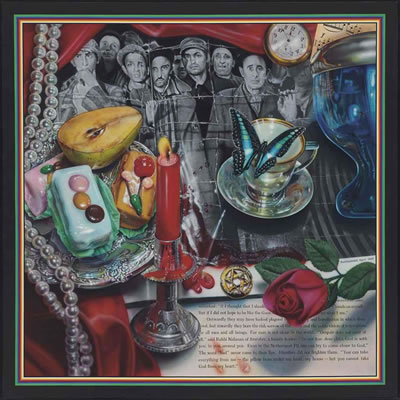
Her daughter Hannah Marcus said her death, in a hospital, was caused by an aortic tear.Ms. Flack’s best-known paintings were still lifes painted from photographs, sometimes with an airbrush. In “Queen,” a dewy rose, an orange section, a playing card and a photo locket with pictures of Ms. Flack and her mother nestle among other symbolic and sentimental objects on a canvas six and a half feet square. “Macarena of Miracles,” which was shown at the 1972 Whitney Biennial, is a precise close-up study of a wooden madonna sculpture in the cathedral of Seville attributed to the 17th-century sculptor Luisa Roldán, with special attention to her elaborately gilded robes and crystal tears. In “World War II (Vanitas),” Ms. Flack depicts a red candle, a string of pearls and a small silver tray of oversize petits fours sitting on a photograph of concentration camp inmates.Before those still lifes, which mostly date to the 1970s, she made simpler, more deadpan photo-based work like “The Kennedy Motorcade,” in which an ordinary press image becomes ominous and otherworldly, or “Farb Family Portrait,” whose syrupy shadows add an eerie eccentricity to the image of an Upper West Side family at home.Works like these were so straightforward and literal that they seemed to invite misunderstanding. The fact that Ms. Flack was often the only woman in a cohort of male painters didn’t help.A painting like “Banana Split Sundae” could easily be taken for a critique of American excess, or a joke, while her appropriation of Baroque Catholic aesthetics in the Macarena paintings was read as satirical, even though she had traveled to Spain to photograph the sculpture after being introduced to the piece by a picture postcard from the curator Marcia Tucker.Ms. Flack always insisted that she was motivated by nothing more than a pure, almost abstract interest in light and color — the same interest that peers like Robert Bechtle or Chuck Close channeled into matte automobiles and expressionless faces — and by a desire to make her work accessible to as many viewers as possible.She did paint “Chanel,” a study of lipsticks and perfume bottles, as, in her words, an “intentionally feminist painting” in 1974, and sexual politics became more explicit in her work later on. But if her subject matter initially seemed feminine, or feminist — and it did — it wasn’t because she had made a programmatic choice to make it so. It was simply because, however fierce her ambition, she was determined to follow her interests and honor her own life.Audrey Lenora Flack was born on May 30, 1931, in Manhattan, the younger of two children of Morris Flack, who owned a garment factory, and Jeanette (Flichtenfeld) Flack. Her parents were both immigrants from Poland.While at the Cooper Union, Ms. Flack began visiting the Cedar Tavern, a well-known artists’ hangout in Greenwich Village, and met older painters like Jackson Pollock and Willem de Kooning. For a while she was a member of their crowd, producing powerful nonfigurative paintings — even as she fended off unwanted advances. (According to her memoir, Mr. Albers made such advances, too.)“I have asked myself why I didn’t sleep with Jackson Pollock, Bill de Kooning, Franz Kline, Mike Goldberg, Mort Feldman or Clement Greenberg,” she wrote. “Power, fame, entree into intellectual circles, exhibitions and reviews all came with these men, yet I couldn’t do it. I wasn’t attracted to testosterone-fueled aggression and out-of-control drinking.”In a memoir, “With Darkness Came Stars,” published this year, she described her mother as a high-stakes poker addict who often disappeared for days at a time. But she also crocheted, embroidered, cut old master reproductions out of magazines and hung Alberto Vargas pinups in the bathroom.Ms. Flack graduated from the High School of Music & Art (now the Fiorello H. LaGuardia High School of Music & Art and Performing Arts) and won admission to the Cooper Union. From there she transferred to Yale, where she earned her B.F.A. in 1952, after being recruited by the artist and educator Josef Albers. She later studied anatomy with Robert Beverly Hale at the Art Students League.n any case, she loved figuration: Under Mr. Albers’s gaze at Yale, she splattered paint on canvas from 10 feet away, but alone in her room she copied old masters. In 1956, she was included in a large Abstract Expressionist group show at Stable Gallery in Manhattan, and her piece, “Lady With a Pink,” was hung between works by Lee Krasner and Milton Avery — but when people noticed its figurative elements, it was moved to a dark corner on the second floor.Ms. Flack’s first marriage, to the cellist Frank Levy, ended in divorce. Their older daughter, Melissa, was eventually diagnosed with severe autism and placed in a residential school, but not before Ms. Flack’s worries about her, as she struggled to care for her, were brushed off by her husband and several pediatricians.When she married Bob Marcus, a former high school sweetheart, in 1970, he adopted her daughters.In addition to her daughter Hannah, she is survived by her other daughter, Melissa Marcus; her stepdaughter, Leslie Marcus; her stepson, Mitchell Marcus; four grandchildren; and two great-grandchildren. Mr. Marcus, a commodities trader, died in May. Another stepdaughter, Aileen Marcus, died in 2022.In the early 1960s, Ms. Flack began painting from photographs, including snapshots of her daughters as well as press photos of John F. Kennedy and of people mourning his assassination. She went on to paint directly over projections, starting with the “Farb Family Portrait” commission from Oriole Farb, the director of the Riverside Museum, which paid for Melissa’s first residential treatment. She also bought a square-format Hasselblad camera, turned her bathroom into a darkroom and learned to paint with an airbrush.In the early 1980s, Ms. Flack switched to sculpture, working in bronze with more unambiguously feminist subjects, as in “Egyptian Rocket Goddess”; after three decades she returned to painting, making intricate, cartoonlike scenes she described as “Post Pop Baroque” that she showed with the Hollis Taggart gallery. She had previously been represented by Louis K. Meisel, starting with his gallery’s first show, in 1973.Her “Leonardo’s Lady” (1974) was the first photorealist painting acquired by the Museum of Modern Art, and her work has been collected by numerous other museums, including the Metropolitan Museum of Art. She and Mary Cassatt were the first two women to be included in the comprehensive textbook “Janson’s History of Art.”She was also a dedicated musician. She fronted a band called the History of Art, for which she wrote art-related songs, and which performed at art museums, comedy clubs and the Cooper Union.Ms. Flack’s dogged commitment to painting in the face of setbacks and sexism was matched by her commitment to her family — but she always knew she had to keep the two separate.“I kept my children and Melissa’s autism secret from the art world,” she wrote in her memoir. “I also never spoke of my husband’s total rejection of his own child and his increasingly abusive behavior. I never let them see the pain or the struggle I was dealing with.“Having children was bad enough, but I thought that having a special-needs child would surely define me as nothing but a mother, a failure, a weak person, and that my work would be dismissed as ‘ladies’ art.’ I couldn’t let that happen. Art was my life long before I had children, and it would remain so forever.”Biography from RoGallery
A photo-realist painter of popular images, Audrey Flack was committed to the idea that the greatest art is that which can be understood by the masses of people. She had major influence in the revitalizing of still-life subjects in the 1970s and 1980s, and unlike most photo-realist painters was emotionally committed to her subject matter. She regarded emotional commitment as part of being feminine, something of which she is proud.
Flack was one of the first painters to acknowledge that she referred to photographs when painting and would project photos from slides onto her canvases, painting over the images. She began working in a representational style when Abstract Expressionism was dominating the art world. She is especially committed to subjects of strong-minded women, eschewing oppression, and openly associated with feminine objects such as finger-nail polish and china cups.
Flack was raised in Washington Heights, New York and graduated from Cooper Union in 1951. Josef Albers, then the new chair of the Yale University School of Art and Architecture, actively recruited her as part of his attempt to upgrade the quality of the students in that department. But determined to be a realist, she fought with Albers continuously, rebelling against his aggressive and exclusively taught theories of hard-edged geometric expression. She earned a B.F.A. degree from Yale, and some said it was only by armed truce with Albers that she graduated.
Seeking strong, realistic anatomy training, she enrolled in the Arts Student League where she studied with Robert Beverly Hale and developed a unique figural style, often painting with Philip Pearlstein. She openly made fun of what she regarded as the male chauvinist, groupie behavior of the New York School of abstract-expressionist painters. She exhibited in the 1950s and often the only representational artist in the group, was perceived as hopelessly middle class in her appeal.
In the early 1960s, Flack began to copy black and white photographs, and her painting "Kennedy Motorcade," was the first color photo from which she copied. Because this photo so closely resembled the photo, she was much criticized by other photo-realist paintings. However, she countered that photos were just another aspect of reality.
By 1970, she was projecting color slides onto her canvases and began to do what became her trademark work, large-scale sensuous, vivid figure and portraits paintings and complex still lifes with gambling and religious iconography. Her work, often done with airbrush, is rarely smaller than six feet in height and width, because of the size, confrontational subject matter, and bright colors was often shocking to viewers.