Page loaded successfully. Showing biography for Axel Olson.
Axel Olson BIOGRAPHY
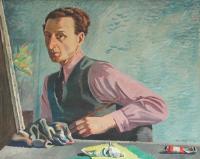
1899 Halmstad, Sweden - 1986 Halmstad, Sweden. Known for: Modernist paintings and drawings.
Axel Olson (1899–1986) was a Swedish painter and a central member of the Halmstad Group, known for his early Expressionist work and later contributions to Swedish Surrealism. He trained at the... Read full biography
Axel Olson (1899–1986) was a Swedish painter and a central member of the Halmstad Group, known for his early Expressionist work and later contributions to Swedish Surrealism. He trained at the Technical Evening School in Halmstad and continued his studies in Copenhagen before undertaking formative... Read full biography
Axel Olson (1899–1986) was a Swedish painter and a central member of the Halmstad Group, known for his early Expressionist work and later contributions to Swedish Surrealism. He trained at the Technical Evening School in Halmstad and continued his studies in Copenhagen before undertaking formative travels abroad. His early development was shaped by encounters with modernist movements in Germany and France, experiences that broadened his visual vocabulary and strengthened his interest in... Read full biography
Axel Olson (1899–1986) was a Swedish painter and a central member of the Halmstad Group, known for his early Expressionist work and later contributions to Swedish Surrealism. He trained at the Technical Evening School in Halmstad and continued his studies in Copenhagen before undertaking formative travels abroad. His early development was shaped by encounters with modernist movements in Germany and France, experiences that broadened his visual vocabulary and strengthened his interest in structure, rhythm, and expressive form. In 1922–23, Olson undertook extended study trips to Italy and Germany that allowed him to devote himself fully to painting. Traveling via Berlin and Munich, he arrived in Rome in May 1922 and continued on to Florence... Read full biography
Axel Olson (1899–1986) was a Swedish painter and a central member of the Halmstad Group, known for his early Expressionist work and later contributions to Swedish Surrealism. He trained at the Technical Evening School in Halmstad and continued his studies in Copenhagen before undertaking formative travels abroad. His early development was shaped by encounters with modernist movements in Germany and France, experiences that broadened his visual vocabulary and strengthened his interest in structure, rhythm, and expressive form. In 1922–23, Olson undertook extended study trips to Italy and Germany that allowed him to devote himself fully to painting. Traveling via Berlin and Munich, he arrived in Rome in May 1922 and continued on to Florence and Venice, where he studied the older masters. His travel diary describes Rome as sensual and intense, marked by heat, dust, street life, a... Read full biography
Artist Biography
Biography page for Axel Olson ((1899 - 1986)), known for Modernist paintings and drawings. Showing 2 biographical entries and 0 sample artworks.
Axel Olson - Artist Info
About Axel Olson
Biography from Bukowski Stockholm
In 1923 the young artist Axel Olson from Halmstad, traveled to Berlin to study under the German sculptor and artist Alexander Archipenko. This introduced Axel Olson to the continental avant-garde movements: French Cubism, Russian Constructivism and Italian Futurism.
In the 1910s he visited the avant-garde gallery Der Sturm, where Gösta Adrian-Nilsson, Sigrid Hjertén, Isaac Grünewald and Einar Jolin had exhibitions at the beginning of the First World War. In Berlin, he saw exhibitions of Pablo Picasso, Fernand Léger, Kurt Schwitters and learned from Archipenko that "the human body to function as a machine in motion, or as a nature morte at rest, as a mechanical beings or as a robot."
With this influence Axel Olson began to build his artwork dynamically and rhythmically in true cubist spirit. In 1930 Axel left cubism to focus on surrealism that completely took over the art scene both in Europe and in Scandinavia. Axel Olson's cubist artworks are few, but brilliant and best during the brief period in Berlin.Biography from Stockholm Auktionsverk
Axel Olson (1899–1986) was a Swedish painter and a central member of the Halmstad Group, known for his early Expressionist work and later contributions to Swedish Surrealism. He trained at the Technical Evening School in Halmstad and continued his studies in Copenhagen before undertaking formative travels abroad. His early development was shaped by encounters with modernist movements in Germany and France, experiences that broadened his visual vocabulary and strengthened his interest in structure, rhythm, and expressive form.
In 1922–23, Olson undertook extended study trips to Italy and Germany that allowed him to devote himself fully to painting. Traveling via Berlin and Munich, he arrived in Rome in May 1922 and continued on to Florence and Venice, where he studied the older masters. His travel diary describes Rome as sensual and intense, marked by heat, dust, street life, and the centrality of wine in daily rhythms. The drawing associated with this period was created during his stay in Rome and reflects the heightened observational focus that characterized his work at the time.
Upon returning to Sweden, Olson became a driving force within the Halmstad Group, contributing to its distinctive blend of Constructivism, Cubism, and Surrealism. His work evolved toward increasingly refined compositions, balancing geometric clarity with poetic, dreamlike imagery. Throughout his long career, he remained committed to exploring the relationship between structure and emotion, producing a body of work that played a significant role in shaping twentieth-century Swedish modernism.
Exhibitions
Exhibited with the Halmstad Group in Halmstad
Exhibited with the Halmstad Group in Gothenburg
Exhibited with the Halmstad Group in Stockholm
Exhibited with the Halmstad Group in Copenhagen
Included in later retrospectives documenting the Halmstad Group’s role in introducing international modernism to Sweden
Collections
Hallands Konstmuseum, Halmstad
Moderna Museet, Stockholm
Nationalmuseum, Stockholm
Göteborgs Konstmuseum, Gothenburg
Malmö Konstmuseum, Malmö
Literature
Monographs on the Halmstad Group featuring Axel Olson
Exhibition catalogues from Halmstad Group shows in Sweden and Denmark
Scholarly publications on Swedish modernism discussing Olson’s contributions