Page loaded successfully. Showing biography for Barton Benes.
Barton Benes BIOGRAPHY
1942 Hackensack, New Jersey - 2012 New York City. Known for: Sculpture, shredded money assemblage, collage.
Following is The New York Times obituary of the artist. Barton Lidice Benes, Provocative Artist, Dies at 69. By PAUL VITELLO. Published: June 18, 2012. Barton Lidice Benes, a New York sculptor who... Read full biography
Following is The New York Times obituary of the artist. Barton Lidice Benes, Provocative Artist, Dies at 69. By PAUL VITELLO. Published: June 18, 2012. Barton Lidice Benes, a New York sculptor who worked in materials that he called artifacts of everyday life, expanded his definition of "everyday"... Read full biography
Following is The New York Times obituary of the artist. Barton Lidice Benes, Provocative Artist, Dies at 69. By PAUL VITELLO. Published: June 18, 2012. Barton Lidice Benes, a New York sculptor who worked in materials that he called artifacts of everyday life, expanded his definition of "everyday" as he went. He used the everyday mementos of childhood in his early work, and later made sculptures from chopped up, everyday American cash (purchased pre-shredded from the Federal Reserve). When... Read full biography
Following is The New York Times obituary of the artist. Barton Lidice Benes, Provocative Artist, Dies at 69. By PAUL VITELLO. Published: June 18, 2012. Barton Lidice Benes, a New York sculptor who worked in materials that he called artifacts of everyday life, expanded his definition of "everyday" as he went. He used the everyday mementos of childhood in his early work, and later made sculptures from chopped up, everyday American cash (purchased pre-shredded from the Federal Reserve). When friends started dying of AIDS, and Mr. Benes himself tested HIV-positive, he began working in everyday materials of the epidemic — pills and capsules, intravenous tubes, HIV-infected blood and cremated human remains. Mr. Benes, who died of complications... Read full biography
Following is The New York Times obituary of the artist. Barton Lidice Benes, Provocative Artist, Dies at 69. By PAUL VITELLO. Published: June 18, 2012. Barton Lidice Benes, a New York sculptor who worked in materials that he called artifacts of everyday life, expanded his definition of "everyday" as he went. He used the everyday mementos of childhood in his early work, and later made sculptures from chopped up, everyday American cash (purchased pre-shredded from the Federal Reserve). When friends started dying of AIDS, and Mr. Benes himself tested HIV-positive, he began working in everyday materials of the epidemic — pills and capsules, intravenous tubes, HIV-infected blood and cremated human remains. Mr. Benes, who died of complications of AIDS on May 30 at 69, created a body of work that was exhibited internationally and included in the collections... Read full biography
Artist Biography
Biography page for Barton Benes ((1942 - 2012)), known for Sculpture, shredded money assemblage, collage. Showing 2 biographical entries and 0 sample artworks.
Barton Benes - Artist Info
About Barton Benes
Biography from the Archives of askART
 Following is The New York Times obituary of the artist.
Barton Lidice Benes, Provocative Artist, Dies at 69
By PAUL VITELLO
Published: June 18, 2012
Barton Lidice Benes, a New York sculptor who worked in materials that he called artifacts of everyday life, expanded his definition of "everyday" as he went. He used the everyday mementos of childhood in his early work, and later made sculptures from chopped up, everyday American cash (purchased pre-shredded from the Federal Reserve).
When friends started dying of AIDS, and Mr. Benes himself tested HIV-positive, he began working in everyday materials of the epidemic — pills and capsules, intravenous tubes, HIV-infected blood and cremated human remains.
Mr. Benes, who died of complications of AIDS on May 30 at 69, created a body of work that was exhibited internationally and included in the collections of the Art Institute of Chicago and the Smithsonian.
His work dealing with the AIDS epidemic was acclaimed for its raw approach to death. Some of it was so raw that he had difficulty finding art galleries willing to show it. Among his best known works — though it was never exhibited publicly — was his collection of memento-mori filling his 850-square-foot Greenwich Village apartment and studio floor to ceiling: thousands of artifacts like tribal masks, animal skeletons, taxidermy, religious relics, voodoo dolls and a stockpile of celebrity ephemera. He called it "my tomb."
When friends started dying of AIDS, and Mr. Benes himself tested HIV-positive, he began working in everyday materials of the epidemic — pills and capsules, intravenous tubes, HIV-infected blood and cremated human remains.
Mr. Benes, who died of complications of AIDS on May 30 at 69, created a body of work that was exhibited internationally and included in the collections of the Art Institute of Chicago and the Smithsonian.
His work dealing with the AIDS epidemic was acclaimed for its raw approach to death. Some of it was so raw that he had difficulty finding art galleries willing to show it. Among his best known works — though it was never exhibited publicly — was his collection of memento mori filling his 850-square-foot Greenwich Village apartment and studio floor to ceiling: thousands of artifacts like tribal masks, animal skeletons, taxidermy, religious relics, voodoo dolls and a stockpile of celebrity ephemera. He called it "my tomb."
Another work, Lethal Weapons, raised health alarms. It was a collection of 30 vessels, including a water pistol, a perfume atomizer and a set of hollow darts, each filled with the artist's or other people's HIV-infected blood.
Both works were shown in 1993 at the North Dakota Museum of Art without incident, said Laurel J. Reuter, the museum director. "After we announced it, I think we had one woman write us a letter," she said in an interview. "After we talked to her about the art, and why it was important, she came to the opening."
Lethal Weapons was also exhibited in Lund, Sweden, but not before Mr. Benes agreed to let the authorities heat the installation to 160 degrees Fahrenheit in a hospital oven to make it safe for public viewing.
Barton Lidice Benes was born in Hackensack, N.J. on Nov. 16, 1942, the son of Marie and Richard Benes. His father, a son of Czech immigrants, gave him his middle name in memory of Lidice, a Czech town destroyed by the Nazis in 1942. After his parents divorced, Barton and his mother lived in Queens with his Czech-born grandparents, who were steeped in Roman Catholic traditions of honoring the relics of saints, including their bones.
Mr. Benes's younger brother, Warren, attributed the artist's interest in artifacts partly to his frequent visits to the American Museum of Natural History. "He would have been happy to spend the rest of his life inside one of those dioramas," Warren Benes said.
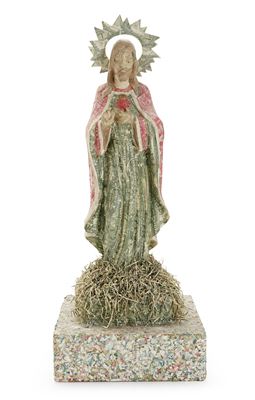
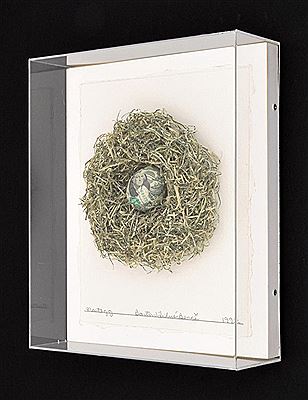
Mr. Benes graduated from Pratt Institute in Brooklyn. He first gained notice for a series of pieces, including a statue of the Virgin Mary, in which he used shredded United States currency. After the devastating 1997 floods in North Dakota, he made sculptures from the broken remnants of personal property that flood victims had brought to the museum. He titled the project Flood.
Besides the curio collection and the furniture, the North Dakota Museum of Art's recreation of Mr. Benes's studio will eventually include his remains. In his bequest he asked that his ashes be kept in a pillowcase on the bed. "It makes me comfortable," he said "that I get to live in my own pyramid now."
Online Source:
http://www.nytimes.com/2012/06/19/arts/design/barton-lidice-benes-provocative-artist-dies-at-69.html?_r=1&ref=obituariesBiography from Swann Galleries
Barton Lidicé Beneš was a sculptor and visual artist who worked in materials that he described as artifacts from everyday life. He became well-known for his collection and installations of relics ranging from cremation ashes to shredded money to bodily fluids to found objects to celebrity ephemera. Calling these reliquaries "museums," Beneš's own apartment also became a larger-scale installation of its own, holding memento mori.
A veteran of the AIDS crisis, Beneš's work blended activism, poetry, and resistance, forcing a confrontation with death and fears of transmission. His most controversial work was titled "Lethal Weapons" and featured objects such as a toy gun, darts, and other found objects filled with his own blood.