Page loaded successfully. Showing biography for Beatrice (Ribak) Mandelman.
Beatrice (Ribak) Mandelman BIOGRAPHY

1912 Newark, New Jersey - 1998 Taos, New Mexico. Known for: Abstract easel painting, murals, printmaking.
Born on December 31, 1912 in Newark, New Jersey, from an early age Beatrice Mandelman was determined to be an artist. At age 12, she began taking classes at the Newark School of Fine and Industrial... Read full biography
Born on December 31, 1912 in Newark, New Jersey, from an early age Beatrice Mandelman was determined to be an artist. At age 12, she began taking classes at the Newark School of Fine and Industrial Art. In the 1930s, she attended Rutgers University, the Newark School of Fine and Industrial Art and... Read full biography
Born on December 31, 1912 in Newark, New Jersey, from an early age Beatrice Mandelman was determined to be an artist. At age 12, she began taking classes at the Newark School of Fine and Industrial Art. In the 1930s, she attended Rutgers University, the Newark School of Fine and Industrial Art and the Art Students League in New York City. In 1935 Mandelman was employed by the Works Progress Administration (WPA), first as a muralist and then as a printmaker with the Graphic Division of the New... Read full biography
Born on December 31, 1912 in Newark, New Jersey, from an early age Beatrice Mandelman was determined to be an artist. At age 12, she began taking classes at the Newark School of Fine and Industrial Art. In the 1930s, she attended Rutgers University, the Newark School of Fine and Industrial Art and the Art Students League in New York City. In 1935 Mandelman was employed by the Works Progress Administration (WPA), first as a muralist and then as a printmaker with the Graphic Division of the New York Project. One of the original members of the Silk Screen Unit under Anthony Velonis, Mandelman worked in the WPA until 1942, when it was disbanded. During this period she was associated with numerous New York School artists including Louis... Read full biography
Born on December 31, 1912 in Newark, New Jersey, from an early age Beatrice Mandelman was determined to be an artist. At age 12, she began taking classes at the Newark School of Fine and Industrial Art. In the 1930s, she attended Rutgers University, the Newark School of Fine and Industrial Art and the Art Students League in New York City. In 1935 Mandelman was employed by the Works Progress Administration (WPA), first as a muralist and then as a printmaker with the Graphic Division of the New York Project. One of the original members of the Silk Screen Unit under Anthony Velonis, Mandelman worked in the WPA until 1942, when it was disbanded. During this period she was associated with numerous New York School artists including Louis Lozowick, Willem de Kooning, Arshile Gorky, Jackson Pollock, and Stuart Davis. By 1941, Mandelman's works were included in important exhibitions... Read full biography
Artist Biography
Biography page for Beatrice (Ribak) Mandelman ((1912 - 1998)), known for Abstract easel painting, murals, printmaking. Showing 2 biographical entries and 0 sample artworks.
Beatrice (Ribak) Mandelman - Artist Info
About Beatrice (Ribak) Mandelman
Biography from the Archives of askART
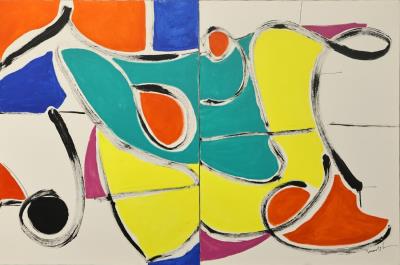 Born on December 31, 1912 in Newark, New Jersey, from an early age Beatrice Mandelman was determined to be an artist. At age 12, she began taking classes at the Newark School of Fine and Industrial Art. In the 1930s, she attended Rutgers University, the Newark School of Fine and Industrial Art and the Art Students League in New York City.
In 1935 Mandelman was employed by the Works Progress Administration (WPA), first as a muralist and then as a printmaker with the Graphic Division of the New York Project. One of the original members of the Silk Screen Unit under Anthony Velonis, Mandelman worked in the WPA until 1942, when it was disbanded.
During this period she was associated with numerous New York School artists including Louis Lozowick, Willem de Kooning, Arshile Gorky, Jackson Pollock, and Stuart Davis. By 1941, Mandelman's works were included in important exhibitions at the Chicago Art Institute, the Museum of Modern Art and the National Gallery of Art in Washington, DC.
In 1942 Mandelman married Louis Ribak and in 1944, they traveled to Santa Fe to visit Ribak's teacher and mentor, the artist John Sloan, who'd recommended the climate and atmosphere. Finding Santa Fe congested, they took the train along the Rio Grande and a stagecoach up to Taos and decided to settle there.
An impulsive and inspired move, it was a decision that would effectively remove them from the art world's mainstream. In 1944 Taos was a well-known art community, but there were no galleries exhibiting modern art. A new influx of artists from New York and California during the late 40s and 50s would change this. A group of these artists, including Mandelman and Ribak, Ed Corbett, Agnes Martin, Oli Sihvonen, and Clay Spohn, would become known as the "Taos Moderns".
Mandelman was an intensely dedicated painter. In the relative isolation of Northern New Mexico she found the freedom to develop a style that was distinctly her own. Inspired by the light, the local color, the landscape and the confluence of diverse cultures in Taos, her work flourished.
Through out her lifetime, together with Ribak and after his death in 1979, Mandelman was adventurous and profoundly curious about art and life and culture. She loved to travel and drew inspiration from it. Over the years she lived for extended periods in Mexico and traveled extensively in South America, Europe, Asia and Africa.
Beatrice Mandelman died on June 25th, 1998 in her home in Taos. In the last months of her life, she produced the thirty-one works in the Winter series. Over the span of seven decades, Beatrice Mandelman produced a body of work consisting of hundreds of paintings, prints, collages, and works on paper.
Source:
Mandelman Ribak Foundation,
http://www.mandelman-ribak.org/beatrice_mandelman/biography.phpBiography from David Cook Galleries
The daughter of Austrian and German Jews, Beatrice Mandelman was introduced to abstract art as a young girl. A friend of her parents, the painter and printmaker Louis Lozowick, returned from Russia with exciting news about the non-figurative Constructivist movement. At age twelve, she began her art studies by taking evening classes at the Newark School of Fine and Industrial Art. After college at Rutgers University, she continued her formal training at the Art Student's League in New York, working with the lithographer George Pickens.
Through another teacher, the painter Bernard Gussow, she learned more about Cubism and other European modernist schools. In 1935, Mandelman was employed by the WPA, first as a muralist and then as a printmaker with the Graphic Division of the New York Project. As one of the original members of the Silk Screen Unit under Anthony Velonis, she developed new techniques. Working in the WPA until 1942 when it was disbanded, Mandelman created monochromatic lithographs of social realist subjects, but her silkscreen prints are more brilliantly colored with more abstract gestures — the first glimmer of her mature style.
In 1942, she married fellow artist Louis Ribak. Two years later, the couple traveled to Santa Fe to visit his mentor John Sloan, who had recommended the Southwestern climate for Ribak's asthma. After finding Santa Fe too congested, they took a train and a stagecoach to Taos and decided to move there. This dramatic life change removed them from the New York art scene during the nascent period of Abstract Expressionism, but they wanted to separate themselves from the tension they felt there.
Though it was a vibrant art colony, Taos didn't have any galleries that exhibited the most contemporary trends. This initially disappointed the couple, but after World War II artists such as Clay Spohn, Edward Corbett, Agnes Martin, and Oli Sihvonen began to settle in town and eventually became known as the Taos Moderns. Eulalia C. Emetaz opened the Galería Escondida in order to show their work, and Mandelman and her husband founded the Taos Valley Art School and helped create the Taos Art Association.
In Taos, Mandelman flourished as a bold, emotive colorist with her own personal style. Of her path, the artist said, "I'm an original. I broke all the rules. I'm using a very primitive language—squares, circles, triangles, primitive colors. And I made a very sophisticated art out of it." Her legacy continues at the Harwood Museum in Taos, which in 2010 received 133 works gifted from the Mandelman-Ribak Foundation. That same year, the Harwood debuted the Mandelman-Ribak Gallery, an 1100-square-foot gallery presenting temporary exhibitions of modern and contemporary art.
©David Cook Galleries, LLC