Page loaded successfully. Showing biography for Benedict Chukwikadibia Enwonwu.
Benedict Chukwikadibia Enwonwu BIOGRAPHY

1917 - 1994. Known for: Painting, sculpture.
Ben Enwonwu is recognized as one of the great names of African modern art. He studied at Ruskin School of Art and the Slade. Enwonwu's engagement with contemporary Western training and academia was... Read full biography
Ben Enwonwu is recognized as one of the great names of African modern art. He studied at Ruskin School of Art and the Slade. Enwonwu's engagement with contemporary Western training and academia was as unequivocal as his connection to the traditional art of his ancestors which had had such an impact... Read full biography
Ben Enwonwu is recognized as one of the great names of African modern art. He studied at Ruskin School of Art and the Slade. Enwonwu's engagement with contemporary Western training and academia was as unequivocal as his connection to the traditional art of his ancestors which had had such an impact on the course of modern art. In Africa Dances Enwonwu explores one of his favorite, central themes - dance and ceremony. "Like culture, Art changes its form with the times. It is setting the clock... Read full biography
Ben Enwonwu is recognized as one of the great names of African modern art. He studied at Ruskin School of Art and the Slade. Enwonwu's engagement with contemporary Western training and academia was as unequivocal as his connection to the traditional art of his ancestors which had had such an impact on the course of modern art. In Africa Dances Enwonwu explores one of his favorite, central themes - dance and ceremony. "Like culture, Art changes its form with the times. It is setting the clock back to expect that the art form of Africa today must resemble that of yesterday otherwise the former will not reflect the African image. African art has always, even long before western influence, continued to evolve through change and adaptation to... Read full biography
Ben Enwonwu is recognized as one of the great names of African modern art. He studied at Ruskin School of Art and the Slade. Enwonwu's engagement with contemporary Western training and academia was as unequivocal as his connection to the traditional art of his ancestors which had had such an impact on the course of modern art. In Africa Dances Enwonwu explores one of his favorite, central themes - dance and ceremony. "Like culture, Art changes its form with the times. It is setting the clock back to expect that the art form of Africa today must resemble that of yesterday otherwise the former will not reflect the African image. African art has always, even long before western influence, continued to evolve through change and adaptation to new circumstances. And in like manner, the African view of art has followed the trend of cultural change up.... Read full biography
Artist Biography
Biography page for Benedict Chukwikadibia Enwonwu ((1917 - 1994)), known for Painting, sculpture. Showing 3 biographical entries and 0 sample artworks.
Benedict Chukwikadibia Enwonwu - Artist Info
About Benedict Chukwikadibia Enwonwu
Name variants
Ben Enwonwu
Biography from The Auction Room London
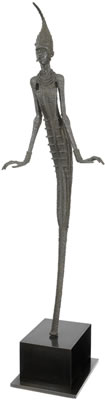 Ben Enwonwu is recognized as one of the great names of African modern art. He studied at Ruskin School of Art and the Slade. Enwonwu's engagement with contemporary Western training and academia was as unequivocal as his connection to the traditional art of his ancestors which had had such an impact on the course of modern art. In Africa Dances Enwonwu explores one of his favorite, central themes - dance and ceremony. "Like culture, Art changes its form with the times. It is setting the clock back to expect that the art form of Africa today must resemble that of yesterday otherwise the former will not reflect the African image. African art has always, even long before western influence, continued to evolve through change and adaptation to new circumstances. And in like manner, the African view of art has followed the trend of cultural change up to the modern times." 1950, Ben Enwonwu.
After schooling in Nigeria Enwonwu attended Ruskin School of Art in Oxford and went on to the Slade School of Fine Art University London, 1944 - 1947, he also attended Goldsmith College. He graduated from Slade with a first Class Honors Diploma in Sculpture. Later enrolling at the University of London post graduate studies in Anthropology. In 1948 he graduated from the University of London and became a fellow of the Royal Anthropological Institute of Great Britain and Ireland and was elected to the Royal Society of British Artists. In 1948 Enwonwu returned to Nigeria and worked as an Artist Adviser to the Federal Government. In 1956 he was commissioned by the British Government to do a portrait of Queen Elizabeth II. A copy of the bronze sculpture stands at the parliament Building in Lagos, while the original is in the Queens Art Collection. In 1954 he received an (OBE) Distinguished Order of the British Empire. He was commissioned by the Federal Government to produce a sculpture that would symbolize the new Nigerian nation for the National Museum, the resulting was the sculpture 'Anyanwu' (Sunshine in Igbo) remains one of his most visible works.
He held several positions in the world of Art both in Nigeria and abroad, 1966 - 1968 he became a fellow of the University of Lagos, he was appointed Art supervisor to the federal government a position he held till 1971. In 1975 he was awarded one of the highest national honors, Officer of the National Order of the Republic. In 1977 he was appointed Art Consultant to the International Secretariat, second world Black and African Festival of Art and Culture. Amongst his most celebrated commission were The Drummer Boy produced for the Nigeria Telecommunications Headquarters in Lagos and Sangbo (Yoruba God of thunder) for the Nigerian Electric Board. In 1985 a major retrospective exhibition was organized by Royal Society of Arts at the Mall Galleries, London, which later moved to Lagos in 1987, he held his last major exhibition at the National Museum in Lagos in 1990.Biography from Arthouse Contemporary Limited
Ben Enwonwu (1917-1994) was the most important Nigerian modernist sculptor. Although he is said to have had his first art training under his father who was a traditional sculptor, and despite that he worked in both realistic and abstract styles, his art generally reveals an unmistakably modernist sensibility. He received his first art instruction in the 1930s while a student under the first British art teacher in colonial Nigeria, Kenneth C. Murray. But, unlike his classmates who never went beyond the naïve naturalism encouraged by Murray, he developed a sculptural language largely influenced by the work of European modernists. His later sculpture, after his training overseas and after his encounter around 1950 with the Negritude philosophy of the Paris-based Leopold Senghor and Aimé Cesaire, expressed formal rhythms he associated with African music and dance.
In 1971, Ben Enwonwu, who served as the Federal Art Supervisor (1959-1968) and Federal Cultural Advisor (1968-1971), was appointed professor of fine art at the University of Ife. Freed from the official duties of the previous decade, Enwonwu’s tenure at Ife proved to be one of the most productive years in his career as an artist. While there he painted mostly southern Nigerian rural scenes, including his well-known Ututu series. In these landscapes, gigantic, gnarled tropical trees tower over village clearings in which people carry out their routine or ceremonial activities. through them Enwonwu expressed his romantic fascination for the pristine environment uncorrupted by the chaos and instability of the modern life.Biography from Bonhams Bond Street
Benedict Chukwikadibia Enwonwu boarded MV Aureol, a British ocean liner traveling from Lagos to Liverpool, on 18 August 1952. The artist was heading to London for his second exhibition at the Galerie Apollinaire. The show consisted of 205 works and included sculptures, oil paintings, pastels and watercolours. He had previewed the collection at the Exhibition Centre in Lagos in July 1952. The exhibition was opened in London by Lord Munster, the under-secretary of state for the colonies, who referred to Enwonwu as a "distinguished artist and sculptor". The works were well received by critics and members of the public alike.
Bibliography S. Ogbechie, Ben Enwonwu: the Making of an African Modernist, (Rochester, 2008), p.12.