Page loaded successfully. Showing biography for Bikash Bhattacharjee.
Bikash Bhattacharjee BIOGRAPHY
1940 Kolkata, India - 2006 Kolkata, India. Known for: Paintings.
Painter Bikash Bhattacharjee is one of India's most widely acclaimed painters. He was a realist in technique who used the traditions of Titian and Velasquez in unexpected, often highly symbolic,... Read full biography
Painter Bikash Bhattacharjee is one of India's most widely acclaimed painters. He was a realist in technique who used the traditions of Titian and Velasquez in unexpected, often highly symbolic, unsettling and surrealistic ways. As the critic Manasij Majumder writes, Bhattacharjee "accepted the... Read full biography
Painter Bikash Bhattacharjee is one of India's most widely acclaimed painters. He was a realist in technique who used the traditions of Titian and Velasquez in unexpected, often highly symbolic, unsettling and surrealistic ways. As the critic Manasij Majumder writes, Bhattacharjee "accepted the challenge of transforming his consummate skill to evoke the subtleties of surface realism into a pliant tool of creativity without dismantling the received art forms." He also, like many of his... Read full biography
Painter Bikash Bhattacharjee is one of India's most widely acclaimed painters. He was a realist in technique who used the traditions of Titian and Velasquez in unexpected, often highly symbolic, unsettling and surrealistic ways. As the critic Manasij Majumder writes, Bhattacharjee "accepted the challenge of transforming his consummate skill to evoke the subtleties of surface realism into a pliant tool of creativity without dismantling the received art forms." He also, like many of his contemporaries, "eschewed any ideological loyalty to an imagined Indian identity in art," as Majumder writes. A member of the Society of Contemporary Artists—alongside other transformational artists like Somnath Hore and Ganesh Pyne—he made art that was an... Read full biography
Painter Bikash Bhattacharjee is one of India's most widely acclaimed painters. He was a realist in technique who used the traditions of Titian and Velasquez in unexpected, often highly symbolic, unsettling and surrealistic ways. As the critic Manasij Majumder writes, Bhattacharjee "accepted the challenge of transforming his consummate skill to evoke the subtleties of surface realism into a pliant tool of creativity without dismantling the received art forms." He also, like many of his contemporaries, "eschewed any ideological loyalty to an imagined Indian identity in art," as Majumder writes. A member of the Society of Contemporary Artists—alongside other transformational artists like Somnath Hore and Ganesh Pyne—he made art that was an instrument of aesthetic and social critique; in his prime, his paintings were a window into the struggles of Christie's Mumbai... Read full biography
Artist Biography
Biography page for Bikash Bhattacharjee ((1940 - 2006)), known for Paintings. Showing 3 biographical entries and 0 sample artworks.
Bikash Bhattacharjee - Artist Info
About Bikash Bhattacharjee
Name variants
Bikash Battacharejee
Biography from the Archives of askART
 Painter Bikash Bhattacharjee is one of India's most widely acclaimed painters. He was a realist in technique who used the traditions of Titian and Velasquez in unexpected, often highly symbolic, unsettling and surrealistic ways. As the critic Manasij Majumder writes, Bhattacharjee "accepted the challenge of transforming his consummate skill to evoke the subtleties of surface realism into a pliant tool of creativity without dismantling the received art forms." He also, like many of his contemporaries, "eschewed any ideological loyalty to an imagined Indian identity in art," as Majumder writes.
A member of the Society of Contemporary Artists—alongside other transformational artists like Somnath Hore and Ganesh Pyne—he made art that was an instrument of aesthetic and social critique; in his prime, his paintings were a window into the struggles of poverty and socioeconomic unrest that surrounded him. Bhattacharjee began showing his work in 1965, and was the subject of dozens of solo exhibitions and dozens more group shows worldwide. He received numerous awards along the way, by institutions including the Academy of Fine Art, Kolkata, in 1962; the Birla Academy of Art and Culture, Kolkata, in 1971, and the Lalit Kala Akademi in New Delhi, which bestowed on him its National Award in 1971 and 1972. In 1988 he was awarded the prestigious Padma Shri, one of the highest civilian awards given by the Indian government.
He was born and raised in Kolkata and he died in Kolkata. He graduated from the Indian College of Arts and Draftsmanship there in 1963. Throughout his life, he was as invested in the future of his craft and his community as he was in his own work, having taught at his alma mater from 1968-1972, and at the Government.Biography from Saffronart
Bikash Bhattacharjee (1940-2006)
"What humans have not seen with their eyes, they see through their habits." Born in Kolkata in 1940, Bikash Bhattacharjee lost his father at a very early age. In 1963, he graduated from Indian College of Art and Draftsmanship. He joined the same college as professor in 1968. From 1973, Bhattacharjee began teaching at the Government College of Arts and Crafts and taught there till 1982. Bhattacharjee drew inspiration for his work from his early dreary days, where vivid images of his struggling - the crumbling walls of buildings and the multitudes of people living there - wove a certain magic in his mind. His drawings form a fitting introduction to his paintings, revealing the predilection of the artist for forms: forms that are consistent in terms of tone rather than line. Bhatacharjee carefully expresses the textural effects of crayons, pastels and pencil using the combination of highlights and depths of passages built of varying intensities of line.
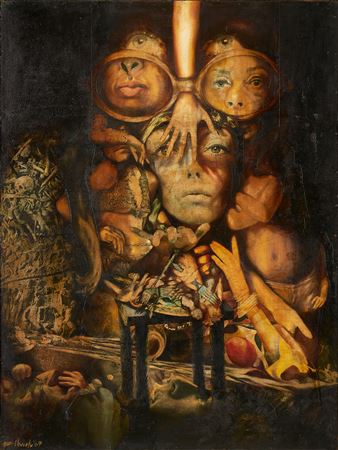
Improbable characters (both psychologically and physiologically) play a role on the canvas and dominate his oils. Yet his work is a powerful combination of realism and fantasy, where reality sets the ball rolling and fantasy helps the canvas assume a new reality. His subject is always clear, recognizable, painted with faithfulness to detail and invested with a sense of the dramatic. Female beauty is a major preoccupation with him.
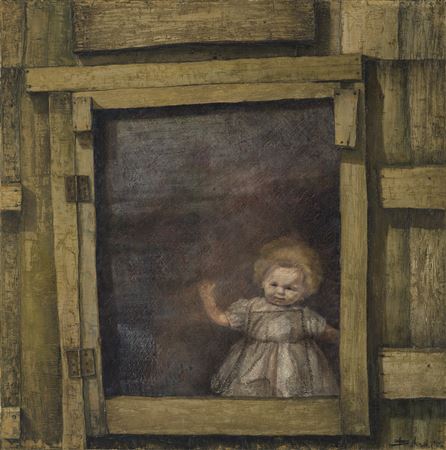
His series of 'Doll' paintings from the early 1970s, particularly his nocturnal landscapes populated by dolls, reflects the political violence that was taking his city, Kolkata, by storm at the time. The origins of the series, however, can be traced to the day when a young girl asked him to repair and repaint her baby doll. "Late that night when Bikash returned from his downtown studio, the doll in hand, trudging along the empty violence-stained streets to his North Calcutta home he had an epiphanic experience of trauma and terror haunting the city and their multi-layered impact upon man in his social and existential context." The next day, "He hit upon the idea of placing not a human figure but a baby doll as the central motif of the desolate city-scape soaked with the terror of political violence…As a result every such frame first spells out an uncanny sensation, as does the pictorial structure of any surrealist canvas, of unrelated facts yoked together with no apparent logic or order and then hastens to exude the entire gamut of feelings of innocence and terror, helplessness and violence, and living human presence and lifeless ambience so masterly juxtaposed" (Manasij Majumder, Close to Events: Works of Bikash Bhattacharjee, Niyogi Books, New Delhi, 2007, p. 7
But he also creates a varied cast of characters in his canvases - old men and women, children, domestic help. The ability to create an authentic milieu as a background to the characters heightens the drama.
Bhattacharjee's women are a strange mixture of spirituality and sensuality. Different moods of the painter are reflected in his different paintings. Some times flesh and blood figures turn shadowy. Where women in his canvas are an abstraction, men appear to live in their own world. The artist explores the possibilities of oil as a medium and can depict the exact quality of drapery or the skin tone of a woman, the peeling walls of an old building. He had also achieved mastery over the capturing of the quality of light, an effect that lends his work a superb realism as well as an enigmatic quality. His love of cinema had a lot to do with this. He creates a wide variety of characters in all walks of life, but his preoccupation is with female beauty. His use of art techniques of post Renaissance European oil painting could be responsible for creating this illusion of reality. Indeed, he leaves the viewer thinking, his canvases haunt, his paintings are an enigma that suggest and the mind is but a slave that must follow.
Bhattacharjee is also known for his Kolkata cityscapes that he worked on in his twenties. He works with many mediums - oil on canvas, tempera, oil on board, pastels on board, watercolor, crayon and pencil.
The artist passed away in 2006.Biography from Christie's New York, Rockefeller Center
Bikash Bhattacharjee was born in 1940 in Kolkata, India. “Bikash Bhattacharjee’s fantasies are the most this-worldly and also other-worldly [...His paintings are of] subjects where the known is seen in an unusual setting; one’s imagination is stimulated or disturbed. Each scene is painted with a loving attention to light, texture and detail. The compositions are very stable, the unreal is cradled in the real, the pictures are the starting point of questions and reveries which linger in the mind.” (J. Appasamy, ‘New Images in Indian Art: Fantasy’, Lalit Kala Contemporary 15, 1973, pp. 6-7) Bikash Bhattacharjee passed away in Kolkata, India in 2006.