Page loaded successfully. Showing biography for Bill Traylor.
Bill Traylor BIOGRAPHY
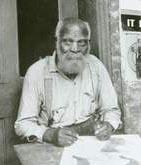
1854 Benton, Alabama - 1947 Montgomery, Alabama. Known for: Folk art painting.
Born a slave on the plantation of George Traylor near Benton, Alabama, Bill Traylor became known as a folk artist who did stark and simple drawings with colored pencils in a flat, child-like style.... Read full biography
Born a slave on the plantation of George Traylor near Benton, Alabama, Bill Traylor became known as a folk artist who did stark and simple drawings with colored pencils in a flat, child-like style. His images are of plantation and street life, domestic animals and people going about their lives in... Read full biography
Born a slave on the plantation of George Traylor near Benton, Alabama, Bill Traylor became known as a folk artist who did stark and simple drawings with colored pencils in a flat, child-like style. His images are of plantation and street life, domestic animals and people going about their lives in the segregated South before and after the Civil War. After the Civil War, he took the name of the plantation owner and chose to remain on the plantation, living there until he was eighty-four years... Read full biography
Born a slave on the plantation of George Traylor near Benton, Alabama, Bill Traylor became known as a folk artist who did stark and simple drawings with colored pencils in a flat, child-like style. His images are of plantation and street life, domestic animals and people going about their lives in the segregated South before and after the Civil War. After the Civil War, he took the name of the plantation owner and chose to remain on the plantation, living there until he was eighty-four years old. It is likely he had no formal education. He worked as a field hand, and married Lourisa Duncan with whom he had nine children. (He fathered another eleven children while on the Plantation). As adults, they lived in Alabama, Washington DC and... Read full biography
Born a slave on the plantation of George Traylor near Benton, Alabama, Bill Traylor became known as a folk artist who did stark and simple drawings with colored pencils in a flat, child-like style. His images are of plantation and street life, domestic animals and people going about their lives in the segregated South before and after the Civil War. After the Civil War, he took the name of the plantation owner and chose to remain on the plantation, living there until he was eighty-four years old. It is likely he had no formal education. He worked as a field hand, and married Lourisa Duncan with whom he had nine children. (He fathered another eleven children while on the Plantation). As adults, they lived in Alabama, Washington DC and Detroit, Michigan. In 1939 at age 84, he decided to leave the plantation, saying "they'r... Read full biography
Artist Biography
Biography page for Bill Traylor ((1854 - 1947)), known for Folk art painting. Showing 3 biographical entries and 0 sample artworks.
Bill Traylor - Artist Info
About Bill Traylor
Biography from the Archives of askART
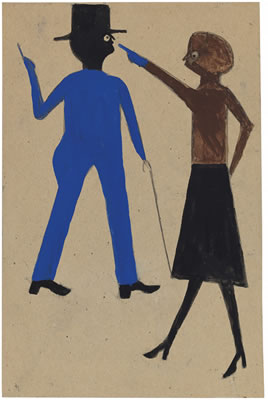 Born a slave on the plantation of George Traylor near Benton, Alabama, Bill Traylor became known as a folk artist who did stark and simple drawings with colored pencils in a flat, child-like style. His images are of plantation and street life, domestic animals and people going about their lives in the segregated South before and after the Civil War.
After the Civil War, he took the name of the plantation owner and chose to remain on the plantation, living there until he was eighty-four years old. It is likely he had no formal education. He worked as a field hand, and married Lourisa Duncan with whom he had nine children. (He fathered another eleven children while on the Plantation). As adults, they lived in Alabama, Washington DC and Detroit, Michigan.
In 1939 at age 84, he decided to leave the plantation, saying "they're all gone", meaning the grown children had moved away from the area and his wife had died. He moved to Montgomery, Alabama where he worked in a shoe factory until his rheumatism prevented him from doing physical labor. On welfare, he took a rent-free sleeping room at the Ross-Clayton Funeral Home, and divided his day time between the local pool hall and the Montgomery fruit and vegetable market.
From 1942 to 1946, during World War II, he lived in Detroit and Washington DC with his children, but then he returned to Montgomery for a year where he resumed his former routines. During this period he had a gangrenous leg amputated while living in Washington D.C. He died in 1947 in a nursing home in Montgomery.
Traylor's artwork was discovered by Charles Shannon, a white artist, who said that "Art came from Traylor like water from a spring." (Rosenak 305-6). In 1939, Shannon met Traylor, then eighty five, when Traylor was sitting on a wooden box drawing on Monroe Street in downtown Montgomery and had just begun prolific drawing. They became friends, and Shannon provided art materials to Traylor and arranged for a 1940 exhibition of his work at the New South Art Center in Montgomery. The director of the Museum of Modern Art in NY proposed to purchase 16 works for the museum in 1943, but the sum he offered was so low that Shannon returned the check.
After Traylor's death, Shannon was in possession of 1500-2000 of his drawings, carefully catalogued them, and in 1979 submitted some of the drawings to auction after showing it in exhibitions around the country. The public response was very positive, and nearly fifty years after Traylor's death, he became one of America's more famous folk artists, praised for his unique abilities to express the culture where he lived.
Sources include:
Chuck and Jan Rosenak, Museum of American Folk Art Encyclopedia of Twentieth-Century American Folk Art and Artists
Peter Falk, Who Was Who in American Art
Sotheby's New YorkBiography from Charleston Renaissance Gallery
BILL TRAYLOR (1854-1947)
Bill Traylor was born a slave on the plantation of George Traylor, near Benton, Alabama, in 1854. After the Civil War, he stayed on as a farm hand, leaving only in 1938 at age 84. By then his wife and the Traylors were dead and his children had moved away. He went to Montgomery, where he worked in a shoe factory until disabled by rheumatism, whereupon he received a government pension.
In 1939, at age 85, Traylor began to draw. "It just come to me," he recollected to a reporter in 1946. He drew geometric forms which he then filled in with color and developed into figures or abstracted plants. His subjects were reminiscences of his life -- the drunken preacher, opossum hunt, chicken stealing and the like. One day in 1939, as Traylor sat on a box in downtown Montgomery, he was "discovered" by the artist Charles Shannon, who saw in Traylor's work a resemblance to African rock painting, although Traylor knew nothing about that tradition. Shannon gave Traylor art supplies and featured his work at New South, an art cooperative in Montgomery, of which Shannon was a founder and member. In 1941 Traylor's work was shown at the Fieldston School in New York, but the artist continued to hang his works on a fence, selling them to passers-by.
In 1942 Traylor went to live with his children in Detroit, where he lost a leg to gangrene. He returned to Montgomery in 1946, where he was the subject of an article in Collier's magazine. In the article the question was posed whether Traylor's work would endure like the primitive cave paintings it resembled or "will it blow down the gutters . . . when Bill is gone?
Traylor was placed with one of his daughters in Montgomery, and subsequently in a nursing home, where he died in 1947. So far his work has not blown away. His drawings were shown at R. H. Oosterom Gallery in New York in 1979 and were included in the exhibition, "Southern Works of Art on Paper, 1900-1950", traveled by the Southern Arts Federation in 1981-82 and in "Black Folk in America, 1930-1980", traveled by the Corcoran Gallery in 1982-83.
Source:
The South on Paper: Line, Color and Light, Robert M. Hicklin Jr., Inc., Spartanburg, South Carolina, 1985, p. 62.
This essay is copyrighted by the Charleston Renaissance Gallery and may not be reproduced or transmitted without written permission from Hicklin Galleries, LLC.Biography from The Johnson Collection
BILL TRAYLOR (1854-1959)
It was only when he was in his eighties that Bill Traylor started making art. His output was prodigious; in the span of less than two decades he created about one thousand pieces. His style was singular and his imagery simple: most often monochromatic silhouetted figures of humans and animals rendered on cardboard.
Traylor was born into slavery on J.G. Traylor’s plantation near Pleasant Hill in Dallas County, Alabama, west of Montgomery. Selma is the county seat, and the area is known as the “black belt,” named for its rich black soil ideal for growing cotton. Not far away is Calhoun, the location of the Calhoun Colored School founded by Charlotte Thorn, aunt of artist Sidney Dickinson. Dickinson arrived in Calhoun in 1917 and painted many of the students, but did not intersect with Traylor, who had remained on the plantation as a farmer laborer. In 1910 Traylor moved to a location outside the city limits of Montgomery and continued working on a different farm, before moving in about 1927 into the city and residing in a boarding house while earning money assisting a shoemaker. Welfare records list his 1936 address as a funeral home where he spent nights, living on the streets during the day and selling pencils.
Around 1938 Traylor began to draw small sketches while sitting outside a blacksmith’s shop in the black business district. The following year John Lapsley and Charles Shannon encountered and befriended him, presenting him with some modest art supplies. Even after the latter gave Traylor some new cardboard to work on, he preferred old cardboard—gathered from cereal and candy boxes, as well as the backings from laundered shirts.
Both Lapsley and Shannon were active participants in the New South School and Gallery, a collaborative of progressive artists and writers which they founded in 1939. Lapsley and Crawford Gillis both had exhibitions; Lapsley and Shannon taught a painting class, and there were discussions groups about music, literature, and contemporary sociopolitical topics. The final New South project was an exhibition of Traylor’s work in early 1940. About one hundred of his pieces covered the walls of the organization’s gallery space. A small booklet with a short text attributed to Shannon accompanied the exhibition and stated: “Bill Traylor’s works are completely uninfluenced by our Western culture. Strictly in the folk idiom—they are as unselfconscious and spontaneous as Negro spirituals.” With Shannon’s assistance, Traylor, who was using two canes and moving slowly, viewed the exhibition, but did not linger. “There had been no acknowledgment that this was his work, and he never mentioned his show again.” The exhibition generated a few articles in the local press, but their tone was rather patronizing.
For imagery Traylor drew on his own experiences and occasionally from newspaper photographs or posters. There are numerous animals—horses, dogs and cats, often with disproportionately large eyes. Sometimes there were underlying stories, but most often the depictions were of single figures; more men than women. The compositions lack perspective and ground lines and bodies often float in space. Traylor never learned to read or write, except for managing a rather scrawled version of his signature. He used poster paints; black was his dominant color, and his next favorite was a bright blue.
Traylor spent his days making art on the streets, and often did not have a roof over his head, despite an occasional stipend from the local welfare agency. Most of his many children had left the South and had settled in Detroit, Philadelphia, Chicago, and New York. He visited them, but never wanted to stay, preferring his life in Montgomery.
Almost thirty years after Traylor’s death in 1948, Shannon began to make plans for the disposition of his collection which had been the basis of the 1940 exhibition at the New South Gallery. He approached a few New York galleries about the prospect of handling Traylor’s work. Several exhibitions and publications ensued, culminating in 1982 with an exhibition in Washington, DC, at the Corcoran Gallery of Art, Black Folk Art in America. Twenty artists were included, and Traylor was represented by thirty-two pieces, one of which appeared on the cover of the catalogue. Other exhibitions followed including one at the Montgomery Museum of Art showcasing Shannon’s gift of thirty works. Questions lingered, however, whether he had taken, bought, or exchanged them for art supplies.
In 1992 Traylor’s descendants filed a lawsuit against Shannon and Hirschl & Adler Modern, a New York gallery that was handling the work. The suit was settled the following year, concluding with the following statement: “We became convinced that, in fact, Shannon had supported Bill Traylor and had paid him fair consideration for his art work.” In 2018 the Smithsonian American Art Museum mounted an extensive exhibition of Traylor’s art and published a thoroughly researched book, Between Two Worlds: The Art of Bill Traylor, which put the artist into context.
The Johnson Collection, Spartanburg, South Carolina
thejohnsoncollection.org