Page loaded successfully. Showing biography for Bruno Widman.
Bruno Widman BIOGRAPHY
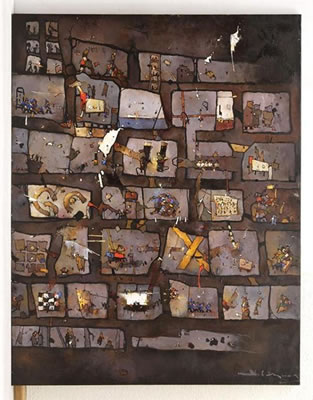
Born 1930 Montevideo, Uruguay. Known for: Abstract painting, dimunitive, fractured images of landscapes, marine scenes, figures.
Fundaci6n Corp Group Centro Cultural . It shouldn’t surprise anyone to find recurring coincidences in the work of otherwise diverse Uruguayan artists. Flowing from the art of Joaquin Torres Garcia... Read full biography
Fundaci6n Corp Group Centro Cultural . It shouldn’t surprise anyone to find recurring coincidences in the work of otherwise diverse Uruguayan artists. Flowing from the art of Joaquin Torres Garcia and Pedro Figari, a strong tradition has come to be embodied, in one way or another, by hater artists.... Read full biography
Fundaci6n Corp Group Centro Cultural . It shouldn’t surprise anyone to find recurring coincidences in the work of otherwise diverse Uruguayan artists. Flowing from the art of Joaquin Torres Garcia and Pedro Figari, a strong tradition has come to be embodied, in one way or another, by hater artists. Many features of this tradition, from a palette of sober and austere colors to a fig urativism that plays with the scale (diminutive beings inserted in out-of-proportion structures, intimations of... Read full biography
Fundaci6n Corp Group Centro Cultural . It shouldn’t surprise anyone to find recurring coincidences in the work of otherwise diverse Uruguayan artists. Flowing from the art of Joaquin Torres Garcia and Pedro Figari, a strong tradition has come to be embodied, in one way or another, by hater artists. Many features of this tradition, from a palette of sober and austere colors to a fig urativism that plays with the scale (diminutive beings inserted in out-of-proportion structures, intimations of childhood, and other representations bursting with subjectivity), clearly show the durability of those two masters’ influence. Bruno Widmann, born in Montevideo in l 930, is currently exhibiting his work in Caracas. His painting signals the presence of... Read full biography
Fundaci6n Corp Group Centro Cultural . It shouldn’t surprise anyone to find recurring coincidences in the work of otherwise diverse Uruguayan artists. Flowing from the art of Joaquin Torres Garcia and Pedro Figari, a strong tradition has come to be embodied, in one way or another, by hater artists. Many features of this tradition, from a palette of sober and austere colors to a fig urativism that plays with the scale (diminutive beings inserted in out-of-proportion structures, intimations of childhood, and other representations bursting with subjectivity), clearly show the durability of those two masters’ influence. Bruno Widmann, born in Montevideo in l 930, is currently exhibiting his work in Caracas. His painting signals the presence of that tradition of which it is a part, and which at the same time it reinterprets and transforms. Widmann, like Ignacio Iturria after him... Read full biography
Artist Biography
Biography page for Bruno Widman ((Born 1930)), known for Abstract painting, dimunitive, fractured images of landscapes, marine scenes, figures. Showing 2 biographical entries and 0 sample artworks.
Bruno Widman - Artist Info
About Bruno Widman
Name variants
Bruno Widmann
Biography from the Archives of askART
 Fundaci6n Corp Group Centro Cultural
It shouldn’t surprise anyone to find recurring coincidences in the work of otherwise diverse Uruguayan artists. Flowing from the art of Joaquin Torres Garcia and Pedro Figari, a strong tradition has come to be embodied, in one way or another, by hater artists. Many features of this tradition, from a palette of sober and austere colors to a fig urativism that plays with the scale (diminutive beings inserted in out-of-proportion structures, intimations of childhood, and other representations bursting with subjectivity), clearly show the durability of those two masters’ influence.
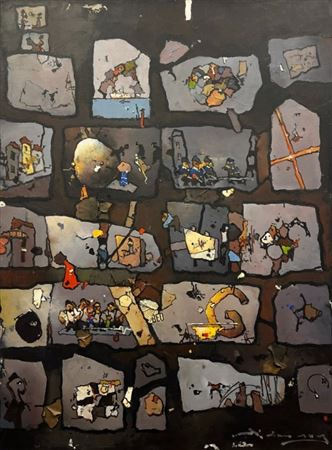
Bruno Widmann, born in Montevideo in l 930, is currently exhibiting his work in Caracas. His painting signals the presence of that tradition of which it is a part, and which at the same time it reinterprets and transforms. Widmann, like Ignacio Iturria after him, embodies a painterhy line that demarcates the current possibilities of Uruguayan art. From a formal standpoint, the most noticeable characteristic of Widmann’s work is its chromatic austerity, which emphasizes chiaroscuro.
With that, he works the surface of the painting and, in consequence, the image in an ambiguous manner. All accents of light are stain-hike, and at the same time they are, often, small being populating space. Categories hike abstraction and figurativism are always relative in these paintings. In truth, they coexist.
Widmann’s space is at once a large abstract plane and a subterranean, sometimes suffocating scenario through which characters travel. Within these light-hess, airless spaces the artists paradoxically manipulates concepts such as freedom, subtlety, urbanism or urbanity, nature and, of course, art and spectacle. One could say that these are Widmann’s overarching themes.
In all of them we, as spectators, are the public that visualizes ((from above» the scene depicted by the artist. From this point of view, we see in the various works a full orchestra in mid-performance, hike a multileveled structure, sort of a laterally open building where the characters coexist and interact.
In other occasions it is a cityscape (with buildings, highways, vehicles, and people), or a plant’s germinating process. What is constant is the earthen-ness, the hack of light and air; the subterranean life which we are forced into by the dense, earthen palette.
An ambiguous reading of the imagines drives the break with logic: outside and inside (the cityscape or the subterranean world); realism and caricature (daily scenes that are at the same time impossible, such a freedom attained at the end of a tunnel that opens below the earth); the solid and the ethereal (air and hand); all of them discordant elements in permanent interaction.
All of these elements belong to Widmann’s imagined world, and they identify him amidst the constant painterhy references he deploys. The artist has established an internal logic of his own, and from it he draws his work’s richness and interest.
Written by Susana Benko, website of ArtNexus magazineBiography from Morton Subastas
Bruno Widmann began his studies with the Italian Sergio Curto, then took courses at the Institute of Contemporary Art in Turin and the Academy of Fine Arts in Perugia, Italy.
On several occasions he traveled to Paris as a guest of the government of France to participate in certain exhibitions held by the Arnaud Gallery in Paris. Over time he created his own style and structured his artwork, which is characterized by being filled with forms, organic suggestions and sometimes geometric inscribed in an infinite space that does not pretend to represent the world, but to deploy it to the limit.
His painting has been part of outstanding individual exhibitions and is part of the most important museum collections internationally, among them the Reina Sofía National Art Center Museum in Madrid, Spain, the Center Pompidou in Paris, France, the Museum of Modern Art from Milan, Italy and the National Museum of Visual Arts of Montevideo Uruguay, among others.
Consulted source: MUÑOZ, Miguel Ángel. Bruno Widmann: chimeras and realities. Chile. National Museum of Fine Arts of Santiago, 2007.