Page loaded successfully. Showing biography for Carl Moon.
Carl Moon BIOGRAPHY
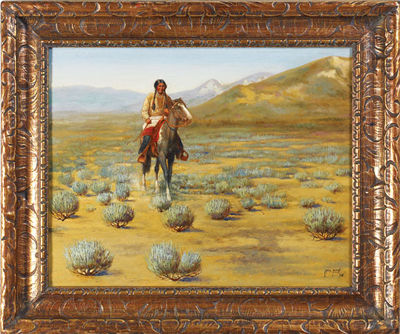
1879 Wilmington, Ohio - 1948 San Francisco, California. Known for: Photography, landscape, children's book illustration-Indian life.
Born in Wilmington, OH on Oct. 5, 1879, Carl Moon graduated from Wilmington High School, and moved to Albuquerque, NM where he had a photography studio. He worked there until 1907 when he moved to... Read full biography
Born in Wilmington, OH on Oct. 5, 1879, Carl Moon graduated from Wilmington High School, and moved to Albuquerque, NM where he had a photography studio. He worked there until 1907 when he moved to the Grand Canyon headquarters of Fred Harvey to manage and operate Harvey's art business. Moon studied... Read full biography
Born in Wilmington, OH on Oct. 5, 1879, Carl Moon graduated from Wilmington High School, and moved to Albuquerque, NM where he had a photography studio. He worked there until 1907 when he moved to the Grand Canyon headquarters of Fred Harvey to manage and operate Harvey's art business. Moon studied painting with visiting artists Thomas Moran, Frank Sauerwein, and Louis Akin. While in the Southwest he captured many pictures of the Pueblo Indians both on film and canvas. In 1911 he wed artist... Read full biography
Born in Wilmington, OH on Oct. 5, 1879, Carl Moon graduated from Wilmington High School, and moved to Albuquerque, NM where he had a photography studio. He worked there until 1907 when he moved to the Grand Canyon headquarters of Fred Harvey to manage and operate Harvey's art business. Moon studied painting with visiting artists Thomas Moran, Frank Sauerwein, and Louis Akin. While in the Southwest he captured many pictures of the Pueblo Indians both on film and canvas. In 1911 he wed artist Grace Purdie and settled in Pasadena in 1914. In California he concentrated on landscapes and illustrated several children's books (Wong and the Wise Old Crow, The Flaming Arrow, Painted Moccasin) about Indians, which he co-authored with his wife. Carl... Read full biography
Born in Wilmington, OH on Oct. 5, 1879, Carl Moon graduated from Wilmington High School, and moved to Albuquerque, NM where he had a photography studio. He worked there until 1907 when he moved to the Grand Canyon headquarters of Fred Harvey to manage and operate Harvey's art business. Moon studied painting with visiting artists Thomas Moran, Frank Sauerwein, and Louis Akin. While in the Southwest he captured many pictures of the Pueblo Indians both on film and canvas. In 1911 he wed artist Grace Purdie and settled in Pasadena in 1914. In California he concentrated on landscapes and illustrated several children's books (Wong and the Wise Old Crow, The Flaming Arrow, Painted Moccasin) about Indians, which he co-authored with his wife. Carl Moon died in San Francisco on June 24, 1948. Memberships: . Pasadena Art. Source: Edan Hughes, "Artists in California, 1786-1940". American Art Annual... Read full biography
Artist Biography
Biography page for Carl Moon ((1879 - 1948)), known for Photography, landscape, children's book illustration-Indian life. Showing 2 biographical entries and 0 sample artworks.
Carl Moon - Artist Info
About Carl Moon
Biography from the Archives of askART
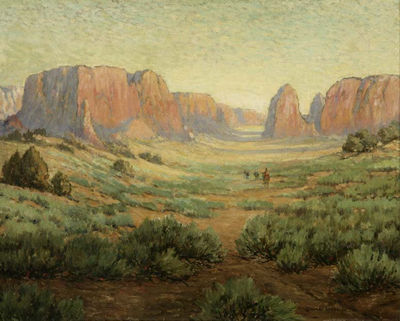 Born in Wilmington, OH on Oct. 5, 1879, Carl Moon graduated from Wilmington High School, and moved to Albuquerque, NM where he had a photography studio. He worked there until 1907 when he moved to the Grand Canyon headquarters of Fred Harvey to manage and operate Harvey's art business.
Moon studied painting with visiting artists Thomas Moran, Frank Sauerwein, and Louis Akin. While in the Southwest he captured many pictures of the Pueblo Indians both on film and canvas.
In 1911 he wed artist Grace Purdie and settled in Pasadena in 1914. In California he concentrated on landscapes and illustrated several children's books (Wong and the Wise Old Crow, The Flaming Arrow, Painted Moccasin) about Indians, which he co-authored with his wife.
Carl Moon died in San Francisco on June 24, 1948.
Memberships:
Pasadena Art Association; Pasadena Library Club; California Writer's Guild.
Exhibitions:
Pasadena Art Inst., 1925, 1927; Carmelita Gardens (Pasadena), 1926; Cartoonist Club (LA), 1928; Pasadena Arts & Crafts, 1941.
Collection:
Huntington Library (San Marino); Library of Congress; Museum of Natural History (NYC); Southwest Museum (LA); Montclair (NJ) Museum; Smithsonian Inst.Biography from Hubbell Trading Post National Historic Site
Carl Moon or Karl, as he spelled his name prior to World War I, was an American photographer, painter, illustrator, poet, writer and collector of Native American artifacts who was born in Wilmington, Ohio on October 5, 1878. He was the son of Sylvester Bronston, a noted country physician of his time, and Lucy Brunetta (Gudgeon) Moon.
Moon was a successful photographer, book and magazine illustrator, painter and writer on Indian subjects. He graduated from Wilmington High School and was a member of the Ohio National Guard in 1897. During his lifetime, he lived in Albuquerque, New Mexico; Grand Canyon, Arizona; and Pasadena, California. As a painter he studied with visiting artists Thomas Moran, Frank Sauerwein and Louis Akin. He was often called the imitator of Edward Curtis and was the last of the great early photographers to go west.
From 1904 to 1907, he ran a photographic studio in Albuquerque, where he made the first collection of photographs and paintings of the Pueblo Indians. It was probably inevitable that a photographer in Albuquerque, New Mexico, in 1904, would specialize in depicting Southwestern Indians. Moon not only achieved distinction for his photographs but for the oil paintings he began making shortly after his arrival in New Mexico. Moon left Albuquerque in 1907 to handle Fred Harvey's art business at the Grand Canyon. He also assisted Harvey and the American Museum of Natural History in New York in acquiring collections of paintings of Indians, which are now highly prized.
He married in 1911 and moved to Pasadena, California, in 1914, where he is remembered as a landscape painter and author. His wife, Grace, shared his interest in Southwest Indians. He began working with his wife as co-writer and as illustrator on children's books about Indians Lost Indian Magic (1918), Wongo and the Wise Old Crow, The Flaming Arrow (1927), Painted Moccasin (1931), and many other Indian and Mexican stories for children. He also painted twenty-four Indian Studies for the Huntington Library, four for the Otto Vollbehr collection (Charlottenburg, Germany) and twenty-six oil paintings of Indians of the Southwest for the Smithsonian Institution.
His artwork is in the collections of Hubbell Trading Post, Ganado, Arizona; Huntington Library, San Marino, California; Montclair Art Museum, New Jersey; Southwest Museum, Los Angeles, California; Library of Congress, American Museum of Natural History, New York City; and National Collection of Fine Arts, Washington, D.C. For the American Museum of Natural History and for Harvey, Moon made a historic collection of pictures of American Indians. He also collected Indian prints for the Library of Congress and for the Montclair Museum.
He was a member of the Pasadena Art Association. Moon died in San Francisco on June 24, 1948.
References:
Dawdy, Doris Ostrander. Artists of the American West: A Biographical Dictionary. [1974] 3 vols. Chicago: Swallow Press. 1985.
Hughes, Edan Milton. Artists in California: 1786-1940. San Francisco: Hughes Publishing Company. 1986.
Moon, Carl and Grace. In Search of the Wild Indian: Photographs and Life Works by Carl and Grace Moon. Text by Tom Driebe. Moscow, Pennsylvania: Maurose Pub. Co. c1997.
Samuels, Peggy and Harold. Samuels' Encyclopedia of Artists of the American West. New Jersey: Castle. 1985.