Page loaded successfully. Showing biography for Carl Robert Holty.
Carl Robert Holty BIOGRAPHY
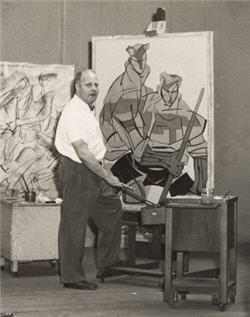
1900 Freiburg, Germany - 1973 New York. Known for: Modernist genre-views-figure, abstract geometric painting, teaching.
Known for his floating, luminous, highly-colorful forms, Carl Holty belongs to the school of pure geometric abstract artists, none more renowned than Piet Mondrian. Holty, a native of Germany, came... Read full biography
Known for his floating, luminous, highly-colorful forms, Carl Holty belongs to the school of pure geometric abstract artists, none more renowned than Piet Mondrian. Holty, a native of Germany, came to the United States as an infant and grew up in Milwaukee, Wisconsin. He studied at the Art... Read full biography
Known for his floating, luminous, highly-colorful forms, Carl Holty belongs to the school of pure geometric abstract artists, none more renowned than Piet Mondrian. Holty, a native of Germany, came to the United States as an infant and grew up in Milwaukee, Wisconsin. He studied at the Art Institute of Chicago and the National Academy of Design in New York, and then went to Munich to enroll in the Hans Hofmann School where he was exposed to Abstract Expressionism. Holty's early work also shows... Read full biography
Known for his floating, luminous, highly-colorful forms, Carl Holty belongs to the school of pure geometric abstract artists, none more renowned than Piet Mondrian. Holty, a native of Germany, came to the United States as an infant and grew up in Milwaukee, Wisconsin. He studied at the Art Institute of Chicago and the National Academy of Design in New York, and then went to Munich to enroll in the Hans Hofmann School where he was exposed to Abstract Expressionism. Holty's early work also shows the influence of Fauvist colors and the work of French artists Maurice de Vlaminck and André Derain. In Europe, Holty began featuring more biomorphic forms in his work and elements reflective of the Organic Surrealism of Joan Miro. By the late 1950s,... Read full biography
Known for his floating, luminous, highly-colorful forms, Carl Holty belongs to the school of pure geometric abstract artists, none more renowned than Piet Mondrian. Holty, a native of Germany, came to the United States as an infant and grew up in Milwaukee, Wisconsin. He studied at the Art Institute of Chicago and the National Academy of Design in New York, and then went to Munich to enroll in the Hans Hofmann School where he was exposed to Abstract Expressionism. Holty's early work also shows the influence of Fauvist colors and the work of French artists Maurice de Vlaminck and André Derain. In Europe, Holty began featuring more biomorphic forms in his work and elements reflective of the Organic Surrealism of Joan Miro. By the late 1950s, he had developed his enduring subject matter large, soft-edged color forms that mix with, and float on,... Read full biography
Artist Biography
Biography page for Carl Robert Holty ((1900 - 1973)), known for Modernist genre-views-figure, abstract geometric painting, teaching. Showing 2 biographical entries and 0 sample artworks.
Carl Robert Holty - Artist Info
About Carl Robert Holty
Biography from the Archives of askART
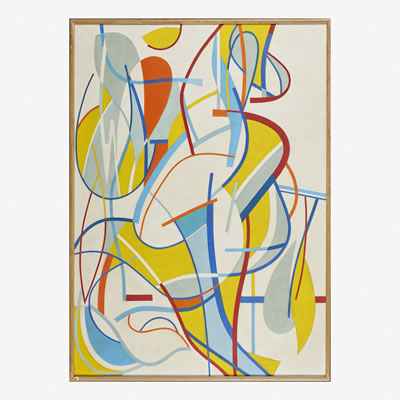 Known for his floating, luminous, highly-colorful forms, Carl Holty belongs to the school of pure geometric abstract artists, none more renowned than Piet Mondrian.
Holty, a native of Germany, came to the United States as an infant and grew up in Milwaukee, Wisconsin. He studied at the Art Institute of Chicago and the National Academy of Design in New York, and then went to Munich to enroll in the Hans Hofmann School where he was exposed to Abstract Expressionism. Holty's early work also shows the influence of Fauvist colors and the work of French artists Maurice de Vlaminck and André Derain.
In Europe, Holty began featuring more biomorphic forms in his work and elements reflective of the Organic Surrealism of Joan Miro. By the late 1950s, he had developed his enduring subject matter large, soft-edged color forms that mix with, and float on, a lush chromatic stain.
Always dedicated to abstract art, Holty found greater artistic acceptance in Europe than in the United States. When he returned to the United States in 1936, he became an important advocate of modern art, helping to establish the American Abstract Artists organization in New York.
Source:
Web-site of Comenos Fine ArtBiography from The Johnson Collection
CARL ROBERT HOLTY (1900-1973)
An active member of American Abstract Artists, Carl Robert Holty’s background, education, and influences were international. He was born in Freiburg, Germany, where his father, a resident of Milwaukee, Wisconsin, and not yet a naturalized citizen of the United States, was studying medicine. Shortly after his birth, the family returned to Wisconsin where Holty was raised, initially in the countryside near Green Bay. When he was about six years old, the family moved to Milwaukee. He demonstrated an early interest in drawing, taking private lessons from German-born painter Friedrich Wilhelm Heine at the age of twelve, which he later admitted “I don’t think it did me too much good.”
Continuing his artistic pursuits in high school, Holty became the Art Editor and Chief Cover Designer of his yearbook and newspaper. In 1919, Holty began pre-med studies at Marquette University in Milwaukee, and for a short time before the end of World War I went into the Students’ Army Training Corps and was stationed at Camp Grant in Rockford, Illinois. Admitting to his father that he did not want to be a doctor, Holty spent the summer at Ox-Bow School of Art, an affiliate of the Art Institute of Chicago, in Saugatuck, Michigan. He then proceeded to New York to study at the National Academy of Design during 1920 and 1921 and remained East until 1923. After a period of uncertainty, he ended up back in Chicago doing crayon portraits; his patrons were mostly from wealthy Jewish families. In 1925, Holty gained financial independence through a bequest from his grandfather, and for a brief time taught art informally at the Milwaukee Art Institute.
From late 1924 until 1934 Holty lived abroad, traveling and spending time in Switzerland and five months in Tangiers, Morocco. During 1926 he was in Munich and worked with Hans Hofmann, who was noted for his “push-pull theory,” in which he maintained that a painter can create the illusion of depth through the use of color and shape. This approach influenced Holty throughout his career. He explored Cubism, and was particularly interested in Juan Gris’ methodical style. When he moved to Paris in 1930, he became friendly with Robert Delaunay, and joined Abstraction-Création, a relaxed group established to counteract Surrealism and the rise of representational art. Piet Mondrian and Josef Albers were members, along with Alexander Calder, the only other American. Holty’s colorful and experimental compositions from this period are clearly marked by a variety of influences, namely the biomorphic abstractions of Wassily Kandinsky and Joan Miró, who during the 1940s worked in Holty’s New York studio.
Upon his return to the States in 1934 Holty went to Milwaukee and was employed as an art lecturer for the Federal Forum, a New Deal program sponsored by the Department of Education; he did twenty-one lectures a week for five weeks, for which he was paid one hundred dollars a week. In 1936 he was back in New York and along with Ilya Bolotowsky helped to establish the American Abstract Artists, organized according to one of the group’s catalogues “to foster public appreciation for this [abstract] direction in painting and sculpture.” Fifteen hundred people visited their first exhibition despite—or perhaps because of—a hostile press. Holty served as the organization’s president for a while. His painting at the time consisted of colorful, hard-edged geometric abstractions of barely recognizable figures.
Beginning in 1939 Holty held a teaching position at the Art Students League in New York and would teach there again in 1950. In 1948 Howard Thomas, a colleague from Milwaukee, invited him to be artist-in residence at the University of Georgia in Athens. During his two years there his paintings took an important turn away from the hard-edged abstractions that had defined the past decade toward more painterly and amorphous compositions. He regularly used swatches of bright color—especially blue juxtaposed with orange—that partially obscured underlying figures and created a vibrant tension on the surface. He explained his theory: “In breaking up the shapes or forms, it is imperative not to attempt to rejoin them because that leads to transformation only. By breaking them and keeping them broken, the forms, large and small, are simply densities in the rhythmic movement of color and shapes.”
Holty’s teaching appointments continued and were varied: at Washington University in St. Louis, Missouri, 1950–1952; the summer of 1951 at the University of California, Berkeley; and from 1955 to 1959 at Brooklyn College, New York. In summer 1961 he returned to his roots as artist-in-residence at the University of Wisconsin-Milwaukee. During this time, the 1950s and 1960s, Holty exhibited work that had become even more abstract and expressive. Contours were softened, so that they were almost feathery. His good friend Romare Bearden, with whom he co-authored a book in 1969 titled The Painter’s Mind: A Study of Structure and Space in Painting, described Holty’s method: he laid the canvas flat so that the paint, applied with big house-painting brushes, would not drip. Then he would walk around the canvas, examining it from all sides. As Bearden explained: “Holty’s composition depended on an interpenetration of color planes from each side of the canvas, as opposed to the usual method of planes moving in varying approximations of depth from a frontal position.”
In 2020 the Georgia Museum of Art rewarded Holty with a retrospective of his career: Carl Holty: Romantic Modernist.
The Johnson Collection, Spartanburg, South Carolina
thejohnsoncollection.org