Page loaded successfully. Showing biography for Chaim Gross.
Chaim Gross BIOGRAPHY
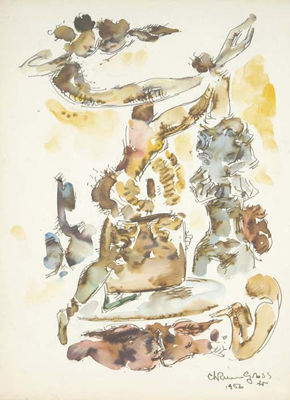
1904 Kolomyia, Ukraine - 1991. Known for: Wood carving-moving figures, religious imagery, acrobats, children.
A sculptor originally from Austria, Chaim Gross is best known for his lively, naturalistic, often interlocking figure compositions, carved in South American hardwood, and is credited with being "One... Read full biography
A sculptor originally from Austria, Chaim Gross is best known for his lively, naturalistic, often interlocking figure compositions, carved in South American hardwood, and is credited with being "One of the pioneers of the first generation of direct carvers". (Falk) He was born in Kolomyia, then an... Read full biography
A sculptor originally from Austria, Chaim Gross is best known for his lively, naturalistic, often interlocking figure compositions, carved in South American hardwood, and is credited with being "One of the pioneers of the first generation of direct carvers". (Falk) He was born in Kolomyia, then an Austrian crown-land but now part of Poland. He was the youngest of ten children of Moses Gross, a lumber merchant, and the former Lea Sperber. The family were Hasidic Jews with focus on orthodox... Read full biography
A sculptor originally from Austria, Chaim Gross is best known for his lively, naturalistic, often interlocking figure compositions, carved in South American hardwood, and is credited with being "One of the pioneers of the first generation of direct carvers". (Falk) He was born in Kolomyia, then an Austrian crown-land but now part of Poland. He was the youngest of ten children of Moses Gross, a lumber merchant, and the former Lea Sperber. The family were Hasidic Jews with focus on orthodox Jewish culture, intellectual pursuits and appreciation of beauty. When he was six, his family moved to the village of Slobodka Lesnia, where Gross had a tutor. In 1912 the family moved to the city of Kolomyja, in what is now the southwest Ukraine in the... Read full biography
A sculptor originally from Austria, Chaim Gross is best known for his lively, naturalistic, often interlocking figure compositions, carved in South American hardwood, and is credited with being "One of the pioneers of the first generation of direct carvers". (Falk) He was born in Kolomyia, then an Austrian crown-land but now part of Poland. He was the youngest of ten children of Moses Gross, a lumber merchant, and the former Lea Sperber. The family were Hasidic Jews with focus on orthodox Jewish culture, intellectual pursuits and appreciation of beauty. When he was six, his family moved to the village of Slobodka Lesnia, where Gross had a tutor. In 1912 the family moved to the city of Kolomyja, in what is now the southwest Ukraine in the USSR, and Gross attended a Hebrew school and also spent much time on the farm of an uncle. World War I broke out, and the Russian troops occupie... Read full biography
Artist Biography
Biography page for Chaim Gross ((1904 - 1991)), known for Wood carving-moving figures, religious imagery, acrobats, children. Showing 3 biographical entries and 0 sample artworks.
Chaim Gross - Artist Info
About Chaim Gross
Name variants
Chiam Gross
Biography from the Archives of askART
 A sculptor originally from Austria, Chaim Gross is best known for his lively, naturalistic, often interlocking figure compositions, carved in South American hardwood, and is credited with being "One of the pioneers of the first generation of direct carvers". (Falk) He was born in Kolomyia, then an Austrian crown-land but now part of Poland. He was the youngest of ten children of Moses Gross, a lumber merchant, and the former Lea Sperber. The family were Hasidic Jews with focus on orthodox Jewish culture, intellectual pursuits and appreciation of beauty.
When he was six, his family moved to the village of Slobodka Lesnia, where Gross had a tutor. In 1912 the family moved to the city of Kolomyja, in what is now the southwest Ukraine in the USSR, and Gross attended a Hebrew school and also spent much time on the farm of an uncle. World War I broke out, and the Russian troops occupied Kolomyja and some of them brutally attacked Gross's parents. In 1916, he, at age 12, escaped and went from Silesia to Vienna to Budapest, and he supported himself at menial jobs including working as a jeweler. He also did much sketching in his spare time, and by the end of the war, he was determined to be an artist.
He studied for six months at the free art academy in Budapest. However, in 1920, the government of Hungary was overthrown, and Gross, as a Jewish alien was held in a detention camp but ultimately ended up in Vienna where he enrolled in the Kunstgewerbeschule (School of Arts and Crafts) and studied drawing for almost a year. Finally, he and his brother, with whom he had met up, emigrated to New York, arriving on April 14, 1921.
He took a day job of delivering fruits and vegetables, which he held for five years, and studied in night classes at the Educational Alliance Art School on the Lower East Side. He was strongly influenced by the school's director, Abbo Ostrowsky, and in that first year met Isaac and Moses Soyer, as well as Philip Evergood, Peter Blume, Barnett Newman, Adolph Gottlieb, and Saul Baizerman. Gross also met Raphael Soyer, who was then studying at the National Academy of Design and who became his lifelong friend. Gross was welcomed into the Soyer home, whose warm atmosphere was a dimension that had been missing in his life since his family had been dispersed in 1914. .
In 1922 he began sculpture and drawing classes at the Beaux-Arts Institute of Design where Elie Nadelman, from whom he studied modeling in clay from the live model, became his most influential teacher. From that time, Chaim Gross claimed the human figure as his most important subject, and shortly after he determined that direct wood carving was the appropriate technique for him. Matthew Baigell in his Dictionary of American Art wrote that "throughout his career, happiness and optimism have suffused his work. The human figure, his central image, is often shown as a circus performer or dancer and also as a devoted family member. His forms are usually squat and amply volumned; wood grains often emphasize swelled thighs and buttocks." (146)
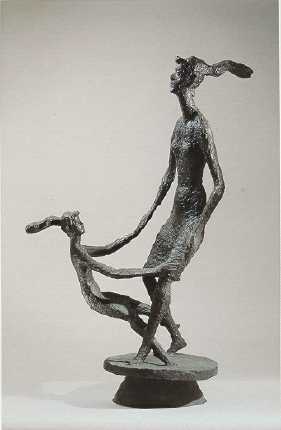
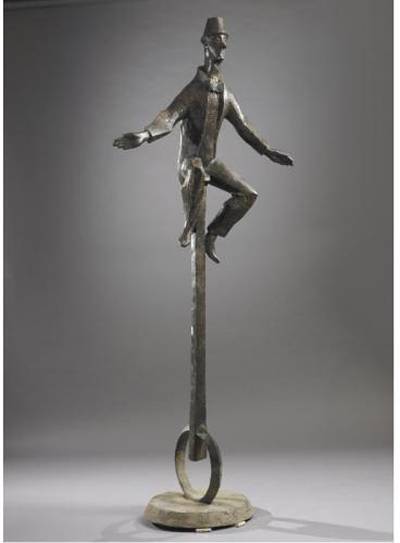
Gross stayed with this commitment to wood carving until the late 1950s when he switched to bronze. His early bronzes were cast from wood carvings and, as a result, resembled wood carving. In 1959, several of his bronzes were exhibited in a retrospective, "Four American Expressionists," at the Whitney Museum of American Art in New York City. In the catalog, Lloyd Goodrich wrote applaudingly of Gross's new bronzes: "They display the freer style of a modeler as compared with a carver [and] a more aerial kind of design. . . . These bronzes indicate a liberating and unfolding of Gross's concepts of form."
In some of his later work, Gross used Hebrew iconography, which expressed his renewed emotional attachment to Judaism and the losses he experienced from the Holocaust. From 1950 to 1957 he carved seven variations in wood on the theme "Lot's Wife", and "Naomi and Ruth" was carved in stone in 1956.
With the Soyer brothers in those early New York days, he went to Woodstock and Provincetown, and became especially active in Provincetown where he did numerous watercolor scenes.
His first exhibition was in 1926 at a group show at the Independent Students Gallery, New York City, and his first solo show was in March 1932 at Gallery 144 in Greenwich Village. Although he lived and worked on the Lower East Side during the Depression era and was a participant in the New York Public Works Project of the WPA artist, his human figure subjects did not reflect social or political themes. In 1934, he became an American citizen.
Among his commissions was a monument four-figure plaster group, "Harvest", for the courtyard of the France Overseas building at the New York World's Fair, and also "Line-man", for the Finland building. In the 1940, at the fair, he carved a "Ballerina" statue from an imbuya wood. He worked before audiences, totaling over 100,000 people, and provided explanation of his processes. "Ballerina" is now at the Brooklyn Museum of Art. After World War II, he received numerous commissions from synogogues and from the Hadassah-Hebrew University Medical Center in Jerusalem.
In addition to sculpting, Gross was also a teacher. From 1927 to 1987, he taught sculpture at the Educational Alliance School in New York City, and from 1948, at the New School of Social Research.
Sources:
Matthew Baigell, Dictionary of American Art
Peter Hastings Falk, Editor, Who Was Who in American Art
Donald Martin Reynolds, Masters of American SculptureBiography from the Archives of askART
 The Chaim Gross Studio Museum, located in Greenwich Village, was founded in 1989 with the mission to collect, preserve, display, and interpret in an historical context Chaim Gross's art and to foster an understanding of how artists live and work.
The selection of works on view demonstrates the contiunity of Gross's personal vision over seven decades: the figure in repose, acrobats, mother and child groupings, and religious Jewish imagery predominate. Although his favorite subjects remained constant, their variations were boundless.
The Chaim Gross Studio Museum, housed in the artist's former home and studio, is operated under the auspices of the Renee and Chaim Gross Foundation. During their lifetimes, the artist and his wife contributed art, their home and financial support. The Museum hopes to continue their efforts by acquiring additional works through donations.
At the Chaim Gross Studio Museum the visitor can examine the artist's work in special gallery settings as well as see where the artist originally worked. On the first floor is an array of his wood and stone carvings ranging from the early 1920s to his final wood sculpture of 1988--89. Also on view is the artist's studio as it looked when Gross was alive. Beneath the skylight the visitor can see his tools, an unfinished carving still in a vise and on surrounding shelves examples of his portrait busts and preparatory maquettes. On the second floor are displayed his later bronzes, as well as changing installations devoted to his watercolors and drawings.
Informal gallery talks for groups of all ages can now be accommodated. Future plans include lectures, films, videos and workshop demonstrations, as well as traveling exhibitions of the artist's work. The Museum promotes scholarly research and encourages graduate students to prepare theses and doctoral dissertations on the life and work of Chaim Gross, maintains a research library, as well as archives relating to the art of Chaim Gross and the collections that he and his wife, Renee, assembled during their fifty-nine year marriage. Catalogues raisonne of the works on paper, and the sculpture, currently are in progress.
Text prepared by April J. Paul, Curator
Source:
The Chaim Gross Studio Museum, //americanart.si.edu/exhibitions/online/gross/gross-noframe.html?/exhibitions/online/gross/grossmuseum1.htmlBiography from ACME Fine Art
Chaim Gross
1904-1991
Education:
National Academy of Fine Arts, Budapest
Kunstgewerbe Schule
Education Alliance, New York
BAID
ASL
Member:
Sculptors Guild (board member)
Education Alliance Alumni Association
Fed. Modern P&S
NIAL
AEA
American Artists Congress
Awards:
NIAL Grant, 1956, 1963 (Award of merit medal)
Exhibitions:
Salons of Am; S Indp. A, 1927, 1929-30, 1933, 1935
Gallery 144, 1932 (Solo)
Tiffany Fellowship, 1933
PAFA ann., 1934, 1943-54 (Prize), 1958-64
Boyer Gallery, 1937
WFNY, 1939, 1964-65
Sculptors Guild, 1938-40, 1942
MOMA, 1940, 1961-62 (The Making of Sculpture)
Paris Salon, 1937 (Medal)
Medici II Gallery, Miami Beach Florida, 1971 (Solo)
Jewish Museum, New York, 1977 (Retrospective)
"NYC WPA Art" at Parsons School of Design, 1977
Chaim Gross came to the United States in 1921 and worked for the WPA during the late 1930's. He was one of the pioneers of direct carving and worked primarily in wood until the late 1950's when he changed to bronze casting.
He was active in Provincetown MA, in 1924, the late 1930's and then from 1943 on. He taught at the Education Alliance Art school in New York, and was the author of many books and films on sculpture.