Page loaded successfully. Showing biography for Charles Biro.
Charles Biro BIOGRAPHY
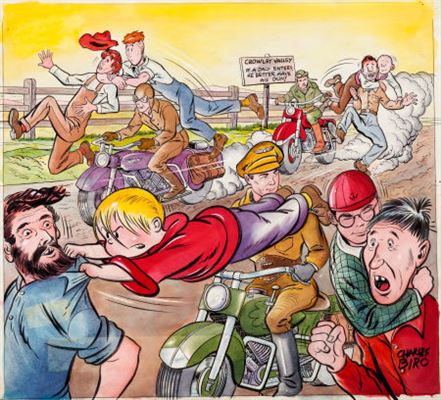
1911 New York City - 1972. Known for: Cartoons-penciller, comic books, writing.
Charles Biro (May 12, 1911 - March 4, 1972) was an American comic book creator and cartoonist. He is today chiefly known for creating the comic book characters Airboy and Steel Sterling, and for his... Read full biography
Charles Biro (May 12, 1911 - March 4, 1972) was an American comic book creator and cartoonist. He is today chiefly known for creating the comic book characters Airboy and Steel Sterling, and for his 16-year run on the acclaimed 1940s series Daredevil Comics for Lev Gleason Publications. Charles... Read full biography
Charles Biro (May 12, 1911 - March 4, 1972) was an American comic book creator and cartoonist. He is today chiefly known for creating the comic book characters Airboy and Steel Sterling, and for his 16-year run on the acclaimed 1940s series Daredevil Comics for Lev Gleason Publications. Charles Biro studied art at both the Brooklyn Museum School of Art and the Grand Central School of Art, and joined the Harry "A" Chesler Shop c. 1936. Working in the multiple roles of writer, artist and later... Read full biography
Charles Biro (May 12, 1911 - March 4, 1972) was an American comic book creator and cartoonist. He is today chiefly known for creating the comic book characters Airboy and Steel Sterling, and for his 16-year run on the acclaimed 1940s series Daredevil Comics for Lev Gleason Publications. Charles Biro studied art at both the Brooklyn Museum School of Art and the Grand Central School of Art, and joined the Harry "A" Chesler Shop c. 1936. Working in the multiple roles of writer, artist and later Supervisor at what was one of the earliest comics packaging art studios, Biro moved on from the Chesler Shop in 1939 to take up similar roles at MLJ Comics. Biro worked as artistic supervisor (as well as writer and artist) for MLJ until 1941, writing... Read full biography
Charles Biro (May 12, 1911 - March 4, 1972) was an American comic book creator and cartoonist. He is today chiefly known for creating the comic book characters Airboy and Steel Sterling, and for his 16-year run on the acclaimed 1940s series Daredevil Comics for Lev Gleason Publications. Charles Biro studied art at both the Brooklyn Museum School of Art and the Grand Central School of Art, and joined the Harry "A" Chesler Shop c. 1936. Working in the multiple roles of writer, artist and later Supervisor at what was one of the earliest comics packaging art studios, Biro moved on from the Chesler Shop in 1939 to take up similar roles at MLJ Comics. Biro worked as artistic supervisor (as well as writer and artist) for MLJ until 1941, writing and drawing such characters as Steel Sterling (a character he created) and Sgt. Boyle, before moving... Read full biography
Artist Biography
Biography page for Charles Biro ((1911 - 1972)), known for Cartoons-penciller, comic books, writing. Showing 1 biographical entries and 0 sample artworks.
Charles Biro - Artist Info
About Charles Biro
Biography from the Archives of askART
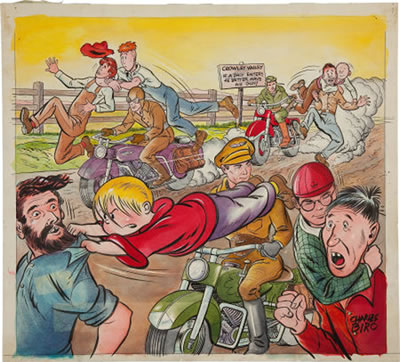 Charles Biro (May 12, 1911 - March 4, 1972) was an American comic book creator and cartoonist. He is today chiefly known for creating the comic book characters Airboy and Steel Sterling, and for his 16-year run on the acclaimed 1940s series Daredevil Comics for Lev Gleason Publications.
Charles Biro studied art at both the Brooklyn Museum School of Art and the Grand Central School of Art, and joined the Harry "A" Chesler Shop c. 1936. Working in the multiple roles of writer, artist and later Supervisor at what was one of the earliest comics packaging art studios, Biro moved on from the Chesler Shop in 1939 to take up similar roles at MLJ Comics.
Biro worked as artistic supervisor (as well as writer and artist) for MLJ until 1941, writing and drawing such characters as Steel Sterling (a character he created) and Sgt. Boyle, before moving to Lev Gleason Publications, for whom he would work for the next 15 years.
While working for Gleason, Biro held the roles of editorial director, head writer and cover artist. According to comics historians Jerry Bails and Hames Ware, Biro did not do much—if any—interior artwork after 1942, focusing solely on covers.
For Gleason, he produced a number of titles, among them (with Bob Wood) a character called Chuck Chandler aka "Crimebuster", who appeared in Boy Comics (1942).
Although Biro's most important work for Gleason was arguably in the nascent genre of crime comics (below), he is perhaps more widely known, however, for his lengthy work on one of Gleason's longest-running titles, producing a landmark run on the first hero to take the name Daredevil (no relation to the Marvel Comics character of the same name). Although primarily by this point in his career a writer and cover artist, Biro drew much of the first issue of Daredevil Comics titled Daredevil Battles Hitler #1 (July 1941). Biro would stay with the title for the rest of his time working for Gleason, and make the character one of the most acclaimed of the Golden Age.
Among his work for other companies, was the comic strip Goodbyland in 1938, and Block & Fall for Centaur Comics (1938). He produced work for Henle and Fiction House in the mid to late 1930s, and co-created the character of Airboy for Hillman Periodicals in 1941.
In October 1955, he wrote and illustrated the first of around 13 issues of a weekly humor book entitled Poppo of the Popcorn Theatre for Fuller, which was "virtually ignored."
For Lev Gleason, Biro helped to create the Crime comics genre with the landmark title Crime Does Not Pay (1942-1955), which he edited along with Bob Wood. The title had an instant effect on the marketplace, and is described in The Comic Buyer's Guide Standard Catalog of Comic Books as "the comic book that got the entire crime comics genre rolling—and may have unwittingly contributed to the formation of the Comics Code years later."
After parting company with Gleason in 1956, Biro "left the field for television," moving into the field of graphic design. He was employed for the last ten years of his life by NBC as a graphic artist between 1962 and 1972. During the late 1960s, he became curious about a comic book convention and walked from NBC over to the convention hotel. When convention staffers realized who he was, he was handed a microphone and spoke spontaneously about his career for 20 minutes.
He died on 4 March 1972, and was nominated for induction into the Eisner Hall of Fame in both 1998 and 2000, before being formally inducted in 2002.
Quote:
Joe Brancatelli: "If Jack Kirby was the most important artistic force in comics during the 1940s, Biro certainly proved to be the finest editor and writer. While others were providing escapist fantasy in their comic books, Charles Biro decided his books would be different and better. He even dubbed them 'Illustories,' but the name never caught on. Throughough his 16-year stint as editorial director and chief writer at Lev Gleason, Biro proved to be the most innovative and certainly most advanced writer in the comic book field."
Source:
Wikipedia:
http://en.wikipedia.org/wiki/Charles_Biro