Page loaded successfully. Showing biography for Charles Constantine Hoffbauer.
Charles Constantine Hoffbauer BIOGRAPHY
1875 France - 1957. Known for: Streets, urban genre, military paintings, camouflage artist.
CHARLES-CONSTANTIN-JOSEPH HOFFBAUER . Hoffbauer was born in Paris in 1875, the son of an Alsatian architect, artist and archaeologist who published Paris through the Ages. He studied at the Ecole des... Read full biography
CHARLES-CONSTANTIN-JOSEPH HOFFBAUER . Hoffbauer was born in Paris in 1875, the son of an Alsatian architect, artist and archaeologist who published Paris through the Ages. He studied at the Ecole des Beaux-Arts under Fernand Cormon and Gustave Moreau, rubbing shoulders with Matisse, Rouault, and... Read full biography
CHARLES-CONSTANTIN-JOSEPH HOFFBAUER . Hoffbauer was born in Paris in 1875, the son of an Alsatian architect, artist and archaeologist who published Paris through the Ages. He studied at the Ecole des Beaux-Arts under Fernand Cormon and Gustave Moreau, rubbing shoulders with Matisse, Rouault, and Marquet, then won an Honorable Mention in the Salon of 1896 and academic prizes in 1898-99. At the Paris Universal Exposition he won a bronze medal. On a French government traveling scholarship called... Read full biography
CHARLES-CONSTANTIN-JOSEPH HOFFBAUER . Hoffbauer was born in Paris in 1875, the son of an Alsatian architect, artist and archaeologist who published Paris through the Ages. He studied at the Ecole des Beaux-Arts under Fernand Cormon and Gustave Moreau, rubbing shoulders with Matisse, Rouault, and Marquet, then won an Honorable Mention in the Salon of 1896 and academic prizes in 1898-99. At the Paris Universal Exposition he won a bronze medal. On a French government traveling scholarship called the Prix National du Salon, Hoffbauer discovered Italy, Greece and Egypt. Then the government purchased Champs de bataille in 1904 (Musée du Luxembourg). On a second scholarship in late 1909, Hoffbauer visited New York where he was greeted by his... Read full biography
CHARLES-CONSTANTIN-JOSEPH HOFFBAUER . Hoffbauer was born in Paris in 1875, the son of an Alsatian architect, artist and archaeologist who published Paris through the Ages. He studied at the Ecole des Beaux-Arts under Fernand Cormon and Gustave Moreau, rubbing shoulders with Matisse, Rouault, and Marquet, then won an Honorable Mention in the Salon of 1896 and academic prizes in 1898-99. At the Paris Universal Exposition he won a bronze medal. On a French government traveling scholarship called the Prix National du Salon, Hoffbauer discovered Italy, Greece and Egypt. Then the government purchased Champs de bataille in 1904 (Musée du Luxembourg). On a second scholarship in late 1909, Hoffbauer visited New York where he was greeted by his friend Charles Dana Gibson (1867-1944), the creator of the "Gibson Girl." Hoffbauer was given two s... Read full biography
Artist Biography
Biography page for Charles Constantine Hoffbauer ((1875 - 1957)), known for Streets, urban genre, military paintings, camouflage artist. Showing 3 biographical entries and 0 sample artworks.
Charles Constantine Hoffbauer - Artist Info
About Charles Constantine Hoffbauer
Biography from the Archives of askART
 CHARLES-CONSTANTIN-JOSEPH HOFFBAUER
Hoffbauer was born in Paris in 1875, the son of an Alsatian architect, artist and archaeologist who published Paris through the Ages. He studied at the Ecole des Beaux-Arts under Fernand Cormon and Gustave Moreau, rubbing shoulders with Matisse, Rouault, and Marquet, then won an Honorable Mention in the Salon of 1896 and academic prizes in 1898-99. At the Paris Universal Exposition he won a bronze medal. On a French government traveling scholarship called the Prix National du Salon, Hoffbauer discovered Italy, Greece and Egypt. Then the government purchased Champs de bataille in 1904 (Musée du Luxembourg). On a second scholarship in late 1909, Hoffbauer visited New York where he was greeted by his friend Charles Dana Gibson (1867-1944), the creator of the "Gibson Girl." Hoffbauer was given two solo shows in 1911 and 1912 at Knoedler's, where his work would be handled in America In the introduction to the 1912 exhibition catalogue, art writer Arthur Hoeber wrote how the artist "assimilated something of our new world energy and alertness. One feels he has caught the spirit of American progress . . . with not a little of its vitality, for these pictures of our city . . . exude American bigness and bustle, the sense of accomplishment despite great obstacles. . . ." Eventually, Hoffbauer would win the coveted Legion of Honor.
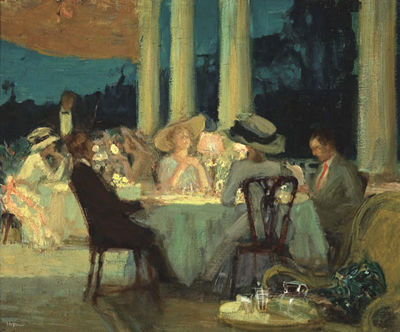
One of his largest paintings, Dîner sur le toit, also referred to as Roof Garden, is a nine-foot-wide painting, now in the National Gallery of New South Wales, in Sydney, Australia. At the Paris Salon of 1905, the huge painting was the talk of the town. Several studies are known (Museum of the City of New York, among others). Claude Roger-Marx wrote on it in Chronique des Arts, and Arsène Alexandre praised it in Le Figaro (both on 29 April 1905). The critics raved over the painting's "luminous beauty," its "frankness," and the "escape from tradition." We see two well-to-do couples in formal attire seated around a table on the roof garden, before skyscrapers and searchlights, an image that captures the excitement of America's Progressive Era.
Hoffbauer served in the French Army as an official war artist during the first world war, won a Croix de Guerre and was the liaison to the American camouflage section. Recommended by the mural painter James Wall Finn, Hoffbauer received a commission in 1935 to paint murals for Battle Abbey, a Confederate memorial in Richmond, Virginia, which were criticized by Thomas Hart Benton for being too conventional. He wondered why a French-born artist had been chosen for the job.
Hoffbauer revisited America to accept a commission for a mural (Missouri at War) in the Missouri State Capitol, and was a member of the 1937 Exposition Internationale's jury. Two years later he became an American citizen, and finally settled in Rockport (Cape Ann) Massachusetts. The Museum of Modern Art in Paris has one of Hoffbauer's battle scenes and for Memorial Hall in Philadelphia Museum he executed Revolt of the Flemish. The artist died on 26 July 1957 in Boston.
Sources:
Steen, James T. "The Story of a Painting," Carnegie Magazine 31/32 (February 1957): 57-59; Charles Hoffbauer (1875-1957). Drawings, Temperas & Oil Paintings. Exh. cat. Somerville, MA: Gropper Art Gallery, 1977; Glueck, Grace. New York: The Painted City. Salt Lake City: Peregrine Smith Books, 1992, pp. 38-39.
Submitted by Michael Preston Worley, Ph.D.
R. H. Love Galleries, ChicagoBiography from the Archives of askART
 Charles Hoffbauer was highly regarded in his lifetime as a fine painter, and muralist as well as an artist successful with the numerous drawings, which served as preparatory studies for his finished works.
He was born in France and studied there with Gustave Moreau and Fernand Cormon and exhibited in the late 1890s with the Paris Salon. He was a prolific artist who once inscribed on a sketchbook page with apparent gratification: "Today I made 59 drawings!" This disclosure would not ordinarily have been mentioned since quantity, of course, is never a measure of talent, but the high level of artistic quality that runs consistently through all of Hoffbauers work, from the slightest pencil sketch to the finished tempera study and reveals a draughtsman of unusual ability.
His mural decorations are in the Confederate Memorial Hall in Richmond, Virginia.
Sources:
Dictionary of American Painters, Sculptors, and Engravers by Mantle Fielding and
Web-site of Comenos Fine Art which cites the following literature:
Doucet, Jerome, "Le Peintre Parisien des New Yoraises/Chez Charles Hobbauer", La Femme dAujourdhui, June, 1905, 4 ills (The Story of Sur les Toits).
Janneau, Guillaume, "Art et Curiosité/Un peintre francaise aux Etats-Units", Le Temps, September 24, 1912. (Lengthy interview with Hoffbauer including comments about his famous teacher, Moreau).
Garth, John. "Charles Hoffbauer at the Legion", The Argonaut, Oct. 7, 1949, pp. 16-17, 3 illus. (extensive description and review of the temperas from the Napoleon set at Palace of the Legion of Honor).
Hoffbauer, Charles. Murals and Historical Paintings. Pamphlet with 30 illustrations. 1949.Biography from Pierce Galleries
Charles Hoffbauer (American, 1875-1957):
Hoffbauer was born in Paris, France, and studied with G. Moreau, F. Falmeng and Cormon in Paris. He was a juror and member of the Ecoles des Beaux Arts and the Societe des Artistes Francais and other Parisian art schools and clubs. After winning his first medal at the Paris Salon in 1898, his popularity skyrocketed and frequent sales of his paintings afforded him a comfortable life.
During World War I he painted on the battlefield and sent paintings to various magazines to illustrate dramatically American soldiers in battle.
Awards include: The Bourse de Yoayage (1902), prix Rosa Bonheur (1902), prix National du Salon (1906), Bonaparte-Prix de I'Institut de France (1929), the Knight Legion of Honor; the distinguished service gold medal from the City of Richmond, VA and more.
Hoffbauer's work is represented in museums worldwide including the Museum of the City of Paris, Musee de Saint Quentin, the Luxembourg Museum and more.
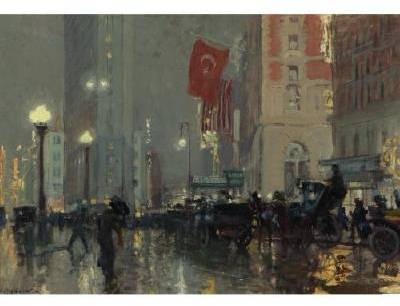
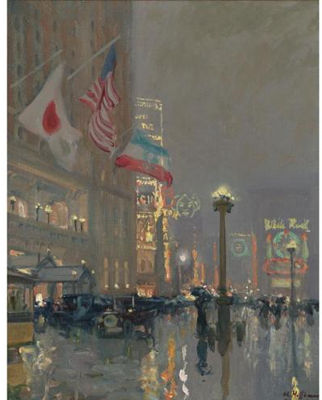
Hoffbauer is best known for his impressionistic scenes of Manhattan with figures and cabs in the rain and for having painting on location scenes of World War I.