Page loaded successfully. Showing biography for Charles Haddon Perdew.
Charles Haddon Perdew BIOGRAPHY
1874 Henry, Illinois - 1963 Henry, Illinois. Known for: Carved duck decoys and duck call whistles, sculpture, collaborative artist.
PERDEW AN ILLINOIS TREASURE, The Chicago Tribune online, by John Husar, April 3, 2020 . Charles Perdew was a spare, rawboned, fiercely independent craftsman who earned a lofty niche in the pantheon... Read full biography
PERDEW AN ILLINOIS TREASURE, The Chicago Tribune online, by John Husar, April 3, 2020 . Charles Perdew was a spare, rawboned, fiercely independent craftsman who earned a lofty niche in the pantheon of wildlife artistry. The handcrafted wooden duck and crow calls he once sold through catalogs for $1... Read full biography
PERDEW AN ILLINOIS TREASURE, The Chicago Tribune online, by John Husar, April 3, 2020 . Charles Perdew was a spare, rawboned, fiercely independent craftsman who earned a lofty niche in the pantheon of wildlife artistry. The handcrafted wooden duck and crow calls he once sold through catalogs for $1 now bring up to $6,000 at auctions. His world-famous duck decoys, many painted by his talented wife, are worth nearly twice as much--and no collection can be complete without at least one. The Perdew... Read full biography
PERDEW AN ILLINOIS TREASURE, The Chicago Tribune online, by John Husar, April 3, 2020 . Charles Perdew was a spare, rawboned, fiercely independent craftsman who earned a lofty niche in the pantheon of wildlife artistry. The handcrafted wooden duck and crow calls he once sold through catalogs for $1 now bring up to $6,000 at auctions. His world-famous duck decoys, many painted by his talented wife, are worth nearly twice as much--and no collection can be complete without at least one. The Perdew name resounds like thunder through the world of antique collectibles. As a pioneer of the immensely creative school of early 20th Century Illinois River carvers, Perdew's work is classic. And 35 years after his death in 1963 at the ripe age of 89,... Read full biography
PERDEW AN ILLINOIS TREASURE, The Chicago Tribune online, by John Husar, April 3, 2020 . Charles Perdew was a spare, rawboned, fiercely independent craftsman who earned a lofty niche in the pantheon of wildlife artistry. The handcrafted wooden duck and crow calls he once sold through catalogs for $1 now bring up to $6,000 at auctions. His world-famous duck decoys, many painted by his talented wife, are worth nearly twice as much--and no collection can be complete without at least one. The Perdew name resounds like thunder through the world of antique collectibles. As a pioneer of the immensely creative school of early 20th Century Illinois River carvers, Perdew's work is classic. And 35 years after his death in 1963 at the ripe age of 89, it still is remarkably functional. "Almost everything Charlie made at first was designed for hu... Read full biography
Artist Biography
Biography page for Charles Haddon Perdew ((1874 - 1963)), known for Carved duck decoys and duck call whistles, sculpture, collaborative artist. Showing 3 biographical entries and 0 sample artworks.
Charles Haddon Perdew - Artist Info
About Charles Haddon Perdew
Biography from the Archives of askART
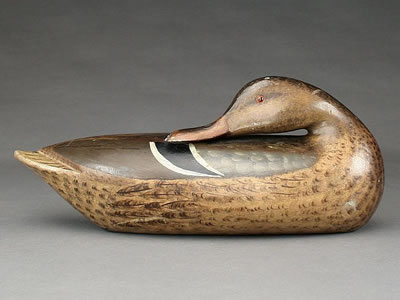 PERDEW AN ILLINOIS TREASURE, The Chicago Tribune online, by John Husar, April 3, 2020
Charles Perdew was a spare, rawboned, fiercely independent craftsman who earned a lofty niche in the pantheon of wildlife artistry.
The handcrafted wooden duck and crow calls he once sold through catalogs for $1 now bring up to $6,000 at auctions. His world-famous duck decoys, many painted by his talented wife, are worth nearly twice as much--and no collection can be complete without at least one.
The Perdew name resounds like thunder through the world of antique collectibles. As a pioneer of the immensely creative school of early 20th Century Illinois River carvers, Perdew's work is classic. And 35 years after his death in 1963 at the ripe age of 89, it still is remarkably functional.
"Almost everything Charlie made at first was designed for hunting," said Don Clark, an old friend and neighbor whose home is a trove of Perdew's work.
He went upstairs to fetch a duck call he bought from Perdew in 1945, which he still uses on the river every year. Soon the sound of a perfectly contented mallard hen floated from the second floor.
"I tuned this thing just once when I bought it and I haven't messed with it since," Clark said. "It works fine for me."
Herb Desch of Chicago, a promoter of antique decoy shows, ranks Perdew among the "big four" of Illinois carvers with Robert Elliston, Ben Graves and Charles Schoenheider Sr. of nearby Putnam. The latter made a dozen iron-footed standing goose ice decoys in 1919, two of which recently sold for $99,000 and $93,500. One of Perdew's rare greenwing teal--which he sold to hunters for $24 a dozen--was auctioned for $30,350 three years ago.
In this state--with one of the more gloried waterfowling traditions--Perdew's carved calls stand alone. In his definitive 1994 volume, "Duck Calls of Illinois," Robert D. Christensen boldly states that "duck and crow calls made by Perdew are, unquestionably, the most treasured of all Illinois calls."
Almost every one was made on a riverside bluff in Henry, where the broad Illinois bends through some of the more storied wetlands in duck hunting lore. A "river rat" who learned to make a living with his hands, Perdew began carving at the age of 14. His output included gun stocks and smithing, bicycle repairs and general carpentry. He and his wife, Edna--who died in 1974 at the age of 92--spent two years building and dressing their house by hand, hauling up the hill by cart enough river stones for a massive foundation.
The house was completed in 1909, featuring all kinds of mirthful Perdew touches--from "eyebrow" windows to an upper-level porch that enabled him to keep an eye on his pals along the river. By the time Perdew died, the house had begun to crumble with age and neglect. Edna soon moved next door to the home of their son, Haddon, a noted carver in his own right.
By the time Haddon died three months ago at 87, the old house had become a wreck. Rain had warped ceilings and walls. The workshop in back--also built from river stone--had burned and crumpled, burying years of artifacts and memories.
But back in February, Henry Mayor Jay McCracken had concocted a vision of restoring the old Perdew place into a public museum and heritage center. He asked Haddon's three sons to donate their grandfather's house to the city in return for preserving the Perdew legacy, and they agreed.
Within weeks the Charles Perdew Museum Association was born with 325 charter members. A cleanup was started and plans were laid to raise hundreds of thousands of dollars to complete the project. These begin with a "Perdew Days" celebration Oct. 3-4, featuring displays and tours of a culturally rich old river town between LaSalle and Peoria that is steeped in steamboat and Indian history.
Meanwhile, restoration continues with years of work ahead.
"You can't imagine what it was like when we got in there," said Mike Dittmer of Putnam, who helps with the cleanup. "To me it was like an archeological find. There was a 1934 letter from Eddie Bauer lying on the basement floor beside a desk. He was begging Charlie for more calls. There were nine duck silhouettes just laying under a bush. A beautiful carved cardinal garden decoration was in the grass. After all these years, we couldn't believe things like these existed."
McCracken unveiled boxes of carved duck heads, old calls, half-worked wooden blanks and tools found in the rubble. There was Edna Perdew's palette, its faded blobs of paint turned to stone. Someone found one of Charlie's famous miniature carved duck boats.
"From the outside it was a perfect haunted house," McCracken said. "Windows were broken, the wood creaked."
Inside, even after the grandsons had removed certain antiques and family treasures, another truckload of precious artifacts remained--from tattered period furniture to the old metal frame bed where Perdew carved his last few ducks after he lost the ability to walk. The walls still contain two of Edna's murals and Charlie's built-in gun rack.
"He was a good old guy," Clark mused from his personal vantage of 75 years. "He'd stop what he was doing to talk to anybody. I remember his huge puff of white hair covered with sawdust and wood chips. His shop smelled of cedar and pine shavings. He'd fix bikes for kids. He'd sit on the front porch in the evenings and carve ducks."
Sometimes he'd trade those ducks for household help. A woman got a pair for helping with the laundry. He gave friends wooden wildlife pins for their wives. He traded a refinished decoy with a uniquely reclining head two bales of hay.
At a time when many practical decoy carvers still settled for essentially a glorified block of wood, Perdew made decoys that looked and floated like ducks.
"You can tell his stuff right away," said Desch, the show's promoter. "They were finely carved around the eye. The nostril is perfect. The nail will be right where the cheek meets the head. The bottom is classic Illinois River with a `V' shape to take the river currents. They were built to bring in ducks--and they did. They brought in an awful lot of ducks."Biography from the Archives of askART
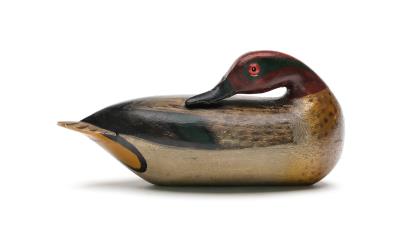 Charles and Edna Perdew of Henry, Illinois, combined their talents to become famous
folk artists in Central Illinois and throughout the rest of the United States. They produced thousands of examples of painted wildfowl sculpture, originally purchased mainly by hunters
to attract ducks, geese and crows to within shooting range.
Charlie was born near Henry in 1874 and was a hunter and carver of decoys. Edna was born in 1882 in Henry and their marriage in 1902 formed an artistic partnership that lasted almost sixty years. For much of that time, Charlie carved and Edna painted from their home and workshop in Henry. Charlie Perdew died in 1963 and Edna survived him until 1974.
The story of this remarkable couple and their artistic legacy has been beautifully portrayed in the book PERDEW: An Illinois River Tradition by Ann Tandy Lacy and published by David Galliher in 1993. Copies of this book can be obtained through the museum.
The Charles Perdew Museum Association has been formed to preserve and educate, renovate and restore the Perdew homestead and workshop and the Perdew’s artistic heritage. The buildings, located at 914 Front Street in Henry, Illinois are mainly for use as a teaching museum and interpretive center.
Source:
Website of the Charles Perdew MuseumBiography from Guyette & Deeter, Inc.
Charles Perdew
If any one name is synonymous with Illinois River Decoys, it must be that of Charles Perdew. Volumes have been written about the man, and his life and work are well known to almost anyone with an interest in decoys. He carved his first decoy as a young man of fifteen, and a letterhead of his indicates that he was producing decoys for sale by at least 1898. At one point, over 600 decoys per year left his shop located behind his home. His was a truly remarkable carving career that spanned over sixty years.
In about 1901, Charlie was operating a gunsmith store and making decoys and calls in Henry. At that time, a young woman named Edna Maude Haddon was hired to paint the decoys that Charlie produced. She had worked previously as a "compositor", setting type for a printer, and her father was a painter and decorator by trade. The patience needed to accurately set type, coupled with what artistic leanings she may have inherited from her father, would have leant themselves to painting decoys. Charlie must have admired more than just her painting skills for, on Thanksgiving evening in 1902, the couple were wed in the home of her parents. He was 28 and she, only 20.
This would become the beginning of a loving relationship that would last for sixty-one years. Charlie would carve and, for over forty years, Edna would paint decoys. In "Perdew - An Illinois River Tradition", Edna is described as "a quiet and strong woman, artistic, loving, and devoted to Charlie". As Charlie often commented – "they were a team – a two-some - - -". Her painting abilities became legendary and, without a doubt, were a significant factor in the desirability of the Perdew's finished product. They lived in a handsome home that Charlie and she had built for themselves in 1909 - 1910 on a bluff overlooking the river.
In 1910, Edna presented Charlie with a son, Charles Haddon Perdew, who too, would eventually work in the family business. Oddly, Edna is rarely listed in any document as being involved with the decoy operation. Only in the 1940 census does she appear as "repainting decoys". In the winter, the couple would read together, or Edna would listen as Charlie played his fiddle. In the summer, the couple raised a large vegetable garden as well as some flowers, fruit trees and a few bee hives. Eventually, Edna suffered the effects of lead poisoning and had to stop painting. A stroke in 1960 ended Charlie's carving career and he passed away a few years later. Edna outlived her husband but, with failing memory, she died in a nursing home in El Paso, Illinois at age 92. This extraordinary couple are buried together in the Henry Cemetery in Henry.