Page loaded successfully. Showing biography for Charles Seliger.
Charles Seliger BIOGRAPHY
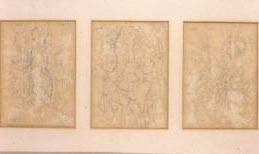
1926 New York City - 2009 New York City. Known for: Small scale organic abstraction.
The following obituary of the artist is from The New York Times, October 9, 2009, A20. "Charles Seliger, Abstract Expressionist, Dies at 83" by William Grimes. Strongly influenced by the Surrealists... Read full biography
The following obituary of the artist is from The New York Times, October 9, 2009, A20. "Charles Seliger, Abstract Expressionist, Dies at 83" by William Grimes. Strongly influenced by the Surrealists and the idea of automatism — the belief that the artist's undirected hand could reach deep into the... Read full biography
The following obituary of the artist is from The New York Times, October 9, 2009, A20. "Charles Seliger, Abstract Expressionist, Dies at 83" by William Grimes. Strongly influenced by the Surrealists and the idea of automatism — the belief that the artist's undirected hand could reach deep into the unconscious — he layered skeins of fine, interlaced lines and overlapping luminous forms that suggested microscopic views of human tissue or plant specimens, land masses seen from an airplane or... Read full biography
The following obituary of the artist is from The New York Times, October 9, 2009, A20. "Charles Seliger, Abstract Expressionist, Dies at 83" by William Grimes. Strongly influenced by the Surrealists and the idea of automatism — the belief that the artist's undirected hand could reach deep into the unconscious — he layered skeins of fine, interlaced lines and overlapping luminous forms that suggested microscopic views of human tissue or plant specimens, land masses seen from an airplane or undiscovered worlds exploding into being. Charles Seliger, whose small-scale, jewel-like paintings of imaginary natural forms made him the most idiosyncratic of the first-generation Abstract Expressionists, died in Manhattan on Oct. 1. He was 83 and lived... Read full biography
The following obituary of the artist is from The New York Times, October 9, 2009, A20. "Charles Seliger, Abstract Expressionist, Dies at 83" by William Grimes. Strongly influenced by the Surrealists and the idea of automatism — the belief that the artist's undirected hand could reach deep into the unconscious — he layered skeins of fine, interlaced lines and overlapping luminous forms that suggested microscopic views of human tissue or plant specimens, land masses seen from an airplane or undiscovered worlds exploding into being. Charles Seliger, whose small-scale, jewel-like paintings of imaginary natural forms made him the most idiosyncratic of the first-generation Abstract Expressionists, died in Manhattan on Oct. 1. He was 83 and lived in Westchester County, N.Y. The cause was a stroke, said his son, Robert. While fellow artists like Jackson P... Read full biography
Artist Biography
Biography page for Charles Seliger ((1926 - 2009)), known for Small scale organic abstraction. Showing 3 biographical entries and 0 sample artworks.
Charles Seliger - Artist Info
About Charles Seliger
Biography from the Archives of askART
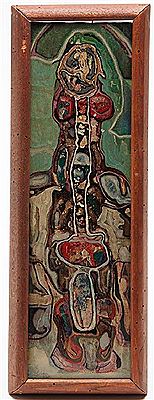 The following obituary of the artist is from The New York Times, October 9, 2009, A20
"Charles Seliger, Abstract Expressionist, Dies at 83" by William Grimes
Strongly influenced by the Surrealists and the idea of automatism — the belief that the artist's undirected hand could reach deep into the unconscious — he layered skeins of fine, interlaced lines and overlapping luminous forms that suggested microscopic views of human tissue or plant specimens, land masses seen from an airplane or undiscovered worlds exploding into being.
Charles Seliger, whose small-scale, jewel-like paintings of imaginary natural forms made him the most idiosyncratic of the first-generation Abstract Expressionists, died in Manhattan on Oct. 1. He was 83 and lived in Westchester County, N.Y.
The cause was a stroke, said his son, Robert.
While fellow artists like Jackson Pollock and Willem de Kooning created high drama with drips and bravura brushwork on billboard-size canvases, Mr. Seliger conjured up his own private worlds on canvases, and later Masonite boards, that rarely exceeded the dimensions of a cafeteria tray.
These poetic explorations, increasingly complex and refined, carried him through a career that lasted more than 60 years.
"He was the last link to the Abstract Expressionist movement," said the art historian Francis V. O'Connor, the author of Charles Seliger: Redefining Abstract Expressionism (2003). "He was the last artist fully committed to the methodology of Surrealism and psychic automatism, which he developed in a carefully thought-out way."
Charles Marvin Zekowski was born on June 3, 1926, in Manhattan. His parents divorced when he was 2, and at 14 he adopted his mother's maiden name. His childhood was chaotic, as he and his mother, destitute, hopped from one residence to another in New York, New Jersey and Maryland.
He began painting and drawing as a child and, after moving to Jersey City in 1940 and discovering a copy of Amedee Ozenfant's Foundations of Modern Art, experimented with the styles of Aubrey Beardsley, Persian miniatures and Cubism. He dropped out of high school in the 10th grade and found work tinting photographs at a studio in Manhattan.
In 1943 he met Jimmy Ernst, the son of the Surrealist artist Max Ernst, and through him began meeting and showing with the dominant figures of the Abstract Expressionist movement at the 67 Gallery and later at Peggy Guggenheim's Art of This Century Gallery, which gave him his first one-man show in 1945, when he was still in his teens.
His painting Cerebral Landscape was included in an influential traveling exhibition of Abstract Expressionists that originated at the David Porter Gallery in Washington in 1945.
In an artistic statement for the exhibition, Mr. Seliger wrote: "I want to apostrophize micro-reality. I want to tear the skin from life, and, peering closely, paint what I see. I want my brain to become a magnifying lens for the infinite minutiae forming reality. Growth is the poetry of all art."
Mr. Seliger got off to a fast start. In 1946 the Museum of Modern Art bought Natural History: Form Within Rock for its permanent collection, and in 1948 he was given his first important museum exhibition, at the De Young Memorial Museum in San Francisco. A year later he joined the prestigious Willard Gallery, where his fellow artists included Mark Tobey and Lyonel Feininger.
In 1948 he married Ruth Lewin, who died in 1975. In addition to his son Robert, of Winchester, Mass., he is survived by his wife, the former Lenore Klebanow; another son, Mark, of Auburn, Mass.; and two grandchildren.
For the next six decades Mr. Seliger worked steadily and slowly, producing no more than 10 paintings a year but always showing and always represented by major dealers, most recently the Michael Rosenfeld Gallery on 57th Street, where he had a solo show last fall. At the same time he maintained a full-time job at Commercial Decal, a china company in Mount Vernon, N.Y., where he started out as a decal artist and retired in 1993 as executive vice president.
Mr. Seliger's earliest paintings, often depicting botanical forms and insects, fused small areas of color in a manner suggestive of stained-glass windows. Later he intensified his focus, concentrating on all-over compositions of intricate tracery and linked patches of color. Often he drew spidery lines and dots with a Leroy pen, normally used for blueprints, which he filled with thinned paint, and applied paint with a single-hair brush.
He read voraciously, and it showed. "He was extraordinarily erudite," Mr. O'Connor said. "Apart from Motherwell, the Abstract Expressionists only knew themselves and their own art, but he knew history, literature, art and even science. One of his first works was an homage to Erasmus Darwin, the grandfather of Charles."
In 1986 the Solomon R. Guggenheim Museum, which owns more than 20 works by Mr. Seliger, presented a retrospective exhibition of his work. In 2003 he received the Pollock-Krasner Foundation's Lee Krasner Award.
Beginning in 1952 Mr. Seliger recorded, in a minute hand, his observations about the art world, his thoughts on painting and the technical details of his works in progress in slim notebooks. In 2005 he donated all 148 volumes of his journals to the Morgan Library & Museum.Biography from Michael Rosenfeld Gallery
I attempt through my imagination, to make visible the structure of matter….I do not observe parts of nature under the microscope; I am not dissecting or analyzing. I have an emotional and intuitive awareness of nature." -Charles Seliger
For almost sixty years, Charles Seliger (American, b.1926) has passionately pursued an inner-world of organic abstraction, celebrating the structural complexities of natural forms. Like many artists of his generation, Seliger was deeply influenced by the Surrealists' use of automatism, and throughout his career he has cultivated a deeply poetic style of abstraction that explores the relationship of order and chaos found in nature.
Attracted to the inner structures of plants, insects and other natural objects, and inspired by a wide range of reading in natural history, biology and physics, Seliger creates abstractions that pay homage to nature's infinite variety. His paintings have been described as 'microscopic views of the natural world,' and although the references to nature and science are appropriate, his abstractions do not directly imitate nature so much as suggest its intrinsic structures.
Seliger was born in New York City, but raised in Jersey City, New Jersey, and spent his teenage years making frequent trips to New York to view museum and gallery exhibitions. Although he never completed high school or received formal art training, Seliger immersed himself in the history of art and experimented with different painting styles including Pointillism, Cubism, and Surrealism.
In 1943 Seliger became friends with Jimmy Ernst, and was quickly drawn into the circle of avant-garde artists championed by Howard Putzel and Peggy Guggenheim. In 1945, at the age of nineteen, Seliger was included in Putzel's seminal exhibition "A Problem for Critics" at 67 Gallery, and had his first solo exhibition at Guggenheim's legendary Art of This Century gallery. At this time, Seliger was the youngest artist exhibiting with members of Abstract Expressionist movement, and he was only twenty years old when the Museum of Modern Art acquired his painting, "Natural History: Form Within Rock" (1946), for the permanent collection.
Seliger had his first major museum exhibition in 1949 at the De Young Memorial Museum, and from the 1950s to the present he has had over 40 solo exhibitions at prestigious galleries in New York City and abroad, including Willard Gallery and Galerie Lopes AG in Zürich. While exhibiting with Willard Gallery, Seliger formed close friendships with Mark Tobey, Lyonel Feininger, and Norman Lewis.
In 1986, Seliger was given his first retrospective exhibition at The Solomon R. Guggenheim Museum, which now holds the largest collection of his work. In addition to the Guggenheim, he is represented in numerous museum collections, including The British Museum, The Metropolitan Museum of Art, The Museum of Modern Art, Wadsworth Atheneum, and Whitney Museum of American Art.
Today, Seliger is primarily known for his meticulously detailed, small-scale abstractions. He uses a variety of self-invented techniques to cover the surfaces of Masonite panels with layer upon layer of acrylic paint, often sanding or scraping each layer to create texture. He then uses a fine brush to delineate the natural forms embedded within the layers of pigment. This labor-intensive technique results in ethereal paintings that give form to elements of the natural world that cannot be perceived by the naked eye.
Now in his seventy-seventh year, Seliger is the 2003 recipient of the Lee Krasner Award, granted by the Pollock-Krasner Foundation, in recognition of his long and illustrious career in the arts.Biography from Michael Rosenfeld Gallery
Charles Seliger (American, June 3, 1926-October 1, 2009) passionately pursued an inner world of organic abstraction, celebrating the structural complexities of natural forms. Like many artists of his generation, Seliger was deeply influenced by the surrealists' use of automatism, and throughout his career, he cultivated an eloquent and poetic style of abstraction that explored the dynamics of order and chaos animating the celestial, geographical, and biological realms. Attracted to the internal structures of plants, insects, and other natural objects, and inspired by a wide range of literature in natural history, biology, and physics, Seliger paid homage to nature's infinite variety in his abstractions. His paintings have been described as "microscopic views of the natural world," and although the characterization is appropriate, his abstractions do not directly imitate nature so much as suggest its intrinsic structures.
Born in New York City but raised in Jersey City, Seliger spent his teenage years making frequent trips back across the Hudson to Manhattan's many museum and gallery exhibitions. Although he never completed high school or received formal art training, Seliger immersed himself in the history of art and experimented with different painting styles including pointillism, cubism, and surrealism. In 1943, he befriended Jimmy Ernst and was quickly drawn into the circle of avant-garde artists championed by Howard Putzel and Peggy Guggenheim. Two years later, at the age of nineteen, Seliger was included in Putzel's groundbreaking exhibition A Problem for Critics at 67 Gallery, and he also had his first solo show at Guggenheim's legendary gallery, Art of This Century. At the time, Seliger was the youngest artist exhibiting with members of the abstract expressionist movement, and he was only twenty years old when the Museum of Modern Art acquired his painting Natural History: Form within Rock (1946) for their permanent collection. In 1950, Seliger obtained representation from the prestigious Willard Gallery, owned by Marian Willard. He formed close friendships with several of her other artists, including Mark Tobey, Lyonel Feininger, and Norman Lewis.
By 1949, Seliger had his first major museum exhibition, at the de Young Memorial Museum, San Francisco. During his lifetime, he exhibited in over forty-five solo shows at prominent galleries in New York and abroad. In 1986, Seliger was given his first retrospective, at the Solomon R. Guggenheim Museum, which now holds the largest collection of his work. His work is also represented in numerous museum collections, including the Metropolitan Museum of Art, the Museum of Modern Art, and the Whitney Museum of American Art in New York; the Wadsworth Atheneum in Hartford, Connecticut; and the British Museum in London. In 2003, at age seventy-seven, Seliger received the Pollock-Krasner Foundation's Lee Krasner Award in recognition of his long and illustrious career in the arts. In 2005, the Morgan Library and Museum acquired his journals—148 hand-written volumes produced between 1952 and the present—making his introspective writing, which covers a vast range of topics across the span of six decades, accessible to art historians and scholars.
Seliger was best known for his meticulously detailed, small-scale abstractions as well as the techniques he invented and used to cover the surfaces of his Masonite panels—building up layers of acrylic paint, often sanding or scraping each layer to create texture, and then delineating the forms embedded in the layers of pigment with a fine brush or pen. This labor-intensive technique results in ethereal paintings that give expression to aspects of nature hidden from or invisible to the unaided eye. His talent and generous spirit will be missed.