Page loaded successfully. Showing biography for Chester Gould.
Chester Gould BIOGRAPHY

1900 Pawnee, Oklahoma - 1985. Known for: Illustrations-cartoon.
Cartoonist Chester Gould, as a young boy, fell under the spell of Mutt and Jeff and Sherlock Holmes. In 1931, he created Dick Tracy, a strip that became nearly as successful as Bud Fishers, and... Read full biography
Cartoonist Chester Gould, as a young boy, fell under the spell of Mutt and Jeff and Sherlock Holmes. In 1931, he created Dick Tracy, a strip that became nearly as successful as Bud Fishers, and featured a detective who became nearly as well-known as Conan Doyles. Gould, the son of a publisher of a... Read full biography
Cartoonist Chester Gould, as a young boy, fell under the spell of Mutt and Jeff and Sherlock Holmes. In 1931, he created Dick Tracy, a strip that became nearly as successful as Bud Fishers, and featured a detective who became nearly as well-known as Conan Doyles. Gould, the son of a publisher of a weekly newspaper, was born in Pawnee, Oklahoma in 1900. Gould once said "It was probably that influence which got me into the frame of mind to become a cartoonist." He migrated to Chicago in 1921 to... Read full biography
Cartoonist Chester Gould, as a young boy, fell under the spell of Mutt and Jeff and Sherlock Holmes. In 1931, he created Dick Tracy, a strip that became nearly as successful as Bud Fishers, and featured a detective who became nearly as well-known as Conan Doyles. Gould, the son of a publisher of a weekly newspaper, was born in Pawnee, Oklahoma in 1900. Gould once said "It was probably that influence which got me into the frame of mind to become a cartoonist." He migrated to Chicago in 1921 to finish college. Although he majored in business administration, he went from school directly into drawing for newspapers. The years before he signed his Dick Tracy contract, Gould recalled, were a decade of frustrating experiences in just about every... Read full biography
Cartoonist Chester Gould, as a young boy, fell under the spell of Mutt and Jeff and Sherlock Holmes. In 1931, he created Dick Tracy, a strip that became nearly as successful as Bud Fishers, and featured a detective who became nearly as well-known as Conan Doyles. Gould, the son of a publisher of a weekly newspaper, was born in Pawnee, Oklahoma in 1900. Gould once said "It was probably that influence which got me into the frame of mind to become a cartoonist." He migrated to Chicago in 1921 to finish college. Although he majored in business administration, he went from school directly into drawing for newspapers. The years before he signed his Dick Tracy contract, Gould recalled, were a decade of frustrating experiences in just about every Chicago newspaper art department. While he shifted from paper to paper, Gould kept inventing comic strips. Some of the sold, some of them did no... Read full biography
Artist Biography
Biography page for Chester Gould ((1900 - 1985)), known for Illustrations-cartoon. Showing 1 biographical entries and 0 sample artworks.
Chester Gould - Artist Info
About Chester Gould
Biography from the Archives of askART
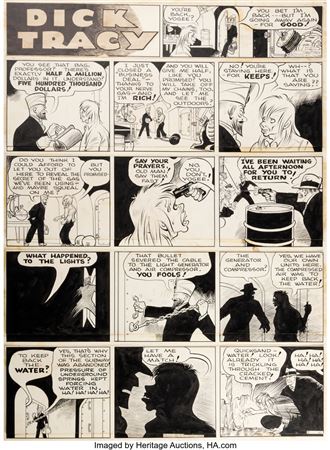 Cartoonist Chester Gould, as a young boy, fell under the spell of Mutt and Jeff and Sherlock Holmes. In 1931, he created Dick Tracy, a strip that became nearly as successful as Bud Fishers, and featured a detective who became nearly as well-known as Conan Doyles.
Gould, the son of a publisher of a weekly newspaper, was born in Pawnee, Oklahoma in 1900. Gould once said "It was probably that influence which got me into the frame of mind to become a cartoonist." He migrated to Chicago in 1921 to finish college. Although he majored in business administration, he went from school directly into drawing for newspapers. The years before he signed his Dick Tracy contract, Gould recalled, were a decade of frustrating experiences in just about every Chicago newspaper art department. While he shifted from paper to paper, Gould kept inventing comic strips. Some of the sold, some of them did not. In 1924, he was doing a topical gag strip called The Radio Lanes for the Chicago American, and later in the 1920s, he drew Fillum Fables that was syndicated by Hearst.
"It was a burlesque of the movies," Gould once said of Fillum Fables. "I cannot claim originality for it. We already had a very capable man doing a strip like that Minute Movies by Ed Wheelan." Goulds movie take-off was one of several imitations Segars Thimble Theatre was another that the Hearst syndicate initiated after Wheelan left. Goulds version, like Wheelans, went for continued stories that burlesqued current popular types of film: melodramas, Westerns, detective stories. Doing the strip meant Gould had to pay attention to Minute Movies and to what was going on in the movie houses. As early as 1927, he was using mock detective continuities.
For Tracy, he could also turn to real life for inspiration. "Chicago in 1931 was being shot up by gangsters," Gould once said, "and I decided to invent a comic strip character who would always get the best of the assorted hoodlums and mobsters." What was needed, he felt, was a detective who "could hunt these fellows up and shootem down." He added, "So I brought out this guy Tracy and had him go out and get his man at the point of a gun." Besides being tough, impatient, and not much of a civil libertarian, Dick Tracy was totally honest. An honest cop was needed in places like Chicago and New York, to mention only two cities with less than spotless police departments at the time. Goulds new strip was soon a success in these markets, as well as in other urban areas.
"Gunplay is part of the strip, and was so from the very beginning," Gould explained. "The law is always armed. Back in 1931, no cartoon had ever shown a detective character fighting it out face to face with crooks via the hot lead route." While gunplay had something to do with the popularity of Tracy, it was the increasingly violent and bizarre methods of dispatching crooks, and the increasingly grotesque villains, that attracted readers and news magazines.
Like several of his Chicago-based colleagues such as Harold Gray and Frank King Gould drew his strip in a bold, simple cartoon style and made no attempt to apply a realistic illustrative approach to his tales of death and violence, all of which helped to give an unusual and distinctive look to Dick Tracy. Gould, with the help of a succession of assistants including Dick Moores, Russell Stamm, Jack Ryan, and Rich Fletcher built his strip into a national institution. He remained a staunch champion of law and order and always responded to criticism that his crooks were too ugly by pointing out that crime was ugly.
Gould remained with the strip until 1977, the year of his retirement. He did not fade away, but spoke out on at least one occasion when he thought Dick Tracy was not being carried on properly.
(Information on the biography above is based on writings from the book, The Encyclopedia of American Comics", edited by Ron Goulart.)