Page loaded successfully. Showing biography for Clara Deike.
Clara Deike BIOGRAPHY
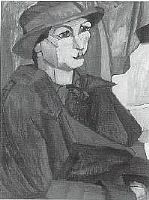
1881 Detroit, Michigan - 1964. Known for: Modernist landscape painting, teaching.
A graduate of the Cleveland School of Art in 1912, Clara Deike was part of the watercolor movement in Northeast Ohio whereby the outdoor sketch became a distinct genre. The group formed the Cleveland... Read full biography
A graduate of the Cleveland School of Art in 1912, Clara Deike was part of the watercolor movement in Northeast Ohio whereby the outdoor sketch became a distinct genre. The group formed the Cleveland Watercolor Society in 1894, and members typically painted outdoors during the summer, enjoying... Read full biography
A graduate of the Cleveland School of Art in 1912, Clara Deike was part of the watercolor movement in Northeast Ohio whereby the outdoor sketch became a distinct genre. The group formed the Cleveland Watercolor Society in 1894, and members typically painted outdoors during the summer, enjoying watercolor for its fast-drying properties. She was a student of Henry Keller, 1869-1949, the first Ohio artist to attain distinction as a watercolorist. With him, she developed a modernist style but she... Read full biography
A graduate of the Cleveland School of Art in 1912, Clara Deike was part of the watercolor movement in Northeast Ohio whereby the outdoor sketch became a distinct genre. The group formed the Cleveland Watercolor Society in 1894, and members typically painted outdoors during the summer, enjoying watercolor for its fast-drying properties. She was a student of Henry Keller, 1869-1949, the first Ohio artist to attain distinction as a watercolorist. With him, she developed a modernist style but she utilized his color theories and went further with her own personalized style that emphasized two-dimensional, decorative design. She often used opaque gouache because of its capacity to give the appearance of flattened forms. Source:. "American Art... Read full biography
A graduate of the Cleveland School of Art in 1912, Clara Deike was part of the watercolor movement in Northeast Ohio whereby the outdoor sketch became a distinct genre. The group formed the Cleveland Watercolor Society in 1894, and members typically painted outdoors during the summer, enjoying watercolor for its fast-drying properties. She was a student of Henry Keller, 1869-1949, the first Ohio artist to attain distinction as a watercolorist. With him, she developed a modernist style but she utilized his color theories and went further with her own personalized style that emphasized two-dimensional, decorative design. She often used opaque gouache because of its capacity to give the appearance of flattened forms. Source:. "American Art Review", 'Genteel Tradition in America', by Richard Love, April 1999. "American Art Review", 'The Triumph of Ohio Watercolor Painters'... Read full biography
Artist Biography
Biography page for Clara Deike ((1881 - 1964)), known for Modernist landscape painting, teaching. Showing 2 biographical entries and 0 sample artworks.
Clara Deike - Artist Info
About Clara Deike
Biography from the Archives of askART
 A graduate of the Cleveland School of Art in 1912, Clara Deike was part of the watercolor movement in Northeast Ohio whereby the outdoor sketch became a distinct genre. The group formed the Cleveland Watercolor Society in 1894, and members typically painted outdoors during the summer, enjoying watercolor for its fast-drying properties.
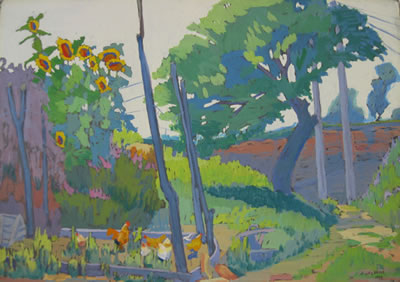
She was a student of Henry Keller, 1869-1949, the first Ohio artist to attain distinction as a watercolorist. With him, she developed a modernist style but she utilized his color theories and went further with her own personalized style that emphasized two-dimensional, decorative design. She often used opaque gouache because of its capacity to give the appearance of flattened forms.
Source:
"American Art Review", 'Genteel Tradition in America', by Richard Love, April 1999.
"American Art Review", 'The Triumph of Ohio Watercolor Painters', by William H Robinson, June 2003Biography from Massillon Museum
Born in Detroit, Clara Deike attended Central High School in Cleveland and graduated from the Cleveland Normal School in 1901. She taught in elementary schools in Ohio and Kentucky until 1909. During the summer of 1909 she studied at the Chicago Art Institute. In the fall of that year, Deike enrolled at the Cleveland School of Art, where Henry Keller and Frederick Gottwald were among her teachers. After graduation in 1912, she taught art at Lakewood and Central High Schools until her retirement in 1945.
Deike avidly pursued summer study, first at Henry Keller's Summer School in Berlin Heights, Ohio (1910-1920), and at Provincetown, Maine (1918). In 1912, Deike co-founded the Women's Art Club of Cleveland. From 1921 to 1923, she studied with Hugh Breckenridge in Gloucester, and also at the Cleveland School of Art. Awarded a sabbatical in 1925-26, she traveled to Germany to study with modernist painter Hans Hofmann. Deike then studied with Diego Rivera over the summer in Mexico. She exhibited her work widely and received numerous awards, especially from the May Show exhibits at the Cleveland Museum of Art.
A committed modernist, Deike's work is a balance of contradictions. As early as 1912, she began exploring Henry Keller's technique of the "blue outline," a method of creating three-dimensional space form by surrounding large, flat shapes with intense blue or purple. During the 1920s, she introduced more rigid structure into her compositions, often wedding intense Fauve color to geometric shapes derived from Cubism. During the 1940s Deike began breaking up forms and allowing fragmented geometric shapes to interpenetrate and merge. Although relatively obscure today, Deike enjoyed a considerable reputation during her lifetime as one of Cleveland's leading progressive artists.
Submitted December 2005 by Christine Fowler Shearer, Director, Massillon Museum, Massillon, Ohio.
Biographical information pulled from the exhibition catalog, Breaking With Tradition: Ohio Women Painters, 1870-1950. Christine Fowler Shearer, author. Published by the Massillon Museum in 2005.
Other sources include clipping files from the Cleveland Museum of Art and the catalog Transformations in Cleveland Art, 1796-1946. William H. Robinson and David Steinburg, authors. Published by the Cleveland Museum of Art in 1996.