Page loaded successfully. Showing biography for Clarence Millet.
Clarence Millet BIOGRAPHY
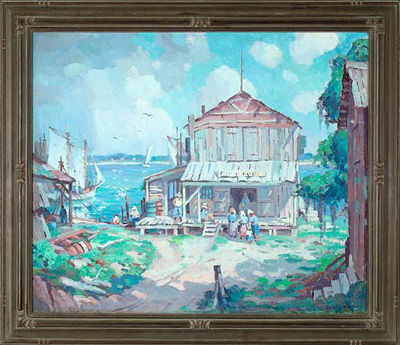
1897 Hahnville, Louisiana - 1959 New Orleans, Louisiana. Known for: Regional scene-plantations, genre and marine painting, etching.
From New Orleans, Clarence Millet was a prolific painter in a simplistic realist style whose work, some of it nostalgic, in the early 20th-century documents much of the lifestyle of Louisiana people... Read full biography
From New Orleans, Clarence Millet was a prolific painter in a simplistic realist style whose work, some of it nostalgic, in the early 20th-century documents much of the lifestyle of Louisiana people in his area. Of his painting, he said: "I paint the things I know, see, and feel - I try to impart... Read full biography
From New Orleans, Clarence Millet was a prolific painter in a simplistic realist style whose work, some of it nostalgic, in the early 20th-century documents much of the lifestyle of Louisiana people in his area. Of his painting, he said: "I paint the things I know, see, and feel - I try to impart to the beholder an experience I have seen and felt.". As a young man, he worked in a store in New Orleans, where his art talent became apparent to persons who encouraged him to get professional... Read full biography
From New Orleans, Clarence Millet was a prolific painter in a simplistic realist style whose work, some of it nostalgic, in the early 20th-century documents much of the lifestyle of Louisiana people in his area. Of his painting, he said: "I paint the things I know, see, and feel - I try to impart to the beholder an experience I have seen and felt.". As a young man, he worked in a store in New Orleans, where his art talent became apparent to persons who encouraged him to get professional training. He became a student at Tulane University in New Orleans and then at the Art Students League in New York City, where George Bridgman was his primary instructor. In the East, he earned special attention for his painting skills including membership... Read full biography
From New Orleans, Clarence Millet was a prolific painter in a simplistic realist style whose work, some of it nostalgic, in the early 20th-century documents much of the lifestyle of Louisiana people in his area. Of his painting, he said: "I paint the things I know, see, and feel - I try to impart to the beholder an experience I have seen and felt.". As a young man, he worked in a store in New Orleans, where his art talent became apparent to persons who encouraged him to get professional training. He became a student at Tulane University in New Orleans and then at the Art Students League in New York City, where George Bridgman was his primary instructor. In the East, he earned special attention for his painting skills including membership in the National Academy of Design and exhibition of his work at the Pennsylvania Academy, the New York Wor... Read full biography
Artist Biography
Biography page for Clarence Millet ((1897 - 1959)), known for Regional scene-plantations, genre and marine painting, etching. Showing 2 biographical entries and 0 sample artworks.
Clarence Millet - Artist Info
About Clarence Millet
Biography from the Archives of askART
 From New Orleans, Clarence Millet was a prolific painter in a simplistic realist style whose work, some of it nostalgic, in the early 20th-century documents much of the lifestyle of Louisiana people in his area. Of his painting, he said: "I paint the things I know, see, and feel - I try to impart to the beholder an experience I have seen and felt."
As a young man, he worked in a store in New Orleans, where his art talent became apparent to persons who encouraged him to get professional training. He became a student at Tulane University in New Orleans and then at the Art Students League in New York City, where George Bridgman was his primary instructor. In the East, he earned special attention for his painting skills including membership in the National Academy of Design and exhibition of his work at the Pennsylvania Academy, the New York World's Fair of 1939 and the Art Institute of Chicago.
Returning to New Orleans, he opened a studio in the French Quarter and became active in local arts organizations including the New Orleans Art Association, New Orleans Art League and the Mississippi Art Association. He was also active with the Federal Arts Project of the WPA during the Depression.
Sources include:
Peter Hastings Falk, Editor, Who Was Who in American Art
http://lsm.crt.state.la.us/painting/millet1.htmBiography from The Johnson Collection
CLARENCE MILLET (1897-1959)
Clarence Millet’s professional journey took him far from his hometown of Hahnville, Louisiana, but his art eventually drew him back to the region of his birth and the city that served as his greatest source of inspiration, New Orleans.
At the age of seventeen, Millet moved to New Orleans, where he worked as a shipping clerk and apprenticed at an engraving company. Friends urged him to pursue an artistic career and, in 1916, his talents were noticed by Louis O. Griffith and Robert Grafton, two visiting artists who were impressed by his talent. Encouraged by their enthusiasm, Millet enrolled at Tulane University in 1920, before departing in 1922 for New York. There, he matriculated at the Art Students League, where his instructors over a two-year stay included George Bridgman.
Following his return to New Orleans in 1924, Millet established a studio in the Vieux Carré, the heart of the French Quarter; at his first, rather rundown, workspace, Alexander Drysdale was a fellow tenant. Millet executed small souvenir pictures and woodblock prints for the tourist trade and struggled to make ends meet. His fortunes shifted when a painting of a New Orleans antique market was included in the 1927 exhibition at the Pennsylvania Academy of the Fine Arts. The canvas’s numerous positive reviews launched a perennial journalistic interest in Millet’s career, garnering national recognition.
In the 1930s, Millet participated in local art programs established by the Works Progress Administration. Millet contributed to the easel division, in which artists were commissioned to create individual paintings of their own design (as opposed to the perhaps better-known WPA murals designed and executed by a team of artists). Artists in the easel division worked for a weekly stipend and created, on average, one or two paintings each month that were then used for display in public spaces and traveling exhibitions.
Millet’s paintings focused almost exclusively on subjects and landscapes that were unique to the Deep South. His style reflected the influence of leading American Impressionists like William Merritt Chase and Childe Hassam, characterized by a highly-keyed palette, visible brushstrokes, and attention to light effects. While based in New Orleans, Millet regularly showed his work in both the South and northeastern urban centers. His panoramic views of rural Louisiana and lively scenes of the French Quarter were exhibited at the New Orleans Art Guild as well as prominent New York venues like the National Academy of Design, the Montross Gallery, and the 1939 World’s Fair.
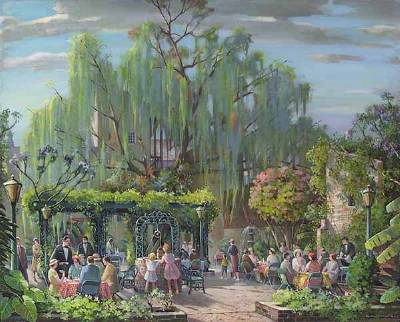
In Patio of the Court of Two Sisters, Millet depicted the landmark restaurant located just down the street from his studio, a subject he painted several times. In this particular courtyard scene, the tables are crowded with chatting diners and attended by dutiful wait staff. Dating to the mid-1940s, the composition is filled with bright sunlight that filters through the foliage around the courtyard to settle on the seated guests, creating an almost nostalgic mood. Unlike many of Millet’s subjects—historic buildings, bridges, and views of the rivers, bayous, fields, and farms of a bye-gone era—the Court of the Two Sisters continues to be a popular spot that both tourists and locals flock to for its shaded patio and Creole cuisine.
Millet enjoyed remarkable success, and he used that success to help foster a thriving cultural community in New Orleans. In 1943, Millet was elected to membership in the National Academy of Design, a high honor that very few Southern artists were accorded. As a member of the Arts and Crafts Club, he taught evening classes at the New Orleans School of Art. Millet also helped establish the New Orleans Art League, a professional and educational arts organization that hosted life drawing classes and held annual exhibitions at the Isaac Delgado Museum of Art (now the New Orleans Museum of Art).
The Johnson Collection, Spartanburg, South Carolina
thejohnsoncollection.org