Page loaded successfully. Showing biography for Curt Echtermeyer.
Curt Echtermeyer BIOGRAPHY

1896 Valparaiso, Chile - 1971 Sant Vicent de Calders, Spain. Known for: Surrealism, realism and unsettling, dark scene painting.
Curt Echtermeyer (Chilean-born German, 1896–1971), painted under the pseudonym name of Curt Brückner, also sometimes listed as C. Brückner pinx., Curt Brückner-Echtermeyer or Echtermeier. He is... Read full biography
Curt Echtermeyer (Chilean-born German, 1896–1971), painted under the pseudonym name of Curt Brückner, also sometimes listed as C. Brückner pinx., Curt Brückner-Echtermeyer or Echtermeier. He is primarily known for his oil paintings of genre and interior scenes with figures, botanical/floral,... Read full biography
Curt Echtermeyer (Chilean-born German, 1896–1971), painted under the pseudonym name of Curt Brückner, also sometimes listed as C. Brückner pinx., Curt Brückner-Echtermeyer or Echtermeier. He is primarily known for his oil paintings of genre and interior scenes with figures, botanical/floral, surrealistic/fantasy works, figures/portraits, streetscenes, circus scenes, jungles, as well as pastels. Curt Echtermeyer was born in Valparaíso, Chile, in 1896 to Romulus Echtermeyer (1871-1940) and... Read full biography
Curt Echtermeyer (Chilean-born German, 1896–1971), painted under the pseudonym name of Curt Brückner, also sometimes listed as C. Brückner pinx., Curt Brückner-Echtermeyer or Echtermeier. He is primarily known for his oil paintings of genre and interior scenes with figures, botanical/floral, surrealistic/fantasy works, figures/portraits, streetscenes, circus scenes, jungles, as well as pastels. Curt Echtermeyer was born in Valparaíso, Chile, in 1896 to Romulus Echtermeyer (1871-1940) and Margarita (née Friedmann) Echtermeyer, and they had four children to include, Heriberto (Tito) Echtermeyer, Curt Echtermeyer, Alexander Echtermeyer and Rosalie Margarita Mercedes Echtermeyer-Ochs—though some family descendants wonder if Curt was really... Read full biography
Curt Echtermeyer (Chilean-born German, 1896–1971), painted under the pseudonym name of Curt Brückner, also sometimes listed as C. Brückner pinx., Curt Brückner-Echtermeyer or Echtermeier. He is primarily known for his oil paintings of genre and interior scenes with figures, botanical/floral, surrealistic/fantasy works, figures/portraits, streetscenes, circus scenes, jungles, as well as pastels. Curt Echtermeyer was born in Valparaíso, Chile, in 1896 to Romulus Echtermeyer (1871-1940) and Margarita (née Friedmann) Echtermeyer, and they had four children to include, Heriberto (Tito) Echtermeyer, Curt Echtermeyer, Alexander Echtermeyer and Rosalie Margarita Mercedes Echtermeyer-Ochs—though some family descendants wonder if Curt was really born in Valparaíso, Chile, or if it was a myth the family fabricated? . Curt’s father Romulus had initially deserted from the army in t... Read full biography
Artist Biography
Biography page for Curt Echtermeyer ((1896 - 1971)), known for Surrealism, realism and unsettling, dark scene painting. Showing 2 biographical entries and 0 sample artworks.
Curt Echtermeyer - Artist Info
About Curt Echtermeyer
Name variants
Curt Bruckner, Curt Bruckner-Eichtermeyer, Echtermeier, C Bruckner pinx
Biography from Meibohm Fine Arts, Inc.
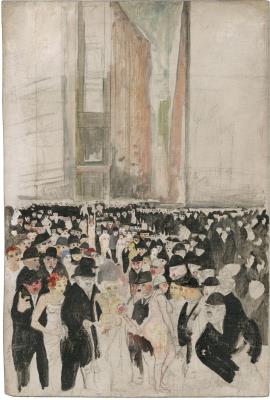 Curt Echtermeyer (Chilean-born German, 1896–1971), painted under the pseudonym name of Curt Brückner, also sometimes listed as C. Brückner pinx., Curt Brückner-Echtermeyer or Echtermeier. He is primarily known for his oil paintings of genre and interior scenes with figures, botanical/floral, surrealistic/fantasy works, figures/portraits, streetscenes, circus scenes, jungles, as well as pastels.
Curt Echtermeyer was born in Valparaíso, Chile, in 1896 to Romulus Echtermeyer (1871-1940) and Margarita (née Friedmann) Echtermeyer, and they had four children to include, Heriberto (Tito) Echtermeyer, Curt Echtermeyer, Alexander Echtermeyer and Rosalie Margarita Mercedes Echtermeyer-Ochs—though some family descendants wonder if Curt was really born in Valparaíso, Chile, or if it was a myth the family fabricated?
Curt’s father Romulus had initially deserted from the army in the 1890’s and crossed the Atlantic to make his luck in Argentina, but later crossed the Andes to start again in Chile. There he found a career and married his wife Margarita, but the family eventually returned to Germany around 1900, and settled in Berlin.
Curt Echtermeyer was related to the writer and philosopher, Ernst Theodor Echtermeyer (German, 1805-1844) and the noted sculptor, Carl Friedrich Echtermeier (formerly Karl Echtermeyer, German, 1845-1910). Shortly after Germany entered WWI on August 1, 1914, Echtermeyer had begun his formal studies at art school, but was luckily “overlooked” for the universal mass conscription that occurred by the Imperial German Army at the time.
Under his real surname of Echtermeyer, his early artwork was often vast, generally somber and dark with dreamlike images and unsettling scenes of surrealistic fantasy. Many of his paintings were populated by pale figures with mask-like faces and he used colors like black, brown, grey and other dark shades which were often punctuated by white or blood-red, while others shined in rainbow colors. When it came to his art, Echtermeyer categorically rejected any type of preparatory studies, and opted to draw directly onto the canvas or wood before applying oil or pastel, and he preferred to paint at night.
From 1925-26, Echtermeyer resided in Paris during Les années folles (the “Crazy Years”) when Paris had succeeded in reestablishing itself as the capital of art, music, literature and cinema after the paralyzing impact WWI had on the country, let alone the rest of Europe. While in Paris, Echtermeyer made connections with other surrealist artists and continued his art studies, although he soon found himself penniless.
Many of his oil paintings done during his time spent in Paris were relatively small and were executed directly onto wood—as a result of the various narrow lodgings he lived in at the time where he sometimes used parts of the furniture to paint on, like the bottoms of drawers. He was also known to have studied in Munich and Rome, and also did restoration work for some of the finest museums in Europe.
During the 1930’s, Echtermeyer was motivated to turn his hand to painting interiors by the changing political circumstances of the time. At the start of WWII, he once again was spared service on the front and because of the Nazi dictatorship, it forced him to develop a fundamentally different ‘second’ style. After the war, Echtermeyer’s paintings under his pseudonym name of Curt Brückner (or Curt Brückner-Echtermeyer) earned him a regular and comfortable income through the well-known Berlin art dealer, Werner Karst (1909-).
Karst had established an assembly line production shop called the "Haus der Tausend Gemälde" (“House of a Thousand Paintings”) on the Kantstraße (Kant Street) in West Berlin, where he sold affordable paintings for German homes, which proved to be quite popular in the mid 20th century. In his shop, Karst collaborated with a team of about thirty contractually-obligated painters to produce a multitude of paintings for resale to the public not only in Germany, but in Europe and the United States.
He rigorously rationalized their painting technique to maintain a high standard of German workmanship and production. Each of the thirty painters always worked on the same motifs in his assembly line technique, with specialized departments for works of Berlin motifs and architectural scenes, genre and interior scenes, figurative works, Alpine/mountainscapes, landscapes, seascapes and marine scenes, floral still lifes and botanicals, and the like.
During his time with Karst, Echtermeyer generally was paid about 100 marks per painting, which equals about $420.00 in today’s dollar (for 2021) and he once stated in an old 1955 article in Der Spiegel news magazine, "I have mastered my craft and work very quickly. If I only do ten pictures a month, I get my money's worth."[1] Amongst the flood of mainly German landscapes during that time period, Echtermeyer seems to have been one of the few artists who supplied interior motifs and figurative works and as a result, he was billed as a specialist in the ‘Old Masters’ style.
Under his pseudonym name of Brückner, Echtermeyer painted mostly genre and interior scenes with figures that emulated the style and feel of 19th century Realism which were intimate, warm, quotidian and idyllic, as well as painting botanical/floral works, portraits and other figurative works. His genre scenes are dominated by warm golden-brown tones which are in stark contrast to the melancholy ashen tones of his surrealist and expressionist imagery of his early work.
His detailed interior genre views often depict comfortable older middle-class men in the pursuit of their trades or hobbies—for example making or playing musical instruments, playing chess, stamp collecting or Rabbis reading, to name a few. His interiors are crammed full with books, globes, plans, papers, models and framed paintings, of which Echtermeyer would sometimes sign the painting in the picture with his well-known pseudonym, “C. Brückner pinx.”, along with the date. In his spare time, he still enjoyed painting surrealist fantasy scenes.
Eventually, the Stalinist dictatorship in the German Democratic Republic (GDR) prompted Echtermeyer to leave Berlin and in 1962, after the erection of the Berlin Wall, he moved to the Old Town district of Bamberg, Germany. His impressions of traditional festivities in Bamberg were reminiscent of fireworks in some of his artwork. Later in his career, the color palette and mood of Echtermeyer’s paintings lightened while some even approached abstraction, but they still teemed with people.
By the end of 1969, Curt Echtermeyer and his wife Wally Gravitz de Echtermeyer fulfilled a life-long dream of moving to Spain. They settled in the tiny hilltop village of Sant Vicenç de Calders in the Province of Tarragona, Spain and from their cottage they were able to look out over the Mediterranean Sea. On December 11, 1971, Curt and is wife lost their lives in a tragic accident in Sant Vicenç de Calders and were interred in the local cemetery of El Vendrell, Catalonia, Spain.
(Written & compiled by Mark Strong of Meibohm Fine Arts, Inc., East Aurora, NY, 14052, meibohmfinearts.com.)Biography from the Archives of askART
 Curt Echtermeyer (1896–1971), also known as Curt Bruckner or Curt Bruckner-Echtermeyer, was a German painter. He was born in Valparaíso, Chile, in 1896 as the son of an immigrant who soon returned to Germany, and his Chilean wife. Curt and his sister grew up in Berlin, where he attended art school from 1914. He lived in Paris in 1925/26, taking up contact with other surrealist artists.
The painter was "overlooked" for conscription in the First World War and spared service at the front in the Second World War. Yet it was the Nazi dictatorship which forced him to develop a fundamentally different second style, and the Stalinist dictatorship in the GDR which prompted him to leave Berlin.[2]
In 1962, after the erection of the Berlin Wall, Curt Echtermeyer took up residence in the Old Town of Bamberg, a picturesque Catholic city. At the end of 1969, Curt Echtermeyer and his wife moved to his beloved Spain. From his cottage in the village of San Vicente de Calders (Province of Tarragona), he could see the Mediterranean Sea. On 11 December 1971, Curt and Wally Echtermeyer fell victim to a tragic accident; they were interred at El Vendrell.
This proponent of Modernism pursued an artistic double life – under the name of Curt Bruckner – by providing highly popular canvases in the style of 19th century Realism. As Echtermeyer, the artist often created vast, dark, dreamlike, unsettling scenes, while as Bruckner, he produced intimate, warm, quotidian, idyllic images.
Echtermeyer categorically rejected preparatory studies, drawing directly onto the canvas or wood before applying oil or pastel, and preferred to paint by night. Many oil paintings of his Paris period are relatively small and executed directly on wood, as he lived in various, narrow, lodgings and sometimes used parts of the furniture, for instance the bottom of drawers.
Curt Echtermeyer was related to the writer Ernst Theodor Echtermeyer and the sculptor Carl Friedrich Echtermeier, formerly Echtermeyer. The latter changed his name in 1905, possibly to confirm the break with his eldest son Romolus, Curt’s father.
Work as Curt Echtermeyer
Echtermeyer’s early work is generally sombre and surreal, populated by pale figures with mask-like faces. Black, grey, brown and dark shades, often punctuated by white or blood-red, prevail in many scenes, while others shine in rainbow colours.
Later, the palette and mood of his paintings lightened, and some approached abstraction, while still teeming with people. His impressions of traditional festivities in Bamberg are reminiscent of fireworks; so is his pastel The Feast of Life from his last years in Spain.
Selection of works signed as Echtermeyer:
• Selbstbildnis (Self-Portrait) (1916)
• Café Boheme Berlin (1922)
• Urwald (Jungle) (1924)
• Mondgöttin (Moon Goddess) (ca. 1925)
• Tanzender Tod (Dancing Death) (ca. 1925)
• Tomaten (Tomatoes) (1927)
• Legende (Legend) (1929)
• Selbstbildnis (Self-Portrait) (ca. 1938)
• Selbstbildnis (Self-Portrait) (1946/47)
• Bildnis eines Tänzers (Portrait of a Dancer)
• Zirkus – buntes Treiben in der Arena (Circus)
• Madame Zebra (1948)
• Prozession in Bamberg I-III, Sandkerwa in Bamberg (1963)
• Das Fest des Lebens (The Feast of Life) (1970)
Work as Curt Bruckner[edit]
Curt Echtermeyer was prompted to turn to interiors by the changed political circumstances in the thirties. After the war, his dexterity earned him a regular and comfortable income with Berlin art dealer Werner Karst, who established a production line of popular and affordable genre scenes for German homes.
Amongst a flood of mainly German landscapes, Curt Bruckner seems to have been one of the few suppliers of figurative motives, billed as “specialist in Old Masters”.
His genre views often depict comfortable middle-class men in the pursuit of their trades or hobbies, for example making or playing musical instruments. Many of these are set in the past – either the nineteenth century, whose artistic style they emulate, or those preceding. The genre senes are dominated by a warm golden brown, contrasting with the melancholy ashen tones of Echtermeyer's surrealist and expressionist imagery.
The historical interiors are crammed with books, globes, plans, models and framed paintings. The virtuoso artist sometimes playfully signed a picture in the picture with "C. Bruckner pinx."
Submitted by Bob Hurley
Source:
"Curt Echtermeyer," Wikipedia, Jan. 2018