Page loaded successfully. Showing biography for Curt Frankenstein.
Curt Frankenstein BIOGRAPHY
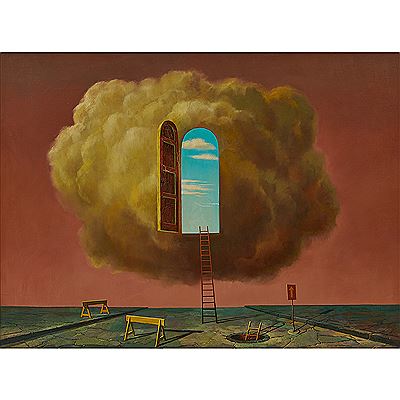
1920 Hanover, Germany - 2009. Known for: Surrealist, narrative painting, lithography, etching.
Curt Frankenstein (1920-2009) was a Wilmette, Illinois surrealist painter and printmaker. He came to the Chicago area from Germany when he was 25. He attended the American Academy of Art, the Art... Read full biography
Curt Frankenstein (1920-2009) was a Wilmette, Illinois surrealist painter and printmaker. He came to the Chicago area from Germany when he was 25. He attended the American Academy of Art, the Art Institute of Chicago and the Otis Art institute of Los Angeles. Subsequently he took courses in... Read full biography
Curt Frankenstein (1920-2009) was a Wilmette, Illinois surrealist painter and printmaker. He came to the Chicago area from Germany when he was 25. He attended the American Academy of Art, the Art Institute of Chicago and the Otis Art institute of Los Angeles. Subsequently he took courses in Lithography under Max Kahn at the Art Institute and in Etching under Hedi Bak at Studio 22 in Chicago. A long time resident of Wilmette, he had a studio and print shop there with his own etching press. Curt... Read full biography
Curt Frankenstein (1920-2009) was a Wilmette, Illinois surrealist painter and printmaker. He came to the Chicago area from Germany when he was 25. He attended the American Academy of Art, the Art Institute of Chicago and the Otis Art institute of Los Angeles. Subsequently he took courses in Lithography under Max Kahn at the Art Institute and in Etching under Hedi Bak at Studio 22 in Chicago. A long time resident of Wilmette, he had a studio and print shop there with his own etching press. Curt Frankenstein first succeeded in selling his paintings in 1954 at the 57th Street Art Fair. He participated in art fairs ever since, sometimes attending as many as six per year. A Surrealist Painter: . It was during the 1950s when abstract art was the... Read full biography
Curt Frankenstein (1920-2009) was a Wilmette, Illinois surrealist painter and printmaker. He came to the Chicago area from Germany when he was 25. He attended the American Academy of Art, the Art Institute of Chicago and the Otis Art institute of Los Angeles. Subsequently he took courses in Lithography under Max Kahn at the Art Institute and in Etching under Hedi Bak at Studio 22 in Chicago. A long time resident of Wilmette, he had a studio and print shop there with his own etching press. Curt Frankenstein first succeeded in selling his paintings in 1954 at the 57th Street Art Fair. He participated in art fairs ever since, sometimes attending as many as six per year. A Surrealist Painter: . It was during the 1950s when abstract art was the attraction that Frankenstein found his calling. He stayed devoted to representational art but combined it with surrealism---brea... Read full biography
Artist Biography
Biography page for Curt Frankenstein ((1920 - 2009)), known for Surrealist, narrative painting, lithography, etching. Showing 1 biographical entries and 0 sample artworks.
Curt Frankenstein - Artist Info
About Curt Frankenstein
Biography from the Archives of askART
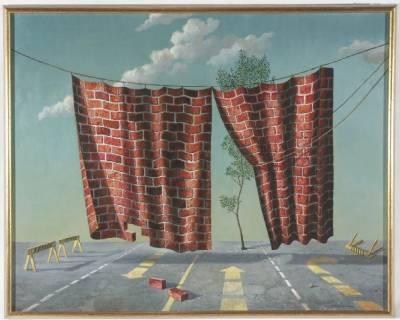 Curt Frankenstein (1920-2009) was a Wilmette, Illinois surrealist painter and printmaker. He came to the Chicago area from Germany when he was 25. He attended the American Academy of Art, the Art Institute of Chicago and the Otis Art institute of Los Angeles.
Subsequently he took courses in Lithography under Max Kahn at the Art Institute and in Etching under Hedi Bak at Studio 22 in Chicago. A long time resident of Wilmette, he had a studio and print shop there with his own etching press.
Curt Frankenstein first succeeded in selling his paintings in 1954 at the 57th Street Art Fair. He participated in art fairs ever since, sometimes attending as many as six per year. A Surrealist Painter:
It was during the 1950s when abstract art was the attraction that Frankenstein found his calling. He stayed devoted to representational art but combined it with surrealism---breaking up realist images to suggest mystery and fantasy. He used familiar images in unfamiliar surprising ways. His paintings are realistic, but at the same time not real. His aim was to break up accustomed views of the world and to suggest that there is more to reality than meets the eye.
The following is a review from Wilmette Life September 4, 1997, Pioneer Press
"I like that tension between fantasy and reality. My painting is realistic, but at the same time it is not real."
By LISA STEIN
Just as in his enigmatic paintings and etchings, there is more to Curt Frankenstein than meets the eye. A little time spent with the artist reveals an extraordinary journey that has always had art as its guide. "Art was the determining factor in my fate," he said last week during an interview in the large, airy space that doubles as his studio and living room of his Wilmette home. "Art has helped me enormously in some difficult situations. I have existed because I was an artist." He is not exaggerating.
Frankenstein was born in Hanover, Germany, in 1922 to a Jewish father and a Lutheran mother. As a child he excelled in art and spent much of his time drawing, to the dismay of his parents who wanted him to choose a more lucrative career. But as Frankenstein reached his teens, his career plans were cut short by the rise of Hitler and the Third Reich. During the infamous Kristallnacht raids in 1938, his father was taken to the Sachsenhausen concentration camp. Luckily, he was released several months later on the condition that he would leave the country immediately. He boarded a freighter ship packed with other refugees bound for the international seaport of Shanghai.
Sailing for Shanghai
In 1939, just months before Hitler invaded Poland, the 17-year-old Frankenstein decided to join his father in Shanghai. Leaving his mother and younger brother in Germany, he boarded a train for Trieste, where he bought a ticket on a passenger ship bound for China. "In Shanghai it was very difficult," he recalled. "The Chinese used to call us 'foreign beggars.' There were thousands of refugees from Poland, Germany and Austria, and there was no way to make money." In desperation he turned to the one thing his parents warned would never earn him a living: painting. He met another German artist who - made a decent income peddling his traditional, European-style paintings door-to-door to wealthy Chinese. "The Chinese found these paintings exotic," Frankenstein said, laughing. He worked as an apprentice in his studio, earning a little money for each painting he completed.
He lived that way, hand to mouth, for eight years. When the war ended, the U.S.S. Nashville sailed into Shanghai harbor, and Frankenstein painted a series of pictures showing the enormous ship floating next to the small Chinese boats. He thought the paintings might make nice souvenirs, so he sailed to the side of the ship in a small boat, holding one up to the sailors who were hanging out on deck. He sold it right away and began selling his works regularly to U.S. sailors of the Medic alert. This way, he met a doctor on a U.S. hospital ship who offered to sponsor Frankenstein, enabling him to move to the United States as a displaced person. "It was such a wonderful opportunity," Frankenstein said. "I jumped at it, even though I did not have a single relative there." His father returned to Germany to join his with and younger son, who lives there to this day. Frankenstein came to Chicago because he received a scholarship to the American Academy of Art through the Hillel Foundation. He lived in Hyde Park, paying for his room and board by working as a freelance commercial artist and illustrator. He later attended the School of the Art Institute and the Otis Art Institute of Los Angeles. He met his wife, Renate, a refugee from Berlin, in Hyde Park through a friend and the two married a year later.
The fair game
Frankenstein first succeeded in selling his paintings in 1954 at the 57th Street Art Fair. He has continued to participate in art fairs ever since, attending about six each year. During the 1950s, Chicago's art world was delirious with the advent of abstraction. But Frankenstein, who was devoted to representational art, knew his passion lay elsewhere. It wasn't until he was in his early 30s that he found his calling in surrealist paintings he saw at the Art Institute. "I wanted the viewer to see a story. Abstraction didn't do that," he explained. "It had beautiful shapes and colors, but no story. I was a storyteller."
He was inspired in particular by Belgian surrealist Rene Magritte and American surrealists George Tooker and Peter Blume. Like Magritte, Frankenstein's visual vocabulary consists of familiar objects - shoes, cups, teapots. And like Magritte, he presents visual riddles that pose questions of meaning and relationship between painted and real objects. For instance, The Faithful Jockey shows a topiary horse with its middle missing. Above the space floats a jockey wearing a patient expression. The branches of the horse's hind and fore legs are slowly growing toward each other but it's going to take a while. The painting is rich in texture and contrast on many levels. "Hike that tension between fantasy and reality," Frankenstein said. "My painting is realistic, but at the same time it is not real."
Late summer is the height of art fair season, and Frankenstein has participated in several, including Highland Part's Port Clinton Art Festival, which used one of its paintings on its much-circulated poster, and the Oakbrook Fine Arts Promenade. He appeared in the North Shore Art League Festival at Northbrook Court. He has won many prizes throughout his career and exhibited in several one-man shows throughout Chicago and the Midwest. His paintings are represented by a Wisconsin gallery and are also included in public and private collections. Looking back on his life so far, Frankenstein feels fortunate to have landed firmly after such a tumultuous start. "Mine is a very happy story," he observed. "I had one of the luckier fates."
The following is a review from The Weekend Edition Press Publications September 2003
What started out as a hobby for Curt Frankenstein as a child is now – more than 70 years later - his life's work. Frankenstein, 81, is showing his paintings in an exhibition at the Elmhurst Art Museum in the Elmhurst Artists' Guild Gallery through Friday, Oct. 10. Through the Senior Citizen's Art Network, to which Frankenstein belongs, a fellow member suggested he have a show at the Elmhurst Art Museum in the Elmhurst Artists' Guild Gallery. Frankenstein was contacted by the Guild, and plans were made. "We do a lot of shows together; he's a great gentleman" said Elmhurst Artists' Guild President Evelyn Ecale Schultz. "He's been painting for years and does wonderful work. His paintings are large and surreal."
The Opening of Heaven is among the works on display in a new exhibit at the Elmhurst Artists’ Guild. At a glance The art of Curt Frankenstein When: Through Friday, Oct. 10 Where: Elmhurst Artists’ Guild Gallery at the Elmhurst Art Museum, 150 Cottage Hill Ave.,
Frankenstein has dabbled in many aspects of the art field. Although he had no formal training as an artist, the need for a job drove him to paint for a living. “As a child, I just liked to do art. I got some praise for it and encourage meant,” Frankenstein said. “I always had a big desire to paint. I had to make a living, art it’s the only thing I know” Originally from Hanover, Germany, Frankenstein left for Shanghai, China, as a teenager in 1939, as his homeland fell into the grips of Adolph Hitler and the Third Reich. He spoke no Chinese, but European paintings were popular among the Chinese at that time. Frankenstein had a knack for creating them. “With no other profession, painting was the only thing I could learn and do well. I had to paint to survive,” Frankenstein said.
In 1947, he received a scholarship to attend the Academy of Arts in Chicago. So at the age of 25, he came to the United States. “I always wanted to be a painter; it just came about in a strange way. It is a very interesting and challenging profession. I’m still very happy in what I’m doing,” he said. After graduating from the Academy ‘of Arts, Frankenstein worked for a time as an illustrator. He freelanced for various types of companies, including advertising agencies and law schools. He considered his education incomplete, so he attended the School of the Art Institute of Chicago in the evening and on Saturdays. Eventually, he decided to paint from imagination. “I wanted to create imaginative paintings. When you paint a specific subject, there are borders,” Frankenstein said. “I saw a couple painters doing well at imaginative painting - they had an idea first, made a sketch, and then painted a picture. It became real, and it is important to paint very real “The real challenge is to show something that doesn’t exist, but make it look as if it does exist,” he said. “It speaks an unwritten story to the intelligent viewer. I try to say something in a picture.”
After years of work, Frankenstein began to accumulate paintings and didn’t know what to do with them. After attending the Old Towne Art Faire in Chicago, he was surprised to learn that there was an audience for his type of art. Then, he began to frequent art fairs around the Midwest, venturing as far as Pittsburgh, Cincinnati and Kansas City
Frankenstein's art is displayed in many corporate collections throughout the country, including those owned by West Publishing in St. Paul, Minn.; the Illinois State Museum; and the Union League Club in Chicago. In addition to being a member of the Senior Citizen's Art Network, Frankenstein is also a member of the American Jewish Art Club and the Wilmette Art Guild. He has received numerous art awards throughout his life, the most recent being “Best of Show” for his painting titled "Black and White" at the Garland of Barrington SAN exhibit. Frankenstein still visits six art fairs each year, mostly in Illinois. His plans for next year include having a one-man show at the Wilmette Public Library and at the Barrington Art Council Gallery.
Source:
Website of the artist, Accessed 11/2015