Page loaded successfully. Showing biography for Da Zhu.
Da Zhu BIOGRAPHY
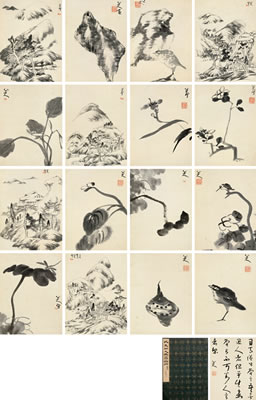
1626 - 1705. Known for: Scroll painting.
Paintings and Calligraphy by Bada Shanren, born Zhu Da. Bada Shanren was a ninth-generation descendant of the Ming-dynasty prince Zhu Quan. After the dynasty's fall, he became a Buddhist monk and... Read full biography
Paintings and Calligraphy by Bada Shanren, born Zhu Da. Bada Shanren was a ninth-generation descendant of the Ming-dynasty prince Zhu Quan. After the dynasty's fall, he became a Buddhist monk and adopted the pseudonym Bada Shanren until the end of his life. Known as one of the "Four Monks" of the... Read full biography
Paintings and Calligraphy by Bada Shanren, born Zhu Da. Bada Shanren was a ninth-generation descendant of the Ming-dynasty prince Zhu Quan. After the dynasty's fall, he became a Buddhist monk and adopted the pseudonym Bada Shanren until the end of his life. Known as one of the "Four Monks" of the early Qing period, Bada Shanren painted landscapes, although he did not create many, and had the mentality of a subject, abandoned by the demised Ming empire. Despite being influenced by Dong Qichang,... Read full biography
Paintings and Calligraphy by Bada Shanren, born Zhu Da. Bada Shanren was a ninth-generation descendant of the Ming-dynasty prince Zhu Quan. After the dynasty's fall, he became a Buddhist monk and adopted the pseudonym Bada Shanren until the end of his life. Known as one of the "Four Monks" of the early Qing period, Bada Shanren painted landscapes, although he did not create many, and had the mentality of a subject, abandoned by the demised Ming empire. Despite being influenced by Dong Qichang, whose landscapes are pithy and elegant, he painted fractured mountains and rivers, shrouded in a desolate aura to present a broken world and probably express sorrow over the death of the country to which he belonged. The style and atmosphere of Bada... Read full biography
Paintings and Calligraphy by Bada Shanren, born Zhu Da. Bada Shanren was a ninth-generation descendant of the Ming-dynasty prince Zhu Quan. After the dynasty's fall, he became a Buddhist monk and adopted the pseudonym Bada Shanren until the end of his life. Known as one of the "Four Monks" of the early Qing period, Bada Shanren painted landscapes, although he did not create many, and had the mentality of a subject, abandoned by the demised Ming empire. Despite being influenced by Dong Qichang, whose landscapes are pithy and elegant, he painted fractured mountains and rivers, shrouded in a desolate aura to present a broken world and probably express sorrow over the death of the country to which he belonged. The style and atmosphere of Bada Shanren's bird-and-flower paintings are consistent with those of his landscapes: cool and impass... Read full biography
Artist Biography
Biography page for Da Zhu ((1626 - 1705)), known for Scroll painting. Showing 1 biographical entries and 0 sample artworks.
Da Zhu - Artist Info
About Da Zhu
Name variants
Dashanren Ba, Shan Ren Ba Da, Shanren Bada
Biography from Christie's Hong Kong
Paintings and Calligraphy by Bada Shanren, born Zhu Da. Bada Shanren was a ninth-generation descendant of the Ming-dynasty prince Zhu Quan. After the dynasty's fall, he became a Buddhist monk and adopted the pseudonym Bada Shanren until the end of his life.
Known as one of the "Four Monks" of the early Qing period, Bada Shanren painted landscapes, although he did not create many, and had the mentality of a subject, abandoned by the demised Ming empire. Despite being influenced by Dong Qichang, whose landscapes are pithy and elegant, he painted fractured mountains and rivers, shrouded in a desolate aura to present a broken world and probably express sorrow over the death of the country to which he belonged. The style and atmosphere of Bada Shanren's bird-and-flower paintings are consistent with those of his landscapes: cool and impassive. The crested mynas from his brushes all appear very obstinate, always proudly raising their heads and looking up with their eyes wide open. By painting the pupils at the upper parts of the birds' eyes, Bada Shanren gave them the cynical look of "I do not care what is happening outside my realm."
The artist rarely inscribed his paintings, as doing so would disrupt the large open space that he left deliberately. In terms of calligraphy, Bada Shanren first studied Dong Qichang's, then that by the masters of the Wei and Jin dynasties, in particular Wang Xizhi's. His running-cursive script calligraphy shares many traits with Huang Tingjian's. The artist once said: "The Jin-period calligraphy is lofty, the Song-period calligraphy sincere and the Tang-period calligraphy graceful. I learn from them all." By mastering different styles Bada Shanren developed his own unique, expressive and unforgettable calligraphy, similar to his paintings.
Like Shitao (1642-1707), Bada Shanren (1626-1705) was also a descendant of the Ming imperial family and a remnant subject who adhered to the Ming regime. He became a monk after the collapse of the Ming, before resuming secular life and earning a living as an artist. Bada Shanren's painting is characterized by his minimalistic, round, wet, translucent and eccentric brushwork; his composition is idiosyncratically light, calm, free yet neat. In Stag and Pine, this distinctive brushwork can be seen in the expressive ink dots applied liberally to depict branches, moss and grassland. Composed to be viewed in a circular motion, the painting guides the eye of the viewer from the focal point - the stag's eyes - to the antlers pointing upwards at the pine branches, and downwards again with the pine needles. The gentle curve of the stag's body mirrors the slightly bent branch, resulting in a composition that is harmonious and full of grace.
Pine trees, cranes and deer are recurring subject matters in Bada Shanren's late works. In addition to being symbols of longevity, they also express the aging artist's wish to return to nature. In contrast to the dignified and solitary look often seen his early work, the facial expressions of his later subjects are more peaceful, their eyes less mocking, reflecting a tranquil state of mind. Stag and Pine is undated and signed with 'Bada Shanren xie' (draw) rather than 'Bada Shanren hua' (paint). Considering the fact that he changed his signature from hua to xie after 1695, and by referring to the deer painting of 1700 and the pine painting of 1701 in the Shanghai Museum, it is believed that this painting was created between 1696 and 1701. Zhang Daqian's inscription is dedicated to Zhang Jiazhu (Chang Chia-chu), a renowned businessman and diplomat from the eminent Zhang family in the Shanghai area, whose siblings included Zhang Gongquan and Zhang Youyi. He was a close friend of the poet Xu Zhimo's and a co-founder of the Crescent Moon Society with Xu and Hu Shi. Part of Zhang Jiazhu's collection of Chinese Modern Paintings was sold with Christie's Hong Kong on 29 May 2012.
Bada Shanren, who was a scion of the Ming imperial family, lived through extreme hardship and tumultuous times at the fall of the dynasty: his bitter experiences are the source of a sense of austerity, coldness and detachment that permeates his works. A bird resting on a rock is one of Bada Shanren's favourite subjects. It is rare for the master to paint egrets.